
MDF vs. Plywood: Comparing Strength, Finish, Weight, Moisture Resistance, Cost, and Manufacturing Ease
Welcome back. You have now studied the two materials separately: MDF is a smooth, dense board made from wood fibres and resin, while plywood is made from cross-laminated wood veneers. The exam is likely to ask you to compare them, not merely list facts about each one.
In this lesson, you will compare MDF and plywood against six key criteria: strength, surface finish, weight, moisture resistance, cost, and ease of manufacture. The important conclusion is that neither material is always “best”; the correct choice depends on the jewellery box’s requirements.
Compare like with like
A good comparison assumes materials are of the same thickness and reasonable quality. A thick, high-quality plywood sheet may perform very differently from thin, cheap plywood; likewise, moisture-resistant MDF differs from standard MDF.
For a typical indoor jewellery box, the usual comparison is:
- standard MDF, intended for dry indoor use;
- interior-grade decorative plywood, suitable for indoor furniture and craft products.
Read the BBC Bitesize manufactured-board comparison to reinforce the essential material facts in exam-friendly language.
In the “Manufactured board” table, read the MDF entry from the MDF description. Then read the plywood entry from the plywood description. Focus on linking each material’s surface and structure to how easily it can be finished and where it can be used.
The six-point comparison
1. Strength
Plywood is generally stronger and stiffer than MDF. Its veneers are arranged with the grain alternating at , spreading strength in different directions. This helps plywood resist bending, sagging, and knocks.
MDF is dense and can be adequate for small indoor products, but it is less reliable at edges and corners. It also holds screws less securely, especially when screws are put into the edge of the board. For a jewellery box with a hinged lid, plywood’s better screw holding is a useful advantage.
Jewellery-box implication: plywood is usually the stronger choice for a durable box, particularly one with hinges, catches, or a lid that will be opened frequently.
2. Surface finish and appearance
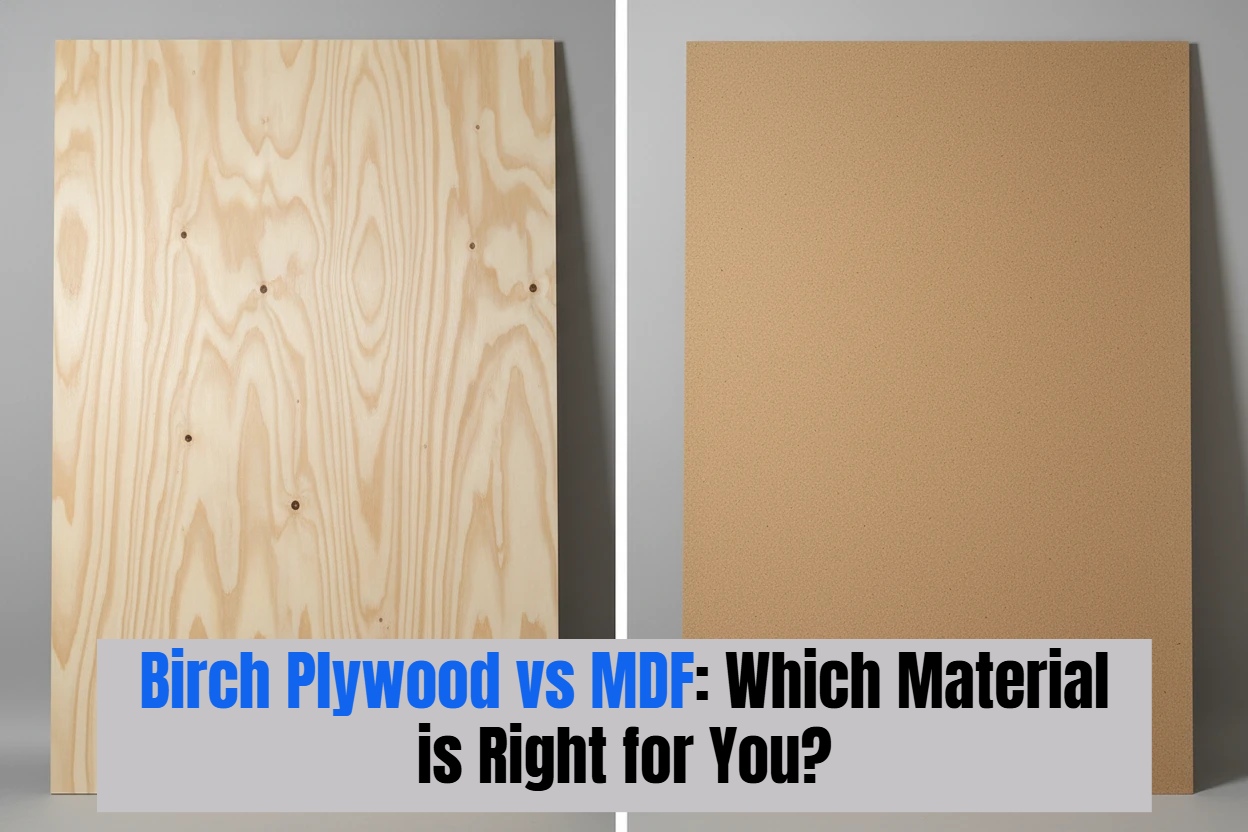
MDF has the smoother, more uniform surface. It has no wood grain, knots, or layers, so it is excellent for a neat painted finish. It can also be cut and shaped into smooth decorative profiles.
Plywood has a real wood veneer surface. High-quality plywood can be sanded and varnished to reveal attractive natural grain, making it suitable for a jewellery box intended to look like real wood. However, lower-quality plywood may have patches or knots, and its cut edges reveal the separate veneer layers.
Jewellery-box implication:
- Choose MDF for a smooth painted box, especially in a modern solid colour.
- Choose good-quality plywood for a natural wood appearance with clear varnish or stain.
3. Weight
MDF is usually heavier than plywood of the same thickness because MDF is a very dense mass of compressed fibres and resin.
Plywood is usually lighter while still remaining strong. This can matter if the jewellery box is designed to be portable, moved often, or carried when travelling.
Jewellery-box implication: plywood is generally better when low weight and strength are both important. For a small box that will stay on a dressing table, weight may be less important than appearance or cost.
4. Moisture resistance
Standard MDF absorbs water readily, especially through its cut edges. When it gets wet, it can swell, soften, and lose its shape. Paint or varnish can slow this down, but a scratch or damaged edge can let moisture in.
Plywood is generally more moisture resistant than standard MDF, particularly if it is a suitable grade and its surfaces and edges are sealed. However, plywood is not automatically waterproof: prolonged damp can cause the veneers to separate, which is called delamination.
Jewellery-box implication: for a box kept in a dry bedroom, either material could be used if finished properly. If the box may be used in a humid room, such as a bathroom, plywood is usually the safer choice. In either case, a protective finish is important.
5. Cost
MDF is usually cheaper. It is made from processed wood fibres and is widely available in consistent sheets, so it is often chosen when keeping costs low matters.
Plywood costs vary greatly. Basic plywood may be close in price to MDF, but attractive furniture-grade plywood with a good face veneer is normally more expensive.
Jewellery-box implication: MDF suits a lower-budget, painted jewellery box. Plywood may cost more, but its strength, lighter weight, and real-wood appearance may justify that extra cost.
6. Ease of manufacture
Here, “ease of manufacture” means how easily the material can be cut, shaped, joined, and finished into the product.
MDF is usually easier to cut and route neatly because it has no grain. It is less likely to splinter, and its uniform structure makes it useful for smooth shaped details. However, it creates very fine dust when cut, so it needs careful dust extraction and respiratory protection. Its poor screw holding can also make assembly more difficult if the design uses hinges or screws at the edges.
Plywood can be cut and finished, but the face veneer can splinter or tear out during cutting. A sharp tool and careful cutting technique reduce this problem. On the other hand, plywood generally holds screws better, which can make fitting hinges, catches, and handles more secure.
| Criterion | MDF | Plywood | What this means for a jewellery box |
|---|---|---|---|
| Strength | Moderate; weaker at edges and with screws | Generally stronger and stiffer | Plywood is better for a durable hinged box. |
| Surface finish | Very smooth; excellent for paint | Natural grain can be varnished; quality varies | MDF suits paint; decorative plywood suits a wood look. |
| Weight | Usually heavier | Usually lighter | Plywood is better for a portable box. |
| Moisture resistance | Low for standard MDF; swells when wet | Usually better, but not waterproof | Plywood is safer in humid conditions. |
| Cost | Usually lower cost | Often higher cost, especially decorative grades | MDF suits a tight budget. |
| Ease of manufacture | Cuts and routes cleanly; creates fine dust; weak screw holding | Can splinter; holds screws better | MDF is easier for smooth shaping; plywood is better for screw-fitted parts. |
MDF VS. PLYWOOD (Which Is Better?? Pros + Cons!!)
Watch selected parts of MDF VS. PLYWOOD (Which Is Better?? Pros + Cons!!) by The Honest Carpenter. It gives a practical workshop-based comparison that matches the six criteria you need for the exam.
Start with cost and grades to see why it is inaccurate to say that all plywood costs the same. Then watch strength and weight, paying attention to sagging, durability, and why MDF is harder to handle. Continue with surface finishes for the difference between MDF paint finishes and plywood’s natural veneer. Watch cutting and screws to compare clean MDF cuts with plywood’s better screw holding. Finally, watch moisture and dust. Treat the examples as general guidance: the exact result still depends on material grade, thickness, and whether edges are sealed.
Choosing according to requirements
The best material choice is a response to the stakeholder’s needs. A stakeholder is the person who will use, buy, or care about the product.
Consider these contrasting design briefs.
Brief A: a painted, low-cost bedroom jewellery box
The stakeholder wants a box that is inexpensive, has a flawless pale-blue painted surface, and will remain on a dry bedside table.
MDF could be the best choice because it is generally cheaper and has a very smooth surface for paint. Its weaker moisture resistance is less serious because the box will be kept dry. The designer should avoid relying on screws in MDF edges, or reinforce screw positions if a hinged lid is required.
Brief B: a durable travel jewellery box with a natural wood appearance
The stakeholder wants a lightweight box with a clear varnish finish, a hinged lid, and enough strength to cope with regular travel.
Plywood could be the best choice because it is lighter, stronger, and holds hinge screws more securely. A good-quality birch plywood face veneer could be varnished to show real wood grain. Its higher cost and the need to carefully finish layered edges would be reasonable trade-offs for this design.
The decision is not:
Plywood is better than MDF.
A stronger conclusion is:
Plywood is more suitable when durability, low weight, secure hinges, and a natural wood finish are priorities. MDF is more suitable when a smooth painted surface and low cost are the main priorities in a dry indoor environment.
Turning comparison facts into exam marks
A comparison answer needs three parts:
- State the property.
- Compare both materials.
- Explain why the difference matters for the product.
For example:
MDF has a smooth, uniform surface, so it is easier to paint to a neat finish. Plywood has a real wood veneer surface, which can be varnished to show natural grain, although its edges show layers. Therefore, MDF would suit a painted jewellery box, while high-quality plywood would suit a stakeholder who wants a natural wooden appearance.
For a strength-and-use comparison:
Plywood is generally stronger and lighter than MDF because its wood veneers are layered in alternating grain directions. It is also better at holding screws, so it would be more suitable for a lightweight jewellery box with a hinged lid. However, MDF may be chosen instead if a lower-cost painted finish is more important than strength.
Notice the balanced structure: a clear comparison, an application to the box, and a limitation or condition. That is much stronger than writing a list of disconnected properties.
Key takeaways
- Plywood is generally stronger, lighter, more moisture resistant, and better at holding screws than MDF.
- MDF is usually cheaper and gives a smoother surface for painting and shaped details.
- MDF is less suitable for damp conditions because it can absorb water and swell.
- Plywood can give a natural varnished appearance, but it may splinter when cut and quality plywood can cost more.
- The best jewellery-box material depends on the stakeholder’s priorities, rather than one material being universally superior.
Next, you will separate a material property—such as strength or moisture resistance—from a test method used to measure it. That will help you turn these comparisons into convincing practical evidence.
Can't find a good explanation? Sign up and we'll make it for you
Sign up