Welcome to the penultimate lesson of our course. In our last session, we addressed a critical internal security risk by exploring how multisignature wallets like Safe can secure your smart contract's administrative functions, replacing a single point of failure with a robust, distributed approval process. Now that you understand how to secure the internal controls of your contract, we must turn our attention to its external dependencies.
Many high-value smart contracts, especially in the realm of tokenized assets and stablecoins, need to react to real-world information like asset prices, interest rates, or the status of reserves. However, blockchains are fundamentally isolated systems, unable to access this external data on their own. This lesson tackles this crucial challenge by explaining the role of blockchain oracles, with a focus on the industry-standard platform, Chainlink. You will learn why oracles are essential and how they provide the secure and reliable data needed to build the very financial instruments you aim to create.
1. The Oracle Problem: A Blockchain's Data Silo
By design, blockchains are deterministic and isolated environments. Every node in the network must be able to independently verify every transaction and arrive at the exact same state. To achieve this, smart contracts are forbidden from making network calls or accessing data outside of the blockchain's own ledger. This isolation is what guarantees their security and reliability, but it also creates a significant limitation known as the "blockchain oracle problem."
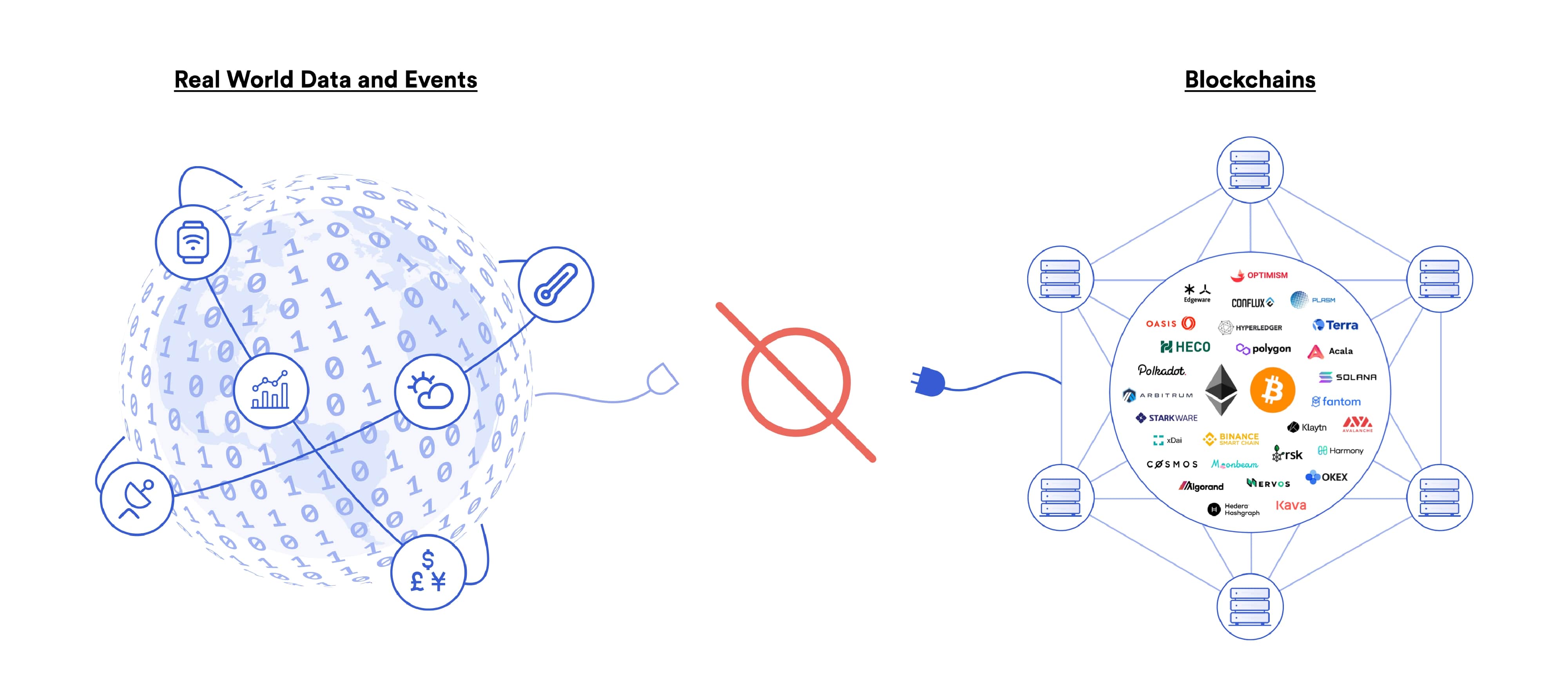
Without a bridge to the outside world, a smart contract is limited to managing only the data that already exists on-chain. This severely restricts its utility for most real-world applications. A lending protocol cannot function without knowing the current market price of collateral, and a fiat-backed stablecoin cannot prove its solvency without verifying the reserves held in an off-chain bank account.
This challenge is analogous to a core principle in your data warehousing experience: a warehouse is only as reliable as the data fed into it by ETL processes. The principle of "garbage in, garbage out" applies with even greater force on the blockchain, where transactions are often irreversible and have immediate financial consequences.
Let's formalize this concept by reading a definition of the problem.
What Is an Oracle in Blockchain? » Explained
This article from Chainlink Education provides a clear definition of oracles and the problem they solve. It's the perfect foundation for our discussion.
Start by reading the definition of a blockchain oracle under the heading "Blockchain Oracle Definition". Then, continue to the section titled "The Oracle Problem" to understand why this limitation is so critical to overcome for applications like tokenized assets.
2. Decentralized Oracles: The Trustworthy Bridge
As you've just read, if a smart contract needs external data, simply feeding it from a single, centralized source is not a solution. Doing so would reintroduce a single point of failure and undermine the entire purpose of using a decentralized blockchain. If that single data source is compromised, goes offline, or simply reports incorrect data, the smart contract will execute based on faulty information, potentially leading to catastrophic losses.
The solution is to use a decentralized oracle network (DON). A DON is a system that fetches data from the outside world and delivers it on-chain in a manner that is just as secure and reliable as the underlying blockchain itself. This is achieved through three layers of decentralization:
- Multiple Data Sources: The network pulls data from numerous high-quality, reputable data providers (e.g., paid APIs from major exchanges and data aggregators), rather than relying on a single source.
- Multiple Independent Nodes: The data is retrieved and reported on-chain by a diverse set of independent, security-reviewed, and Sybil-resistant node operators.
- Aggregation: The individual responses from the node operators are aggregated into a single, validated data point (often using the median) before being written to the smart contract. This process filters out outliers and protects against any single node reporting inaccurate data.
This multi-layered approach creates a system that is highly resistant to tampering, downtime, and inaccuracies.
What Is an Oracle in Blockchain? » Explained
Let's continue with the same article to understand how decentralization is the key to solving the oracle problem.
Read the section "Decentralized Oracles". Pay close attention to the "garbage in, garbage out" concept and how the multi-layered decentralization of a DON, as illustrated in the diagram, mitigates this risk.
3. Chainlink: The Industry-Standard Oracle Platform
Chainlink is the most widely adopted oracle platform, providing the essential infrastructure for a vast range of decentralized applications and securing tens of billions of dollars in value across the DeFi ecosystem.
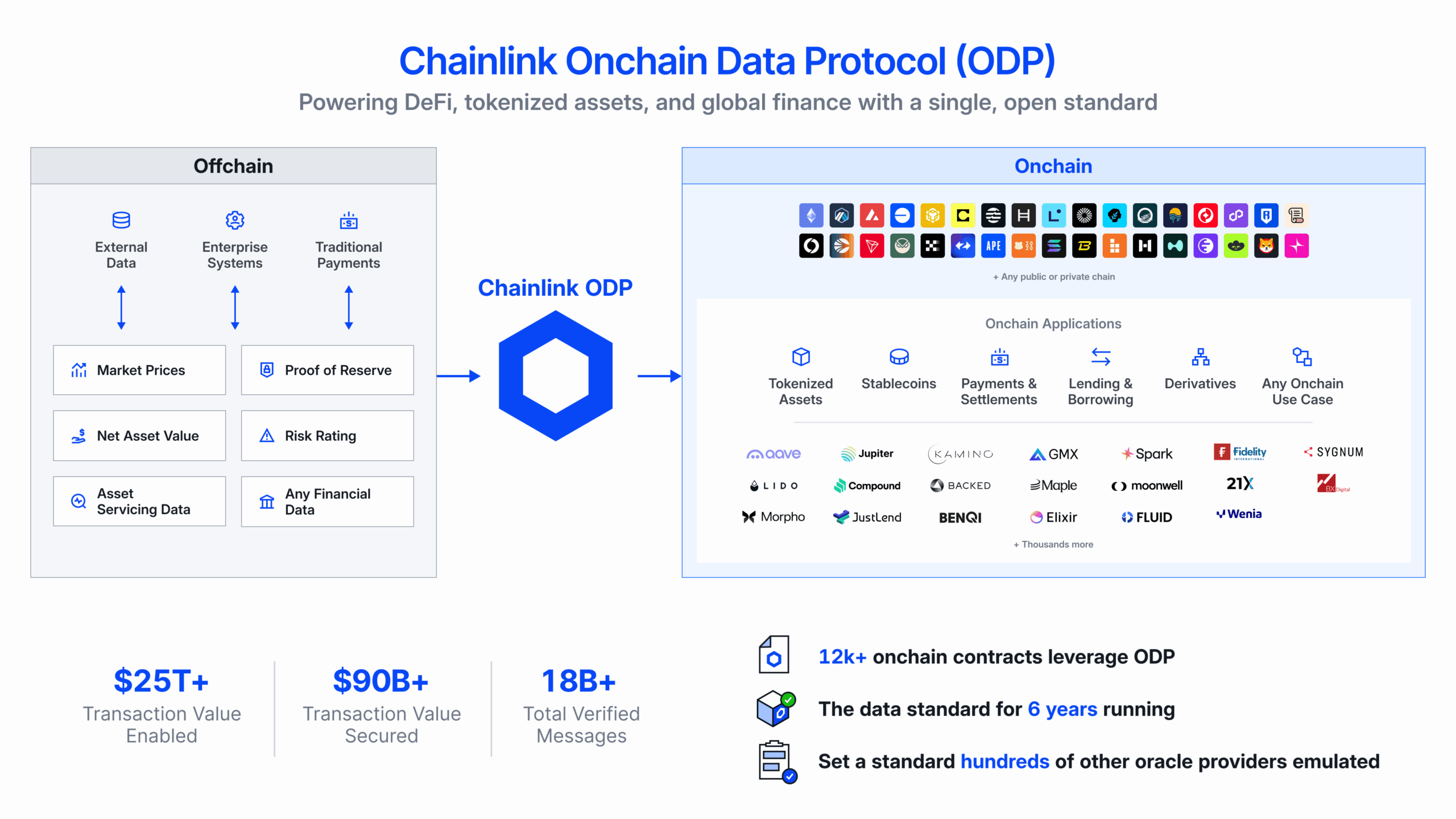
One of Chainlink's most fundamental and widely used services is Price Feeds. These are on-chain reference points, updated by a decentralized oracle network, that provide the latest price of an asset (e.g., ETH/USD). They are pre-built, shared resources that any smart contract can read from, making it incredibly simple for developers to access secure and reliable market data.
The following video provides a practical look at how Chainlink Price Feeds work, including a view of the monitoring dashboard and a simple code example.
[See Description] Chainlink Price Feeds | Chainlink Engineering Tutorials
This Chainlink Engineering Tutorial offers a concise yet detailed explanation of Price Feeds.
Watch the video from the introduction of shared resources to the end of the code demo. As you watch, focus on these key aspects: The concept of Price Feeds as a shared, communal resource. The visualization of the feeds.chain.link dashboard, showing multiple nodes reporting data. The simplicity of the Solidity code required to read a price from a feed.
As you saw, integrating a Price Feed is as simple as importing an interface and calling a view function. This abstracts away the immense complexity of the underlying decentralized network, providing a powerful tool for developers.
4. Oracles in Action: Securing Tokenized Assets and Stablecoins
Now, let's connect this back to your primary goal: building applications for tokenized money. Oracles are not just a theoretical concept; they are the enabling technology for the most critical functions of stablecoins and tokenized securities.
For Fiat-Backed Stablecoins
You've already designed a fiat-backed stablecoin with minting and burning functions controlled by an admin. But how can users trust that every token in circulation is actually backed by a dollar in a bank account? This is where Chainlink Proof of Reserve (PoR) comes in. PoR is an oracle service that automates the verification of off-chain reserves. It can:
- Connect to auditing firms or bank APIs to get the real balance of the reserve account.
- Report this balance on-chain.
- Allow a smart contract to compare the on-chain token supply with the reported reserve balance.
- Even automatically trigger a circuit breaker to halt minting if the reserves fall below the required 1:1 ratio.
This provides real-time, on-chain transparency that is far superior to periodic, manual audits.
Dollar-Denominated Stablecoins: Mechanisms and Oracle ...
This article directly addresses your interest in stablecoins and explains the specific roles Chainlink's services play.
Read the section "The Role of Chainlink and Oracles". Focus on the explanation of Chainlink Proof of Reserve and how it provides transparency for fiat-backed stablecoins. Note also how Chainlink Data Feeds are used for crypto-backed stablecoins, a concept you explored in a previous lesson.
For Tokenized Securities
The same principles apply to tokenized assets, which is highly relevant given your background in investment management software. Imagine a tokenized bond or a real estate fund represented on the blockchain. Oracles are essential for their entire lifecycle.
The following video provides a fantastic overview of how oracles make asset tokenization practical and secure.
How Does Asset Tokenization Work?
This official Chainlink video gives a high-level, business-focused explanation of how oracles enable asset tokenization.
Watch the segment from where oracles are introduced to the end of the bond example. The example of a tokenized bond using Price Feeds for interest rate data and Proof of Reserve for collateral verification is a perfect illustration of these concepts in your domain.
As the video highlights, oracles enable a tokenized asset to be more than just a number on a ledger. They connect it to the real-world data and events that determine its value and behavior, automating processes like coupon payments and collateral checks that are currently manual and slow in traditional finance.
Conclusion
In this lesson, you've bridged the gap between the isolated world of blockchains and the data-rich real world. You now understand that while smart contracts are powerful, their inability to access external data is a fundamental limitation—the oracle problem. Decentralized oracle networks, with Chainlink as the industry leader, solve this problem by providing secure, reliable, and tamper-proof data feeds.
Key Takeaways:
- The Oracle Problem: Blockchains are intentionally isolated systems and cannot natively access off-chain data, which is a requirement for most real-world use cases.
- Decentralized Oracles as the Solution: Decentralized oracle networks (DONs) solve this by using multiple independent nodes and data sources to fetch, validate, and deliver data on-chain, eliminating single points of failure.
- Chainlink is the Industry Standard: Chainlink provides a suite of oracle services that are critical for DeFi and tokenization. Price Feeds offer real-time market data, while Proof of Reserve provides automated transparency for off-chain collateral.
- Enabling Tokenized Finance: For stablecoins and tokenized assets, oracles are not an optional feature but a core component for ensuring transparency (PoR), enabling dynamic functions (e.g., liquidations via Price Feeds), and connecting to traditional financial systems.
We are now at the final step of our course. Having learned to build, test, secure, and connect your smart contracts to the outside world, the last lesson will guide you through a final security review, bringing together all the concepts you've learned to ensure your contracts are robust and ready for deployment.