
Hello, and welcome to Theory of Computation. This opening module develops the proof techniques behind regular languages: not merely drawing automata, but constructing them systematically and proving that they recognize exactly the intended languages.
This lesson introduces the product DFA, the central construction behind closure under Boolean operations. Given DFAs for two languages, you will build one DFA that tracks both computations on the same input. By choosing its accepting states appropriately, the same construction handles intersection, union, difference, symmetric difference, and any other Boolean combination.
If DFA notation is new or needs refreshing, begin with this short formal review.
1. Introduction, Finite Automata, Regular Expressions
Watch “1. Introduction, Finite Automata, Regular Expressions” from MIT OpenCourseWare for a concise grounding in the five components of a finite automaton and what acceptance means.
Watch the DFA definition for the formal five tuple (Q,\Sigma,\delta,q_0,F). Then watch acceptance and languages, focusing on the idea that a string is accepted precisely when its computation ends in an accepting state.
One machine that remembers two computations
Let
and
be DFAs recognizing languages and , respectively.
The important condition is that both machines operate over the same alphabet . If two language descriptions begin with different alphabets, choose a common alphabet—usually their union—and ensure that each DFA has a transition on every symbol in it. A missing transition can be supplied by a nonaccepting sink state. This matters because a DFA’s transition function must be total.
A product DFA simulates and in parallel. Its state is a pair:
where says where would be after reading the input seen so far, and says the same for .
The product machine has:
and transition function
The transition rule is fixed: on each input symbol, update both coordinates according to their original DFAs.
The only part that changes from one Boolean operation to another is the set of accepting states.
For example, a state pair represents one of four possible situations:
| Status in | Status in | Meaning |
|---|---|---|
| rejecting | rejecting | the prefix belongs to neither language |
| accepting | rejecting | the prefix belongs to only |
| rejecting | accepting | the prefix belongs to only |
| accepting | accepting | the prefix belongs to both languages |
Thus, the product DFA records exactly the information needed to evaluate any Boolean expression involving membership in and .
Choosing accepting pairs for Boolean operations
Let be a Boolean rule with two inputs. For example, could mean “both are true,” “at least one is true,” or “the first is true and the second false.”
Define the desired language as
The product DFA for uses the state set, start state, and transition function already given. Its accepting states are
This single definition gives the common constructions below.
| Desired language | Accepting product states |
|---|---|
| pairs where or | |
| pairs where and | |
| pairs where exactly one coordinate is accepting | |
| strings in both languages or neither | pairs where the two coordinates have the same acceptance status |
The last row is sometimes called Boolean equivalence: accept when the two original machines agree about the input.
A useful practical principle follows:
Build the product transitions once; encode the logical operation in the accepting set.
This is more direct than repeatedly redesigning a DFA for every new language expression.
The central invariant
Why does this construction work? The proof rests on a precise statement about every input string, not merely the strings we happen to test.
Write for the extended transition function, which describes the state reached after reading a whole string. It is defined recursively by
and
where and .
For the product DFA, the key lemma is:
for every pair and every string .
In words: after reading any string, the product DFA is in exactly the pair of states that the component DFAs would reach separately on that same string.
This is the invariant that makes the “parallel simulation” intuition mathematically rigorous.
Properties of Regular Languages
Read the intersection construction in Mírian Halfeld-Ferrari’s notes. It presents the same product-state idea and shows how the acceptance argument converts simultaneous acceptance into language intersection.
In the section “Closure under intersection” on pages 14–16, begin at “We shall construct an automaton A that simulates both AL and AM.” Read the product proof. Focus on the meaning of a pair state, the coordinatewise transition rule, and the induction claim about the state reached after reading w.
Proving the invariant by induction
A correctness proof should not say merely that the product “obviously runs both machines.” Instead, prove the invariant by induction on the length of the input string.
Base case
Let . Then the product DFA has read nothing, so it remains in its initial pair:
Likewise,
Therefore the claim holds for the empty string.
Inductive step
Assume the claim holds for some string . That is, assume
Now consider a string , where . By the definition of the extended transition function,
Apply the induction hypothesis:
Now apply the definition of the product transition:
Finally, use the definition of each extended transition function:
Thus the invariant holds for . By induction, it holds for every .
Notice that proving the lemma for an arbitrary starting pair , rather than only , makes the induction especially clean. The start-state version is an immediate consequence.
From the invariant to correctness
Now let denote the product DFA whose accepting set is . We prove that it recognizes the intended Boolean combination .
For any string ,
holds exactly when the state reached by is accepting:
By the invariant, the reached state is
By the definition of , this pair is accepting exactly when
is true. But these two membership statements say precisely that
and
respectively. Therefore,
if and only if
is true. Hence,
That is the complete correctness proof. The proof has two reusable parts:
- Simulation lemma: prove that the product state tracks the two component states.
- Acceptance equivalence: show that the selected accepting pairs implement the desired Boolean rule.
For intersection, this final step specializes to
For difference, it becomes
The induction proof is unchanged; only the accepting-state condition changes.
Worked example: parity of zeros and ones
Let the alphabet be
Define:
and
A DFA for needs two states: one for an even number of zeros and one for an odd number. Reading switches between them; reading leaves the state unchanged. Similarly, a DFA for switches states on and ignores .
Their product has four states, corresponding to the parity pair:
The product begins in the even-even state, since the empty string has zero occurrences of both symbols.
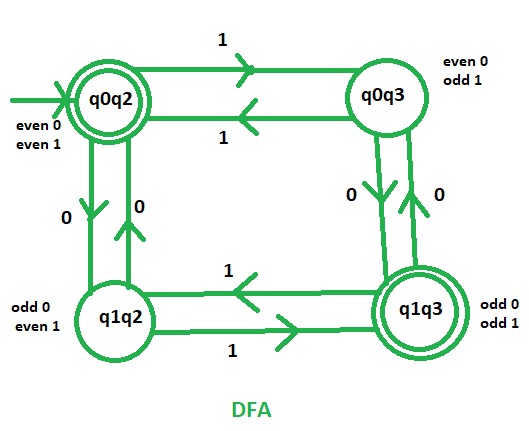
The diagram chooses the Boolean equivalence condition as its acceptance rule. It accepts:
and
Therefore its language is
For instance:
- is accepted because both counts are even.
- is accepted because both counts are odd.
- is rejected because the zero count is odd but the one count is even.
- is rejected because the zero count is even but the one count is odd.
Crucially, the graph of transitions does not need to change to recognize other Boolean combinations of and .
- To recognize , accept only the odd-odd state.
- To recognize , accept every state except even-even.
- To recognize , accept only odd-zero/even-one.
- To recognize , accept the two states with mismatched parity.
This example captures the whole method: pair states represent simultaneous machine configurations; accepting pairs express the logical condition.
A proof-writing checklist
When asked to construct a DFA for a Boolean combination, organize your response in this order:
- Name the component DFAs and state that they share alphabet .
- Define the product DFA completely: state set, alphabet, start state, transition function, and accepting states.
- State the simulation lemma involving .
- Prove the lemma by induction on the length of the input.
- Write an if-and-only-if acceptance argument that translates product acceptance into the intended Boolean condition.
- Conclude language equality, not simply that the construction “seems correct.”
Avoid two common gaps:
- Defining product states but never specifying which pairs are accepting.
- Claiming that the DFA “simulates both machines” without proving the invariant for arbitrary strings.
Key takeaways
A product DFA has one state for each pair of states from the component DFAs, so it can retain both machines’ information after every input prefix. Its transition function always updates each coordinate independently:
Boolean operations are implemented solely by selecting accepting state pairs according to the relevant truth condition. The proof of correctness rests on an induction showing that the product tracks both original computations exactly, followed by an acceptance equivalence argument.
Next, the course turns from proving languages regular to proving that certain languages are not regular, beginning with the pumping lemma for regular languages.
Can't find a good explanation? Sign up and we'll make it for you
Sign up