
Hello. Last lesson established the key idea behind a chemical reaction: new substances form. A word equation is a compact way to record that change. Instead of describing a whole experiment in sentences, it names the substances present at the start and the substances made.
In this lesson, you will learn to place reactants and products correctly, use the symbols in a word equation, and turn a written reaction description into a clear chemical statement. This is the bridge between recognising a chemical change and, in the next lesson, balancing chemical equations.
The structure of a word equation
A word equation uses the names of chemicals to show a reaction.
- Reactants are the starting substances that react.
- Products are the new substances formed.
- Reactants go on the left of the reaction arrow.
- Products go on the right of the reaction arrow.
- A plus sign means “and”: it separates substances on the same side.
The reaction arrow is read as “reacts to form” or “changes into.” It is not an equals sign. The reactants and products are not the same substances; the reaction has formed something new.
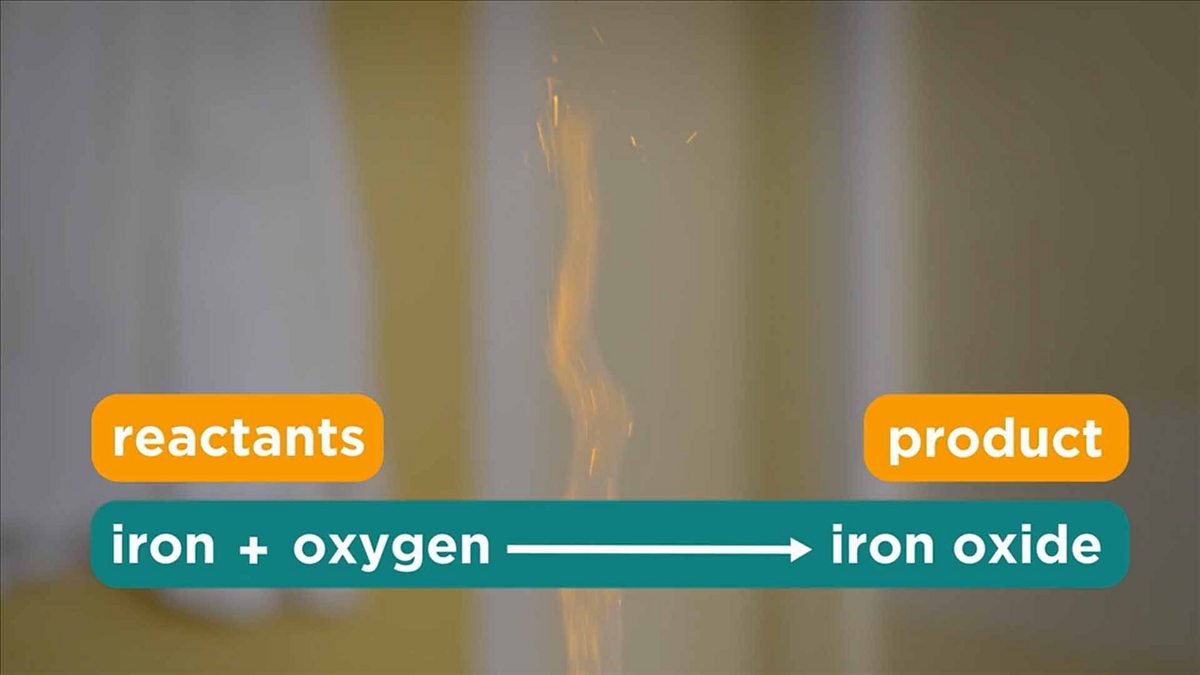
For example, when iron reacts with oxygen, a new compound called iron oxide forms:
Read this aloud as:
“Iron reacts with oxygen to form iron oxide.”
The left-hand side tells you what was present before the reaction. The right-hand side tells you what was made.
How to write word equations. It's EASIER than you think!
Watch “How to write word equations. It's EASIER than you think!” by Revise Chemistry with Mr B for a short visual explanation of reactants, products, and the reaction arrow.
Watch the basic layout to fix the left-side/right-side rule. Then jump to the magnesium example, which applies the rule to a laboratory reaction. Focus on how the speaker decides which names belong on each side before writing anything.
A useful memory sentence is:
Reactants are written on the left; products are written on the right.
Translating a description into an equation
Most questions give you a sentence or a short experiment description rather than the equation itself. Your job is to extract the chemical names and sort them into the two sides.
Use this method:
- Find the starting substances. Look for substances that “react,” are “mixed,” or are “added.”
- Find what is made. Look for words such as “produced,” “formed,” “made,” or “gave.”
- Put the starting substances on the left, separated by plus signs.
- Put the substances made on the right, also separated by plus signs.
Consider this description:
“Methane burns in oxygen to produce carbon dioxide and water.”
- Methane and oxygen are the substances that react.
- Carbon dioxide and water are made during the reaction.
So the word equation is:
Notice that there can be more than one reactant and more than one product. The important thing is not how many names appear, but which side of the arrow each name belongs on.
Here is another example:
“Calcium carbonate reacts with hydrochloric acid. Calcium chloride, water, and carbon dioxide are produced.”
The equation leaves out experimental detail such as “powder,” “dilute,” or “solution.” Its purpose is to name the substances involved in the chemical change.
Writing word equations - BBC Bitesize
Read BBC Bitesize’s “Writing word equations” to see the same left-and-right structure applied to iron reacting with oxygen and to a reaction with several products.
Begin with the opening explanation and read the iron example. Focus on why iron and oxygen are placed before the arrow and iron oxide after it. Then move to the section “How to write a word equation.” Read from the reaction description, and continue through the calcium carbonate example. Identify which words in the description reveal the products. Finally, in “Word equations follow certain rules,” read the formatting rules. Pay particular attention to why the reaction arrow and plus signs have specific jobs.
When the wording is less direct
Sometimes a question describes the products first. Do not copy the sentence order automatically. Instead, ask: Was this substance present at the start, or was it made?
For example:
“Copper sulfate and water were made by reacting copper oxide with sulfuric acid.”
The phrase “were made” identifies copper sulfate and water as products. Copper oxide and sulfuric acid were the starting substances.
This is why the reaction arrow is so useful: it forces you to distinguish the beginning of the reaction from its result.
A word equation does not show:
- the exact number of atoms or particles;
- the amounts of substances required;
- detailed conditions such as heating or a catalyst.
It is a names-only summary. Later, chemical formulae and coefficients will add the detail needed to show that atoms are conserved.
Accuracy rules and common mistakes
At this stage, good word equations follow three simple rules.
1. Use chemical names, not formulae
A word equation should contain names only:
Do not mix a formula for one substance with names for the others. Formula equations are a separate format, which you will meet next.
2. Use plus signs and a reaction arrow
The plus sign joins substances on the same side of the equation. The arrow separates reactants from products.
| Mistake | Why it is a problem | Correct form |
|---|---|---|
| Writing an equals sign | A reaction forms new substances; it is not a mathematical equality. | Use a reaction arrow. |
| Writing the word “plus” | In a standard word equation, use the plus symbol. | Use . |
| Placing a product before the arrow | It makes a substance that is formed look like a starting material. | Put products after the arrow. |
| Including “gas” in the name | Basic word equations use the chemical name alone. | Write “hydrogen,” not “hydrogen gas.” |
3. Keep the chemical names exact
“Acid” is not usually precise enough when the acid is named in the description. “Hydrochloric acid” and “sulfuric acid” are different reactants and can form different products. Similarly, carbon dioxide and carbon monoxide are different substances, so every word matters.
A final worked example shows the full process. Suppose the description says:
“Sulfuric acid reacts with copper oxide to make copper sulfate and water.”
First identify the starting substances: sulfuric acid and copper oxide. Then identify what is made: copper sulfate and water.
The order of the two reactants on the left is not the important feature; the essential rule is that both reactants remain left of the arrow, while both products remain right of it.
A quick writing checklist
Before submitting a word equation, check:
- Have I used the names of all substances?
- Are the reactants on the left?
- Are the products on the right?
- Have I used between substances on the same side?
- Have I used a reaction arrow rather than an equals sign?
- Have I included every product named in the description?
Key takeaways
A word equation is a concise description of a chemical reaction. It has a consistent structure:
Reactants are the starting chemicals and belong on the left. Products are the chemicals formed and belong on the right. Plus signs separate substances on the same side, while the arrow means “reacts to form.”
Next, you will move from names to chemical formulae and learn how to balance a simple chemical equation without changing the formulae of the substances involved.
Can't find a good explanation? Sign up and we'll make it for you
Sign up