
Welcome to Chemical Reactions: Year 9 Essentials. Chemical reactions are usually written using chemical formulae, so before we can describe or balance a reaction, we need to be able to read those formulae accurately.
In this lesson, you will learn to treat a chemical formula as a compact inventory: identify each element from its symbol, then count how many atoms of each element it represents. This is the foundation for writing word equations and, later, balancing chemical equations.
Formulae are chemical “labels”
An element is a substance made from one type of atom. Each element has a chemical symbol, usually one or two letters:
- is hydrogen
- is oxygen
- is carbon
- is nitrogen
- is magnesium
- is chlorine
A chemical formula uses these symbols to show which elements are present and their fixed ratio in a substance.
For example:
is the formula for water. It says that one water particle contains hydrogen and oxygen, in a ratio of two hydrogen atoms for every one oxygen atom.
Atoms in a compound are chemically bonded together. The formula does not tell you how much water is in a glass; it describes the composition of each water particle.
Compounds and chemical formulas | Middle school chemistry | Khan Academy
Watch “Compounds and chemical formulas” from Khan Academy for a visual introduction to compounds, atoms bonded in water and carbon dioxide, and the meaning of formula subscripts.
Watch compounds and molecules to see why water and carbon dioxide contain more than one element. Then watch reading formulas, focusing on why the small lower numbers in H_2O, CO_2, and sucrose give exact atom counts.
Step 1: Find the element symbols
The most important reading rule is:
Every capital letter starts a new element symbol.
A lowercase letter belongs to the capital letter immediately before it.
This means that contains two elements:
- , carbon
- , oxygen
But would mean cobalt, which is one element with a two-letter symbol. Capitalization matters.
Compare these examples:
| Formula part | Element symbol(s) | Meaning |
|---|---|---|
| carbon | ||
| oxygen | ||
| , | carbon and oxygen | |
| cobalt only | ||
| , | sodium and chlorine | |
| , | magnesium and oxygen |
Do not split a two-letter symbol into two elements. For instance, is magnesium, not an element called plus another called . The lowercase letter is part of the same symbol.
Step 2: Read the subscripts
A small number written low and to the right of an element symbol is a subscript. It tells you how many atoms of that element are present.
In the formula
the subscript belongs only to . So the atom count is:
- hydrogen: 2 atoms
- oxygen: 1 atom
There is no number after , so its count is understood to be one.
This is a rule worth memorising:
No subscript means one atom of that element.
The number affects the symbol immediately before it, not the whole formula.
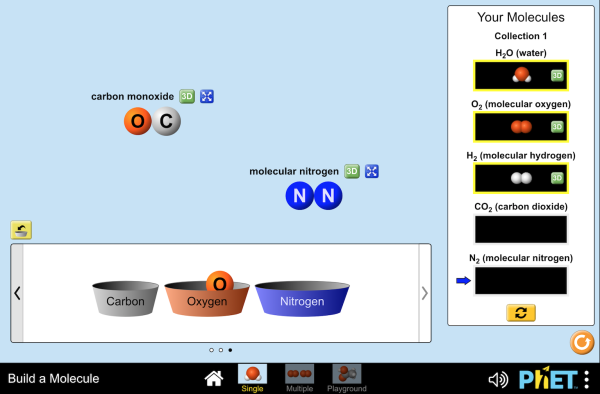
For carbon dioxide:
- : 1 carbon atom
- : 2 oxygen atoms
So one particle of carbon dioxide has three atoms altogether.
A reliable method for any simple formula
When you meet a formula, use the same short routine every time:
- Underline or list each element symbol. Start a new symbol at each capital letter.
- Read the subscript after each symbol.
- Use 1 when there is no subscript.
- State the answer in words, naming each element and its number of atoms.
For example, consider methane:
- Symbols: and
- has no subscript, so carbon has 1 atom.
- has subscript , so hydrogen has 4 atoms.
Therefore, contains one carbon atom and four hydrogen atoms.
Here are a few further examples:
| Formula | Elements present | Atom count |
|---|---|---|
| oxygen | 2 oxygen atoms | |
| nitrogen | 2 nitrogen atoms | |
| magnesium, oxygen | 1 magnesium atom; 1 oxygen atom | |
| sodium, chlorine | 1 sodium atom; 1 chlorine atom | |
| calcium, chlorine | 1 calcium atom; 2 chlorine atoms | |
| carbon, hydrogen | 4 carbon atoms; 10 hydrogen atoms |
Notice the difference between and . Both use oxygen atoms, but specifically represents a particle containing two oxygen atoms bonded together.
Reading longer formulae without getting lost
Longer formulae use exactly the same rules. Work steadily from left to right, treating each capital letter as the start of a new element.
Consider sulfuric acid:
Break it into symbols first:
Then attach the numbers:
- : 2 hydrogen atoms
- : 1 sulfur atom
- : 4 oxygen atoms
Therefore, contains two hydrogen atoms, one sulfur atom, and four oxygen atoms.
Or consider sucrose, a type of sugar:
This formula contains:
- 11 carbon atoms
- 22 hydrogen atoms
- 11 oxygen atoms
The size of the numbers can change, but the reading process does not.
A useful self-check is to ask: Have I counted every capital letter, and have I given every element either its written subscript or an implied one?
Formulae versus reaction numbers
At this stage, focus on the formula itself. A subscript is part of the identity of a substance.
For example:
is water, whereas
is hydrogen peroxide, a different substance. You must never change subscripts just to make numbers look convenient.
Soon, when you write and balance chemical equations, you will meet numbers placed in front of complete formulae. Those are called coefficients and have a different job: they show how many particles or formula units are involved in a reaction. For now, read only the atoms within one formula.
Key takeaways
A chemical formula tells you which elements are present and how many atoms of each are in one particle or formula unit.
- Every capital letter starts a new element symbol.
- A lowercase letter completes a two-letter element symbol, such as , , or .
- A subscript gives the number of atoms of the element immediately before it.
- If there is no subscript, the number of atoms is 1.
- For , the correct reading is one carbon atom and two oxygen atoms.
- Preserve formulae exactly: changing a subscript changes the substance.
Next, you will use observations—such as bubbles, colour changes, temperature changes, or a new solid forming—to decide whether a change is physical or chemical.
Can't find a good explanation? Sign up and we'll make it for you
Sign up