
Hello! Welcome back to your course on modern Ethereum development.
Introduction
In the last module, we focused on the operational aspects of running a dApp, culminating in setting up sophisticated monitoring and alerting. Now, we're shifting our focus from the operator's experience to the user's experience—specifically, tackling one of the biggest points of friction in Web3: gas fees.
As an experienced front-end lead, you know that a smooth onboarding flow is critical for user adoption. Requiring a new user to acquire a specific cryptocurrency (ETH) just to perform their first action is a major hurdle. This lesson introduces a powerful pattern to solve this problem.
We will be covering the learning outcome: Implement gasless transactions using a relayer-based meta-transaction pattern (EIP-2771).
A "meta-transaction" is a design pattern where one user signs a message representing their desired transaction, and a separate entity—a "relayer"—submits it to the network and pays the associated gas fees. EIP-2771 is a standard that formalizes how this interaction works, ensuring that the receiving smart contract can still securely identify the original user.
This pattern is a crucial stepping stone toward more advanced concepts like Account Abstraction, which we will explore in the next lesson.
By the end of this lesson, you will be able to:
- Explain the architecture of a meta-transaction system, including the roles of the user, relayer, and trusted forwarder.
- Implement an EIP-2771 compliant smart contract using OpenZeppelin's
ERC2771Context. - Understand how the
_msgSender()function securely identifies the original transaction signer. - Describe the off-chain components required to relay transactions.
1. The Problem: Gas and the User Experience
Imagine a user new to crypto who wants to claim a free promotional NFT from your new dApp. They connect their wallet, click "Claim," and are immediately blocked by a prompt to pay for gas in ETH, a currency they don't own. Most users will abandon the process right there.
Meta-transactions solve this by decoupling the intent (the user signing a message to claim the NFT) from the execution (a relayer paying the gas to submit the transaction).
To understand the components involved, let's start with a clear definition of the pattern and its key players.
Meta Transactions and ERC-2771 explained
This article from CoinsBench provides an excellent introduction to the motivation behind meta-transactions and defines the core roles in the system.
Read the sections 'Motivation (back then)', 'Welcome Meta-Transactions', and 'Wait… What is a Relayer?'. Focus on understanding the problem being solved and the definitions of the Relayer and Trusted Forwarder.
2. The EIP-2771 Meta-Transaction Flow
Now that you're familiar with the key terms—User, Relayer, Trusted Forwarder, and Recipient Contract—let's visualize how they interact. The following diagram illustrates the standard EIP-2771 flow.
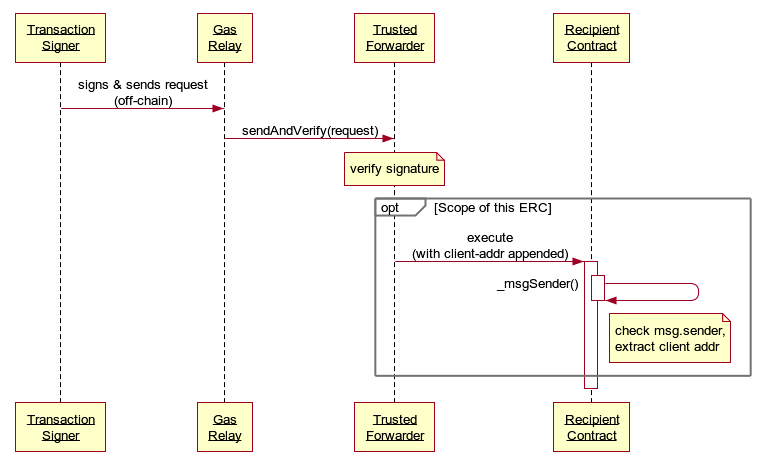
Let's break down this flow step-by-step:
- User Signs: The user, interacting with your dApp's front-end, doesn't send a transaction. Instead, they sign a data structure (using the EIP-712 standard for readability) that contains the details of the function they want to call (e.g.,
claimNFT()). This signature is free. - Relay to Forwarder: The signed message is sent to a Relayer. The Relayer is an off-chain service that wraps this message into a real Ethereum transaction, targeting a specific on-chain contract called the Trusted Forwarder. The Relayer pays the gas for this transaction.
- Forwarder Verifies & Executes: The Trusted Forwarder contract receives the call from the Relayer. Its job is to:
a. Verify the user's signature.
b. Check a nonce to prevent replay attacks.
c. If valid, it makes acallto the final Recipient Contract. Crucially, it appends the original user's address (from) to the end of the calldata of this new call. - Recipient Executes Logic: The Recipient Contract receives the call. At this point,
msg.senderis the address of the Trusted Forwarder. The contract must be able to retrieve the address of the original user, which is now packed into themsg.data.
This brings us to the central challenge: how does the recipient contract securely identify the original user?
3. The Core Mechanism: ERC2771Context and _msgSender()
The EIP-2771 standard solves the user identification problem with a simple but powerful convention. OpenZeppelin provides a base contract, ERC2771Context, that implements this logic for you.
The magic happens inside the _msgSender() function. When you inherit ERC2771Context in your contract, you can use _msgSender() as a secure replacement for msg.sender.
This pattern is analogous to how a web server behind a reverse proxy uses the X-Forwarded-For header. The server's direct connection is from the proxy, but it trusts the proxy to append the original client's IP address in a header. Here, our contract's msg.sender is the Forwarder, but we trust it to append the original user's address in the calldata.
Let's dive into the code that makes this possible.
Meta Transactions and ERC-2771 explained
The same CoinsBench article provides a clear breakdown of OpenZeppelin's implementation. This will show you exactly how _msgSender() works and how to use it in your own contract.
Read the sections starting from 'Our first Meta Transaction'. Pay close attention to the explanation of ERC2771Context.sol and the logic within its _msgSender() function. Then, review the example MyContract to see how it's all put together.
As you saw, the logic is concise:
- Is the call coming from the
trustedForwarder? - If yes: The original signer's address is the last 20 bytes of
msg.data. Return that. - If no: This is a regular transaction. Return
msg.senderas usual.
This allows your contract to support both regular transactions (where the user pays their own gas) and meta-transactions seamlessly. Any function that uses _msgSender() for authorization will work correctly in both scenarios.
Here is a minimal, complete example of a contract implementing this pattern.
// SPDX-License-Identifier: MIT
pragma solidity ^0.8.20;

import "@openzeppelin/contracts/metatx/ERC2771Context.sol";
import "@openzeppelin/contracts/access/Ownable.sol";

// We inherit from Ownable and ERC2771Context.
// Note: OpenZeppelin's Ownable already uses _msgSender(), so it
// automatically becomes compatible with EIP-2771.
contract MyGaslessContract is ERC2771Context, Ownable {
    string public message;

    // The address of the trusted forwarder is passed during deployment.
    constructor(address trustedForwarder) ERC2771Context(trustedForwarder) Ownable(msg.sender) {}

    // This function can only be called by the owner.
    // Thanks to _msgSender(), the 'owner' can be a user who
    // sends a meta-transaction via the trusted forwarder.
    function setMessage(string calldata newMessage) public onlyOwner {
        message = newMessage;
    }

    // This override is required by Solidity when inheriting ERC2771Context.
    // It simply calls the parent implementation.
    function _msgSender() internal view override(ERC2771Context, Context) returns (address) {
        return super._msgSender();
    }
}
4. The Off-Chain Infrastructure: Relayers in Practice
The on-chain part is surprisingly simple thanks to the standard and libraries like OpenZeppelin. The other half of the system is the off-chain relayer service.
A relayer is essentially a backend application that:
- Exposes an API endpoint to receive signed messages from users.
- Maintains a funded Ethereum account (the "hot wallet").
- Performs any necessary validation (e.g., Is this user eligible for a gasless transaction?).
- Constructs the transaction to the
TrustedForwarderand submits it to the network, paying the gas from its hot wallet.
Building and maintaining a secure, reliable relayer is a significant infrastructure task. Fortunately, there are managed services that handle this for you. OpenZeppelin Defender is a popular choice.
This video demonstrates how to set up and use Defender to relay meta-transactions for a dApp.
How to Relay Gasless Meta-Transactions
This video from OpenZeppelin shows a practical, end-to-end implementation of a gasless system using their Defender platform. It will help you connect the theoretical concepts to a real-world setup.
Watch the following segments: Setting up the Relayer (02:50 - 04:16): See how a secure, funded wallet is created in Defender. Creating the Autotask (05:13 - 08:08): Understand how a serverless function (the Autotask) is used as the secure intermediary between the user and the Relayer wallet. Demonstration (08:44 - 10:05): Watch a user with no ETH successfully execute a transaction.
The key takeaway from the video is the separation of concerns:
- Defender Relayer: A secure vault for the gas-paying private key.
- Defender Autotask: A serverless function that runs your logic. It receives the user's signed request via a webhook and uses the Relayer to send the transaction, without ever exposing the private key to your application code.
Conclusion
In this lesson, you've learned how to implement gasless transactions using the EIP-2771 meta-transaction standard. This is a powerful tool for dramatically improving the user onboarding experience for your dApps.
Key Takeaways:
- Meta-transactions decouple the transaction signer from the gas payer, removing a major point of friction for new users.
- EIP-2771 standardizes this pattern, defining the roles of a Relayer, a Trusted Forwarder, and a Recipient Contract.
- The core on-chain mechanism is the
_msgSender()function, provided by OpenZeppelin'sERC2771Context, which securely identifies the original user even when the call comes from a forwarder. - Implementing EIP-2771 requires both on-chain changes (inheriting
ERC2771Contextand using_msgSender()) and an off-chain relayer service to submit and pay for transactions. - Managed services like OpenZeppelin Defender can significantly simplify the creation and maintenance of the required off-chain infrastructure.
Next Lesson Preview:
While EIP-2771 is effective, it has a limitation: every smart contract must be individually designed to support it. What if we could enable gasless transactions for any contract, without requiring modifications? That is the promise of Account Abstraction (ERC-4337). In the next lesson, we will dive into this cutting-edge standard and build a gasless flow using a Paymaster, representing the next evolution of user-centric blockchain design.
Can't find a good explanation? Sign up and we'll make it for you
Sign up