
Hello! Welcome to the final lesson of our module on Account Abstraction.
In our previous lessons, you've implemented gasless transaction flows and compared the legacy EIP-2771 pattern with the modern ERC-4337 standard. We concluded that ERC-4337 is the clear path forward, not just for gas abstraction, but for a whole new paradigm of programmable accounts.
Today, we will dissect the engine of ERC-4337. This lesson focuses on the learning outcome: Describe the roles of the Bundler, EntryPoint, and Paymaster in the ERC-4337 ecosystem.
You've already encountered these terms, but a deep understanding of their specific responsibilities and interactions is critical for architecting and debugging dApps that leverage Account Abstraction. We will move from high-level analogies to the concrete mechanics of how these components work together to execute a user's intent.
1. The ERC-4337 Architecture: An Overview
At its core, ERC-4337 introduces a new, higher-level transaction system that operates on top of the existing Ethereum protocol. Instead of users sending transactions directly, they create UserOperation objects that express their intent. A set of specialized actors then works to get these operations included on-chain.
Let's start with a visual map of this ecosystem.
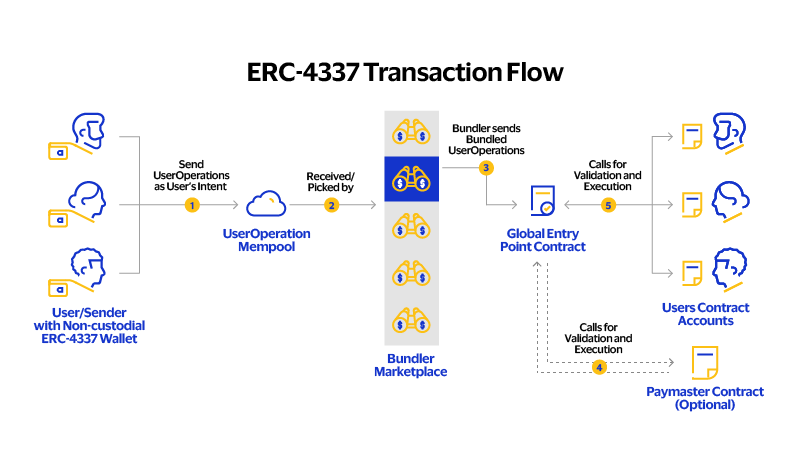
To bring this diagram to life, let's watch a short video that provides a quick overview of the main roles.
ERC 4337 in 7 minutes (the 5 roles in Account Abstraction)
This video from Alchemy, 'ERC 4337 in 7 minutes', offers a concise introduction to the five key roles in the ERC-4337 standard. It will help you quickly place the Bundler, EntryPoint, and Paymaster within the overall flow.
Please watch the entire video (it's short!). Focus on how the off-chain actors (User, Bundler) and on-chain actors (EntryPoint, Paymaster, Smart Contract Account) interact to enable a transaction without the user needing an EOA with ETH.
As the video explained, the system can be broken down into these key roles:
| Role | Type | Analogy | Core Function |
|---|---|---|---|
| User | Off-chain | The Customer | Signs a UserOperation to authorize an action. |
| Bundler | Off-chain | The Delivery Driver | Packages UserOperations into a standard transaction and submits it on-chain. |
| EntryPoint | On-chain | The Central Office | A global contract that verifies and executes the bundled operations. |
| Paymaster | On-chain | The Sponsor | An optional contract that agrees to pay gas fees on the user's behalf. |
| Smart Account | On-chain | The User's Safe | The user's contract-based account that holds assets and executes logic. |
Now, let's dive deep into the three roles at the heart of the learning outcome.
2. The Bundler: The Off-Chain Workhorse
The Bundler is a critical piece of off-chain infrastructure. It's a node or service that monitors a dedicated mempool for UserOperation objects.
To understand its responsibilities, let's consult a guide.
Introductory Guide to Account Abstraction (ERC-4337)
The 'Introductory Guide to Account Abstraction (ERC-4337)' from Blocknative provides an excellent, detailed description of the Bundler's role.
Please read the section titled 'Bundler—facilitating a transaction’s path to finality'. Pay close attention to how Bundlers select operations, pay for gas, and protect themselves by simulating operations beforehand.
Based on your reading, here are the key responsibilities of a Bundler:
- Monitoring: Listens to a dedicated, P2P mempool for
UserOperationobjects. This is separate from the standard Ethereum transaction mempool. - Validation & Simulation: Before including a
UserOperation, the Bundler simulates it off-chain. This crucial step verifies that the operation is valid (e.g., the signature is correct) and that it can pay for its own gas (either from the Smart Account's deposit or via a Paymaster). This protects the Bundler from wasting money on failed transactions. - Bundling: Selects multiple
UserOperations from the mempool, often based on fee-prioritization logic similar to block builders, and packages them into a single, standard Ethereum transaction. This is why it's a "Bundler" and not just a "Relayer"—it's designed for batch processing. - Submission: The Bundler signs and pays for this bundle transaction, sending it to the single
EntryPointcontract address. The Bundler acts as themsg.senderfor this one transaction, paying the ETH for gas upfront. - Reimbursement: The Bundler is compensated for the gas it paid. During the execution of the
UserOperations by theEntryPoint, the gas fees are paid back to the Bundler from either the user's Smart Account or the sponsoring Paymaster.
3. The EntryPoint: The On-Chain Orchestrator
The EntryPoint is the immutable, global, and highly audited singleton contract that serves as the trust anchor of the entire ERC-4337 system. All Bundlers submit their transaction bundles to this single contract.
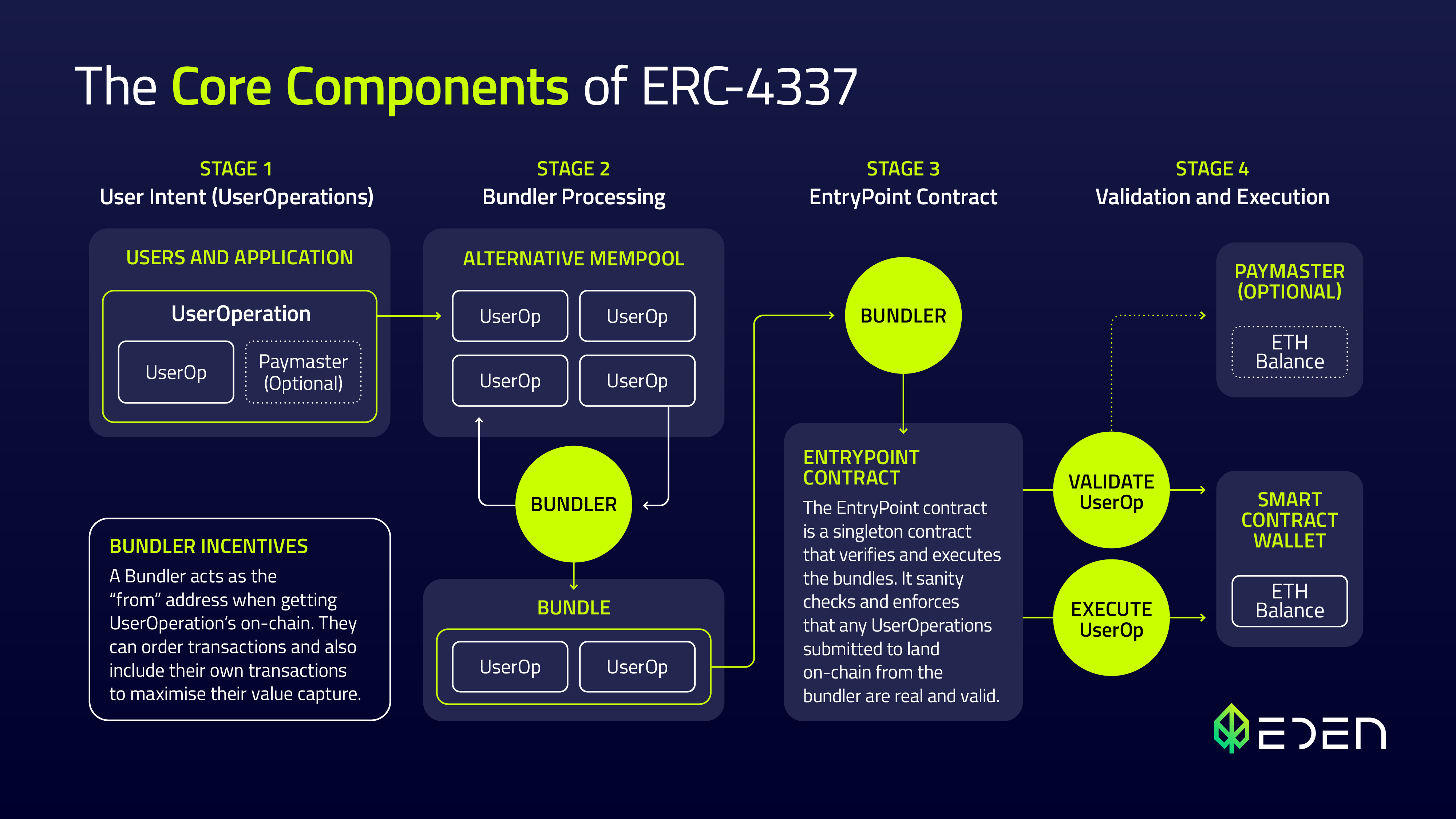
Let's get a more formal definition of its role.
Introductory Guide to Account Abstraction (ERC-4337)
Let's return to the Blocknative guide to understand the EntryPoint's function.
Read the section 'EntryPoint—global contract to validate and execute UserOps'. Focus on its role as a singleton and how it simplifies the logic required in individual smart contract wallets.
The EntryPoint's main function, handleOps, executes a two-phase process for each UserOperation in a bundle:
-
Verification Loop: The EntryPoint iterates through each
UserOperationand performs checks.- It calls
validateUserOpon the user's Smart Account. The account verifies the user's signature and confirms it has enough funds to pay for the operation (if not sponsored). - If a Paymaster is specified, the EntryPoint calls
validatePaymasterUserOpon the Paymaster contract to ensure it agrees to sponsor this specific operation.
- It calls
-
Execution Loop: If verification succeeds, the EntryPoint iterates through the operations again.
- It calls the user's Smart Account, which then executes the
callDatafrom theUserOperation(e.g., calling aswapfunction on Uniswap). - After execution, it calculates the gas cost and collects the fee, reimbursing the Bundler. The fee is taken from the Paymaster's stake or the Smart Account's deposit within the EntryPoint contract.
- It calls the user's Smart Account, which then executes the
By centralizing this complex verification and execution logic, the EntryPoint contract allows individual Smart Accounts to be much simpler and more secure.
4. The Paymaster: The Gas Sponsor
The Paymaster is what makes truly gasless experiences possible for the end-user. It's an optional smart contract that can agree to pay for a user's transaction fees.
Introductory Guide to Account Abstraction (ERC-4337)
The Blocknative guide also provides a clear explanation of the Paymaster's purpose and the different models it can use.
Read the section 'Paymaster—sponsor user transactions'. Note the different use cases it enables and the distinction between Verifying and Deposit Paymasters.
The key functions and features of a Paymaster are:
- Sponsorship Logic: It contains a function,
validatePaymasterUserOp, where developers can implement any custom logic to decide whether to sponsor a transaction. For example:- Sponsor transactions for whitelisted users.
- Sponsor the first 5 transactions for any new user.
- Allow users to pay for gas with an ERC-20 token (the Paymaster pays in ETH and accepts the token from the user).
- Connect to an off-chain service to charge a credit card.
- Staking: To be trusted by the system, a Paymaster must deposit and maintain a stake of ETH in the
EntryPointcontract. This stake serves as the collateral used to reimburse Bundlers, guaranteeing they will be paid for the gas they front. - Types of Paymasters:
- Deposit Paymaster: Allows a third party (like a user) to deposit ERC-20 tokens into the Paymaster. The Paymaster then uses its ETH stake to pay for gas and debits the user's token balance.
- Verifying Paymaster: Relies on an off-chain signature to approve a sponsorship. This is useful for models like credit card payments or subscriptions, where the decision to pay is made off-chain.
5. Putting It All Together: A Transaction Trace
Theory is one thing, but seeing the flow on-chain provides a much deeper understanding. The following video segment analyzes a real ERC-4337 transaction, showing the exact sequence of contract calls. Given your technical background, this should be particularly insightful.
This 'Deep Dive into ERC 4337' from Alchemy provides a fantastic walk-through of an actual transaction trace. You will see the handleOps call to the EntryPoint, followed by the validateUserOp and validatePaymasterUserOp calls, and finally the execution.
Watch the segment from 08:59 to 14:01. Follow along as the presenter labels the addresses for the EntryPoint, Smart Account, and Paymaster in the call trace. This will connect all the concepts we've just discussed.
This trace analysis perfectly demonstrates the orchestration role of the EntryPoint, calling out to the other contracts in the precise order required by the ERC-4337 standard.
Conclusion
You have now completed the final lesson in our module on Account Abstraction. You have a detailed understanding of the core components that make ERC-4337 work.
Key Takeaways:
- Bundler: An off-chain service that listens for
UserOperations, simulates them for validity, bundles them into a single transaction, and pays the initial gas fee to submit them to theEntryPoint. - EntryPoint: A global, singleton on-chain contract that acts as the central coordinator. It safely executes transactions by following a strict verification-then-execution flow, ensuring Bundlers are reimbursed.
- Paymaster: An optional on-chain contract that enables gas sponsorship. It uses custom logic to decide whether to pay for an operation and must stake ETH in the
EntryPointto guarantee its payments.
This deep knowledge of the ERC-4337 infrastructure is essential for any developer building in the modern Ethereum ecosystem.
Next Lesson Preview:
With this module complete, we will now shift our focus from user-facing features like gasless transactions to the efficiency and cost of the contracts themselves. In our next module, "Advanced On-Chain Optimization & Operations," we will begin with the lesson: "Apply gas optimization techniques using storage packing and efficient use of calldata." You'll learn how to write Solidity code that minimizes its on-chain footprint, a critical skill for building scalable and cost-effective applications.
Can't find a good explanation? Sign up and we'll make it for you
Sign up