
A successful cyberattack is rarely “just an IT problem.” In the previous lesson, you learned to infer who might attack and why. Now the focus moves to the organisation: what happens when the attacker succeeds?
For a distinction-level answer, do more than list consequences such as “the company loses money.” You need to trace how the compromised asset affects business processes, customers, staff, and the organisation’s future position. By the end of this lesson, you should be able to analyse operational, financial, reputational, and intellectual-property impacts, explain how they overlap, and make a justified judgement about which matters most in a scenario.
Start with the affected asset, not a memorised list of impacts
The impact of an attack depends on what has been compromised and what the organisation needs that asset for.
A ransomware attack against a school’s timetable system, for example, may disrupt lessons and staff administration. The same ransomware attack against an online retailer’s sales platform may immediately stop orders and payments. A theft of confidential product designs may leave systems running normally today, but could damage the organisation’s ability to compete for years.
A useful starting point is the CIA triad:
| Security failure | Meaning | Likely business effect |
|---|---|---|
| Confidentiality | Information is seen or stolen by unauthorised people. | Data breach, loss of trust, stolen trade secrets. |
| Integrity | Information or systems are changed incorrectly or maliciously. | Incorrect payments, altered records, unsafe decisions, faulty production. |
| Availability | Systems, data, or services cannot be used when needed. | Downtime, delayed work, lost sales, interrupted customer service. |
These are technical descriptions of what went wrong. The four impact categories describe what that failure means to the organisation.
A useful chain for an exam answer is:
Attack asset or process affected business consequence impact category.
For example:
Ransomware encrypts the retailer’s stock-control and order-processing systems. Staff cannot confirm stock levels or dispatch purchases, so orders are delayed and customers may cancel. This creates an operational impact first, which can then lead to financial loss and reputational damage.
The financial loss is not simply “because ransomware happened.” It occurs because the attack prevents a valuable business process from operating.
BIA - Business Impact Analysis (CISSP Free by Skillset.com)
Watch BIA – Business Impact Analysis from Skillset for a short introduction to how organisations identify critical processes, downtime consequences, and wider business effects after an incident.
Watch the BIA overview to see why organisations identify essential operations and recovery priorities. Then watch recovery targets, focusing on how downtime and data loss affect different systems differently. Finish with business consequences, which connects service interruption, lost income, customer trust, and legal obligations.
A business impact analysis (BIA) identifies the organisation’s essential processes and considers what would happen if they were interrupted. You do not need to carry out a full BIA for this unit yet, but its basic idea improves your scenario answers: an asset is important because it supports an important organisational objective.
The four impact categories
1. Operational impact: the organisation cannot work normally
An operational impact is disruption to day-to-day activities or the delivery of goods and services.
It can result from an availability failure, such as a denial-of-service attack or ransomware, but it can also result from an integrity failure. If an attacker changes stock records, patient appointments, payroll details, or manufacturing settings, staff may have to stop using the affected system until its information can be trusted again.
Typical operational impacts include:
- staff unable to access files, email, systems, or networks;
- employees redirected from their normal jobs to deal with the incident;
- delayed production, deliveries, payments, appointments, or customer support;
- a website, online shop, or booking system becoming unavailable or slow;
- suppliers unable to exchange orders or invoices;
- services to customers or the public being reduced or stopped;
- increased workload while records are checked, restored, or recreated.
Consider a manufacturer whose production-control system is unavailable after an attack. The immediate operational impact is that machinery may not receive correct instructions and production may stop. Staff may need to use manual processes, contact customers about delays, and work overtime to clear the backlog after recovery.
Operational impact is often the first visible effect of an incident. It can then create the other impacts:
- stopped production can lead to lost sales;
- delayed service can frustrate customers;
- a public outage can reduce confidence;
- rushed manual work can cause further errors.
2. Financial impact: costs, lost income, and lost future opportunities
A financial impact is any loss that can reasonably be expressed in money. It is broader than money stolen directly from a bank account.
It helps to divide financial impacts into three groups:
| Type of financial impact | Examples |
|---|---|
| Immediate direct costs | Ransom payment, stolen funds, emergency IT consultants, replacement devices. |
| Recovery and compliance costs | New security software, investigations, audits, legal advice, customer compensation, public-relations support. |
| Indirect and opportunity costs | Paid staff time, overtime, lost sales, cancelled contracts, missed tenders, lost future customers. |
For instance, suppose a phishing attack lets a criminal alter an invoice’s bank details. The direct financial loss may be the payment sent to the criminal. However, the total financial impact may also include the cost of investigating the incident, correcting supplier records, paying staff overtime, and compensating a supplier if the mistake delays a delivery.
Be careful not to assume every incident automatically causes every cost. A strong answer uses conditional language where necessary:
The organisation may lose revenue if the online service remains unavailable during a busy sales period. It could also face consultant and recovery costs while systems are rebuilt. If personal data was compromised, legal advice, notification activity, and possible regulatory consequences could create additional costs.
This is more accurate than writing, “The organisation will definitely receive a fine.” A fine depends on the facts of the incident, the organisation’s legal duties, and whether it handled data and security appropriately.
3. Reputational impact: loss of trust and confidence
A reputational impact is damage to how customers, staff, suppliers, investors, regulators, or the public view an organisation.
Reputation is less immediately measurable than a ransom payment, but it can be commercially serious. Customers may choose a competitor if they believe an organisation cannot keep payments, personal data, or services safe. Existing customers may complain, reduce their use of the service, or cancel contracts. Suppliers may become less willing to share sensitive information or offer favourable terms.
Reputational damage is especially likely where an incident is:
- public, widely reported, or discussed on social media;
- linked to stolen customer or employee personal data;
- repeated after a previous breach;
- handled poorly, for example through unclear or delayed communication;
- connected to a service that people depend on, such as healthcare, transport, or banking;
- evidence that the organisation ignored a known weakness.
There is an important distinction here:
A breach itself is not always the same as reputational damage.
If an organisation detects and contains a minor incident quickly, with no data loss or service interruption, many customers may never be affected. However, a large public breach involving sensitive data can undermine trust even after the technical systems have been repaired.
Reputation also creates a delayed financial effect. A customer’s loss of confidence is reputational; cancelled subscriptions or reduced sales caused by that loss of confidence are financial consequences.
4. Intellectual-property impact: losing what makes the organisation distinctive
Intellectual property (IP) is valuable knowledge or creative work that gives an organisation an advantage. It may include:
- product designs and prototypes;
- engineering drawings;
- source code;
- research and development results;
- formulas, manufacturing methods, and trade secrets;
- confidential business strategies;
- pricing plans and tender information;
- unpublished media or creative work.
The key question is: could a competitor, criminal, or foreign organisation gain an advantage from this information?
If attackers steal a company’s product design, the company may lose exclusivity. A competitor could copy it, release a similar product earlier, undercut the price, or improve its own product without paying the original research and development costs.
Unlike a deleted file, stolen IP is difficult to “restore.” Backups can restore the organisation’s own copy of a design, but they cannot make an attacker forget it or stop it being copied, sold, or used elsewhere.
This means the IP impact can be severe even if:
- the organisation has no downtime;
- no money is stolen immediately;
- the attack is not widely publicised;
- the systems are restored quickly.
A stolen customer database is mainly a confidentiality and personal-data issue, with likely reputational and legal implications. It may also have commercial value. By contrast, a stolen unreleased design, formula, or source code is much more clearly an intellectual-property loss because it can weaken competitive advantage.
A basic risk assessment and management method
Read the National Cyber Security Centre’s guidance to see how an organisation links important assets to meaningful operational, financial, legal, and reputational consequences.
In Step 3 – Understand your assets and assess impact, read the asset ownership discussion, then continue through the example asset register. Focus on why an asset’s owner and business purpose matter when judging impact. In Table 1: Example asset register, compare the rows for intellectual property, corporate IT, HR information, operational technology, and online sales. Pay close attention to the IP and corporate-system examples. Notice that one compromised asset can produce several different impacts. Finally, in Step 7 – Assess cyber security risk, read the wider definition of harm. This reinforces that a cybersecurity impact is not limited to confidential data or immediate monetary loss.
Real incidents often produce several impacts at once
The following chart shows reported effects of breaches and attacks on businesses and charities. Notice that added staff time, new protective measures, and interruption to normal work can be more common than obvious public outcomes such as reputational damage or legal costs.
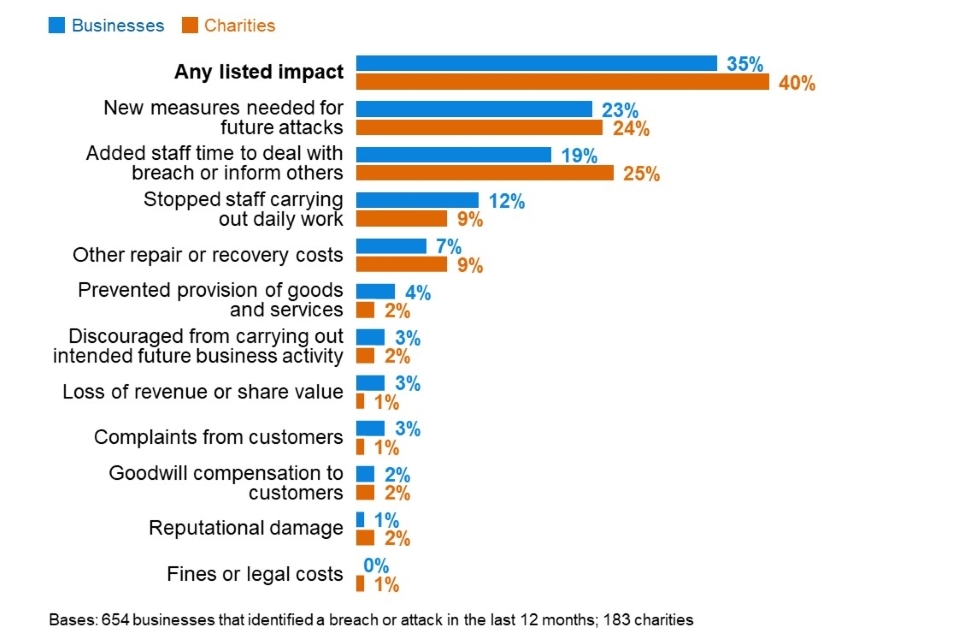
The chart is useful because it challenges the idea that a successful attack matters only when money is stolen. A short incident may still consume staff time, delay work, and force the organisation to improve its security.
The 2024 UK Cyber Security Breaches Survey makes a similar distinction between an attack’s immediate outcome and its wider impact. For example, a website may be taken down temporarily, but the broader consequences may include staff being diverted to incident work, costs of recovery, customer complaints, and future security investment.
Cyber security breaches survey 2024 - GOV.UK
Read the relevant parts of the UK Government’s Cyber Security Breaches Survey to connect the four impact categories to evidence from organisations that reported attacks.
In Section 4.5 How are businesses affected?, begin with the paragraph starting the outcomes overview. Then study Figure 4.6. Sort the listed outcomes mentally into operational, financial, reputational, and IP-related effects; some belong in more than one category. Continue through Nature of the impact and Figure 4.7. Read the non-monetary effects discussion. Focus on why staff time and new protective measures still matter even when data has not been lost. In Section 4.6 Financial cost of breaches or attacks, read the introductions and examples for Tables 4.1 to 4.4. In particular, read the immediate-cost definition, then compare it with the long-term and indirect costs. Finish with the combined-cost explanation. Do not memorise every figure; learn the distinction between direct costs, staff-time costs, and indirect losses.
When using survey evidence, interpret it carefully:
- It shows what surveyed organisations reported, not the guaranteed effect of every cyberattack.
- A low percentage does not mean an impact is unimportant. Loss of IP might be less common than staff disruption but could be devastating to a research company.
- Survey figures cannot replace analysis of the scenario. The type of organisation, affected asset, length of outage, and data involved determine severity.
A worked distinction-level analysis
Consider this scenario:
A small manufacturer is hit by ransomware on Monday morning. Its production-planning system, stock records, email, and shared project folders are encrypted for three days. Attackers also copy unreleased computer-aided design files and claim online that they will publish them unless the company pays. Several customers have orders due that week.
A weak answer might say:
The attack will cause downtime, cost money, damage reputation, and result in stolen IP.
That identifies categories, but it does not explain them. A stronger analysis links each impact to evidence.
| Impact area | Analysis of the scenario |
|---|---|
| Operational | The encrypted production-planning and stock systems prevent staff from checking materials, scheduling work, and confirming delivery dates. Production may slow or stop for three days. Email disruption also makes it harder to inform customers and suppliers. |
| Financial | The company may pay for incident-response specialists, system rebuilding, and overtime. It may lose revenue if orders are cancelled or delayed. It could face contractual costs if it misses agreed delivery dates. These costs arise from the interrupted production process, not simply from the existence of ransomware. |
| Reputational | Customers expecting orders that week may lose confidence if the manufacturer cannot communicate or meet deadlines. The attackers’ public claim increases the chance that customers, suppliers, and possible future clients hear about the breach. Damage will be more serious if the company appears unable to explain how it is protecting customer information and future orders. |
| Intellectual property | The unreleased design files are potentially the most serious long-term impact. A competitor could obtain or copy the designs, reducing the manufacturer’s competitive advantage. Backups can restore the company’s files but cannot reverse the disclosure if the attacker publishes or sells them. |
Make a justified judgement
At distinction level, you should decide which impact is most significant and explain why. There is not always one perfect answer, but your judgement must follow the evidence.
For this manufacturer, a justified conclusion could be:
The most immediate impact is operational because production, stock control, and communication are unavailable for three days, creating urgent delays to customer orders. However, the most serious long-term impact may be the theft of unreleased design files. The systems can potentially be restored from backups, but stolen designs could permanently reduce the company’s competitive advantage and lead to future financial loss if competitors copy or undercut its products.
This answer does three useful things:
- It distinguishes immediate from long-term impact.
- It recognises that restoring availability does not restore confidentiality.
- It explains why IP could be more serious than the visible outage.
A reliable structure for exam responses
For a scenario question, use this five-part structure for each impact you discuss:
- Name the affected asset or business process.
- State what the successful attack does to it.
- Explain the operational, financial, reputational, or IP consequence.
- Use scenario evidence.
- Judge the severity, with a reason and sensible condition where needed.
A concise model paragraph looks like this:
The attack has a major operational impact because the organisation’s online ordering system is unavailable during its busiest period. Customers cannot place orders and staff cannot process payments or dispatch goods. This is likely to cause financial loss through missed sales and may also damage the organisation’s reputation if customers use competitors instead. The impact is high because the affected system supports the organisation’s main source of income.
Avoid these common mistakes:
- Listing without explaining: “There will be financial and reputational impacts.”
- Treating every impact as separate: operational downtime may cause financial loss and reputational harm.
- Assuming outcomes without evidence: do not state that a fine is certain unless the scenario supports it.
- Ignoring time: distinguish immediate disruption from lasting loss of customer trust or IP.
- Equating low visibility with low severity: secret theft of designs may be more serious than a short public outage.
Key takeaways
- The impact of a successful attack depends on the asset affected and the business process it supports.
- Operational impacts disrupt day-to-day work, production, services, and customer delivery.
- Financial impacts include direct losses, incident-response costs, recovery expenditure, staff time, lost income, and missed opportunities.
- Reputational impacts arise when customers, staff, suppliers, or the public lose trust in the organisation.
- Intellectual-property impacts can weaken long-term competitive advantage; backups may restore files, but they cannot undo disclosure.
- The four categories overlap. A distinction-level answer explains the causal chain between technical incident and business consequence, then makes a supported judgement about severity.
Next, you will focus on a related skill: judging the severity of a non-monetary loss by considering the value of the affected asset.
Can't find a good explanation? Sign up and we'll make it for you
Sign up