
Hello! Welcome to your first lesson in our course on microservices with Spring Boot. I'm excited to get started with you on this journey to prepare you for your target roles.
Given your solid background in Spring Boot, we'll be able to move quickly through the implementation details in later lessons. For now, our focus is on building a strong conceptual foundation, which is absolutely critical for the architectural and system design questions you'll face in mid-senior level interviews.
This first lesson addresses a fundamental question: Monoliths versus Microservices. We will go beyond simple definitions to explore the critical trade-offs, benefits, and challenges of each architectural style. By the end of this lesson, you'll be able to explain not just what they are, but more importantly, when and why you would choose one over the other—a key skill for impressing interviewers.
1. Defining the Architectures: Monoliths and Microservices
Let's start by establishing a clear definition for both architectural styles. At a high level, the difference comes down to the deployment unit.
A monolithic architecture is the traditional approach where an entire application is built and deployed as a single, indivisible unit. Think of a Spring Boot application packaged as a single .jar or .war file containing all the business logic for features like user management, payments, and inventory.
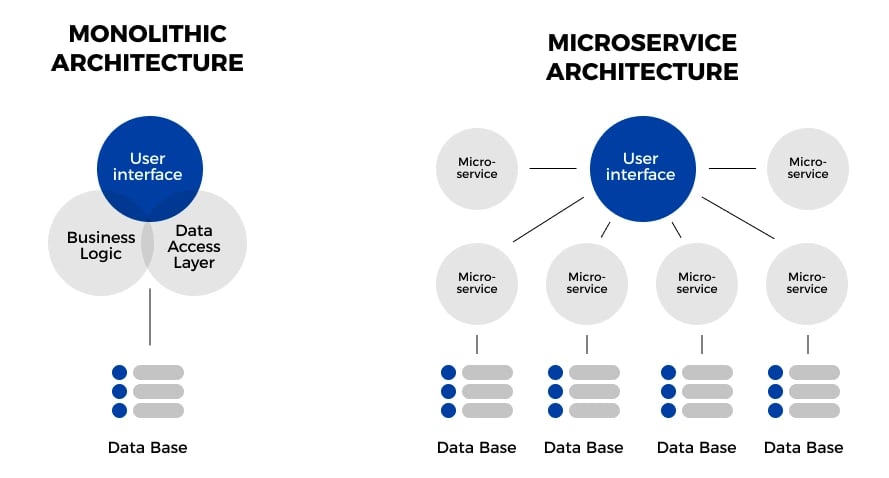
A microservices architecture, on the other hand, structures an application as a collection of small, autonomous services. Each service is self-contained, responsible for a specific business capability, and can be developed, deployed, and scaled independently. These services communicate with each other over a network, typically using APIs.
Key Characteristics at a Glance
To get a clearer picture, let's look at their core characteristics. The following reading provides a concise summary.
Microservices vs Monolith: A Complete Architecture Guide for ...
This article, 'Microservices vs Monolith: A Complete Architecture Guide', offers a great starting point. Please read the sections that define each architecture to solidify your understanding of their fundamental characteristics.
Please read the two sections titled 'What is a Monolithic Architecture?' and 'What are Microservices?'. Focus on the key characteristics listed for each.
To hear these concepts explained in an interview-centric way, watch the following video from Java Brains.
Top 25 Microservice Interview Questions Answered - Java Brains
This clip from 'Top 25 Microservice Interview Questions Answered' by Java Brains provides excellent, concise definitions of both monolithic and microservices architectures, framed specifically for interview preparation.
Watch the segment from 01:13 to 03:27, where the speaker defines microservices. Then, watch from 05:11 to 05:57 for the definition of a monolithic architecture. Pay attention to how the speaker emphasizes that the key difference lies in the deployed unit, not the codebase structure.
2. A Tale of Two Monoliths: The "Big Ball of Mud" vs. the "Modular Monolith"
A common mistake in architectural discussions is to treat all monoliths as inherently bad. This isn't true. The real enemy is unmanaged complexity, which often results in what's called a "Big Ball of Mud"—a system with no clear internal structure, making it difficult and risky to change.
However, a well-structured "Modular Monolith" enforces strong boundaries between different functional areas within the single application. This internal modularity makes the system easier to maintain and can be a stepping stone to a microservices architecture if needed.
Recognizing this distinction is a sign of architectural maturity in an interview. To explore this idea further, let's watch a segment from a talk by Jimmy Bogard, a well-known software architect.
Modularizing the Monolith - Jimmy Bogard - NDC Oslo 2024
In this segment from 'Modularizing the Monolith', Jimmy Bogard explains the 'architectural pendulum' and makes a crucial distinction between 'good' monoliths that are easy to change and 'bad' monoliths that have become a 'big ball of mud'.
Watch the clip from 00:50 to 02:14 to understand the problem that led to microservices. Then, watch from 06:53 to 11:52, where he defines what a monolith is, contrasts 'good' vs. 'bad' monoliths, and explains why internal boundaries are the key differentiator.
3. Comparing Benefits and Challenges
Now that we have clear definitions, let's analyze the practical trade-offs. The decision to use one architecture over the other is driven by weighing their respective benefits and challenges against your project's specific needs.
This image provides a high-level summary of the pros and cons for each architecture.
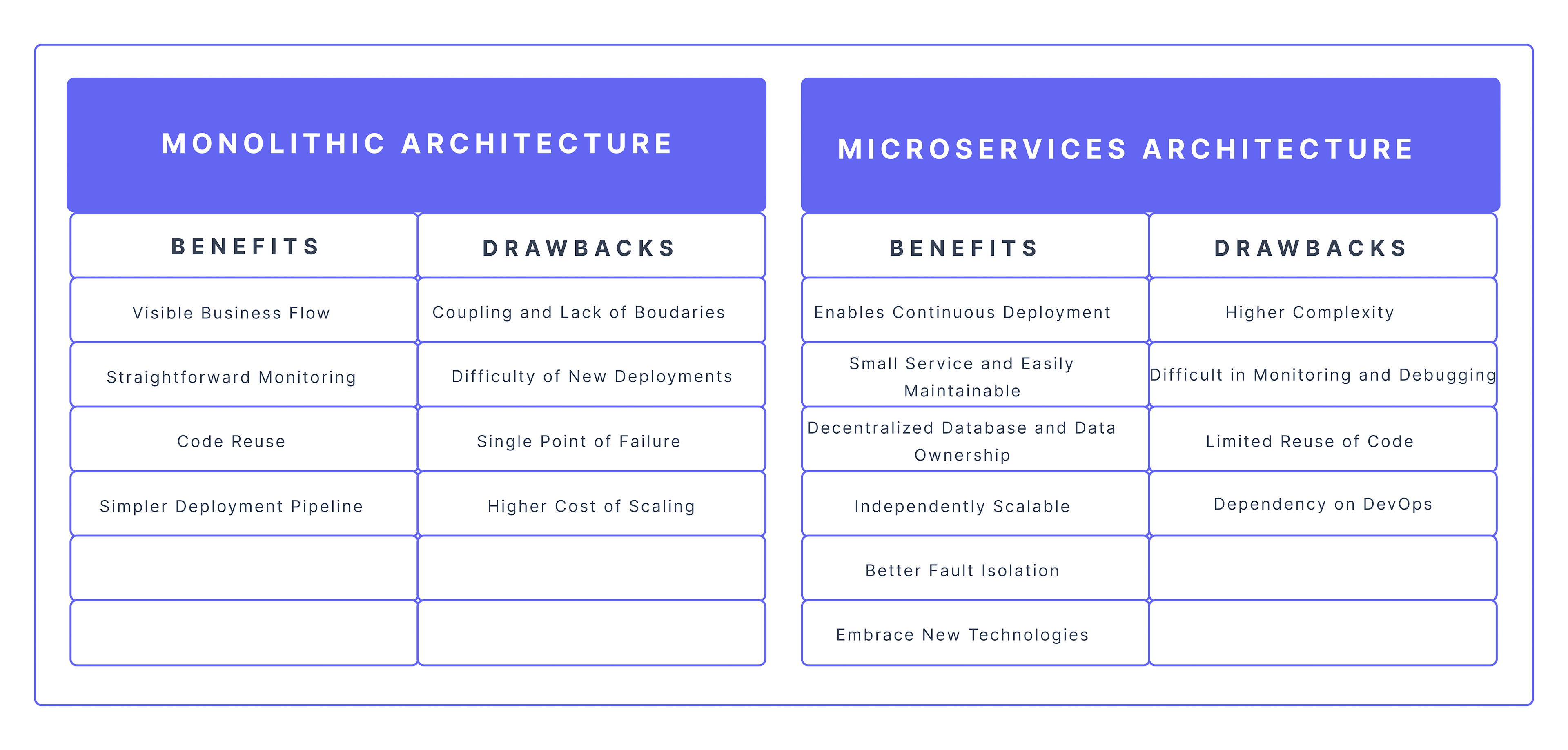
Let's dive deeper into these points.
Benefits of Microservices
Microservices offer several key advantages, especially for large and complex systems:
- Independent Scalability: You can scale individual services based on their specific resource needs. For example, in an e-commerce app, you can scale the product search service independently during a sales event without scaling the user profile service.
- Technology Diversity (Polyglot): Each service can be built with the technology stack best suited for its job. You could have a Python service for machine learning, a Java/Spring Boot service for business logic, and a Node.js service for handling UI requests.
- Faster, Independent Deployments: Since services are decoupled, a change in one service doesn't require rebuilding and redeploying the entire application. Teams can release updates more frequently and with less risk.
- Fault Isolation: If one service fails, it doesn't necessarily bring down the entire application. Other services can continue to function, improving overall resilience (though this requires careful design, as we'll see).
- Team Autonomy: Small, cross-functional teams can own a service end-to-end, from development to deployment and maintenance. This aligns with Conway's Law, which states that a system's design will reflect the organization's communication structure.
Challenges of Microservices
These benefits come at a cost. The distributed nature of microservices introduces significant complexity:
- Operational Overhead: You have to manage, deploy, and monitor dozens or even hundreds of services instead of just one. This requires mature DevOps practices and sophisticated tooling for automation, orchestration (like Kubernetes), and observability.
- Distributed System Complexity: This is the biggest challenge. You must deal with network latency, service discovery, fault tolerance (e.g., circuit breakers), and ensuring data consistency across services. Debugging a request that spans multiple services is far more difficult than debugging a monolith's stack trace.
- Complex Testing: While unit testing a single service is straightforward, integration and end-to-end testing become much more challenging.
- Data Consistency: Without a single, shared database that provides ACID transactions, ensuring data consistency across services is a major hurdle. This often requires complex patterns like the Saga pattern, which we will cover in Module 4.
The following video segments provide an excellent discussion on these points from an interview perspective.
Top 25 Microservice Interview Questions Answered - Java Brains
Let's return to the Java Brains video to hear a detailed breakdown of the advantages and, just as importantly, the challenges you'll face with microservices.
First, watch the discussion on the advantages of microservices from 05:57 to 09:48. Then, watch the segment on challenges from 14:48 to 17:50. Notice how the speaker emphasizes the increased operational complexity and the need for coordination.
4. Making the Right Choice: The Interview Scenario
In an interview, you'll rarely be asked for just definitions. The real test is a scenario-based question like: "When would you choose a monolith over microservices?" or "You're starting a new project; which architecture do you use?"
Your answer should demonstrate a pragmatic, trade-off-driven mindset.
When to Choose a Monolith (especially a Modular Monolith):
- Early-Stage Projects & MVPs: When speed to market is critical and the business domain is still evolving. The simplicity of a monolith allows a small team to build and iterate quickly.
- Small, Simple Applications: If the application's scope is limited and it doesn't have complex scaling requirements, the overhead of microservices is unnecessary over-engineering.
- Small Teams: A small team can be more productive working on a single codebase without the coordination overhead of a distributed system.
- Lack of Operational Maturity: If the organization doesn't have strong DevOps practices or experience with distributed systems, starting with microservices is a recipe for disaster.
The strongest answer for a new project with uncertain requirements is often: "Start with a well-structured, modular monolith." This allows you to move fast while keeping the option to extract services later when the domain boundaries are clearer and the complexity is justified.
When to Choose Microservices:
- Large, Complex Systems: For applications with multiple, complex business domains that need to evolve independently.
- High Scalability Needs: When different parts of the application have vastly different performance and scaling requirements.
- Large, Distributed Teams: When you need to enable multiple teams to work and deploy autonomously without stepping on each other's toes.
The following article is packed with excellent, interview-ready answers that dive deep into these trade-offs.
Monolith & Microservices tough questions & answers for ...
This Medium article, 'Monolith & Microservices tough questions & answers for interviews', provides fantastic, detailed answers to the kinds of scenario-based questions you'll face. It gives concrete examples and justifications.
Please read these three sections carefully: The section answering question #1, 'Deep Dive into Trade-offs', which uses a great e-commerce example to show where microservices add complexity. The section for question #3, 'Choosing the Right Architecture', which justifies starting with a modular monolith. The section for question #15, 'When Not to Use Microservices', which provides a clear checklist of indicators that a monolith is a better fit.
Test your understanding!
You are the lead engineer on a team of 5, tasked with building a new food delivery application. The primary goal is to launch an MVP in 3 months to test product-market fit. The CEO mentions long-term plans to expand into grocery delivery and pharmacy services, which would be handled by separate business units.
Which architectural style would you propose for the initial MVP, and how would you justify your decision to the CEO? What would be your strategy for future expansion?
Show answer
For the initial MVP, the most pragmatic choice would be a well-structured, modular monolith.
Justification for the CEO:
- Speed to Market: Our top priority is launching in 3 months. A monolith allows us to develop and deploy much faster because we avoid the significant upfront complexity of setting up a distributed system (inter-service communication, separate deployment pipelines, service discovery, etc.).
- Lower Initial Cost & Complexity: We are a small team of 5. Managing a single application is far simpler and requires less operational overhead than managing multiple services. This lets us focus our limited resources on building features, not infrastructure.
- Flexibility for Learning: The exact business requirements will likely change as we get user feedback. It is much easier and faster to refactor and evolve our domain model within a single codebase than across multiple, distributed services. Starting with microservices now would force us to make premature decisions about service boundaries that we might get wrong.
Strategy for Future Expansion:
The key is "well-structured." We will build the monolith with clear internal boundaries, organizing code into modules based on business capabilities (e.g., orders, restaurants, users, delivery). These modules will communicate through clean, internal APIs.
This approach gives us the best of both worlds: we get the speed of a monolith now, and when the time comes to expand into grocery or pharmacy services, we will have a clear path to extract these well-defined modules into independent microservices. We defer the complexity of microservices until the business has proven the need and we have a clear understanding of the domain.
Key Takeaways
- Monolith: A single, unified deployment unit. Simple to develop and deploy initially but can become hard to scale and maintain as it grows.
- Microservices: An application structured as a collection of small, independent services. Offers scalability, flexibility, and team autonomy but introduces significant operational and distributed systems complexity.
- It's All About Trade-offs: There is no "best" architecture. The choice depends on team size, project complexity, scalability requirements, and organizational maturity.
- Start with a Modular Monolith: For new projects with uncertain domains, this is often the most pragmatic approach. It prioritizes speed while preparing for future evolution.
Next Up
You now have a solid understanding of the foundational architectural patterns. But how do you decide where to draw the lines between services? In our next lesson, we will explore Domain-Driven Design (DDD) and the concept of a Bounded Context, which provide a powerful strategic framework for defining your microservice boundaries.
Can't find a good explanation? Sign up and we'll make it for you
Sign up