Introduction
Welcome to a new module, "Practical Opening Play." In the last module, we focused on the art of attack, learning how to build pressure and deliver a decisive blow. But a powerful attack doesn't happen by chance; it's built on the foundation of a solid opening. If the middlegame is the main battle, the opening is how you deploy your troops.
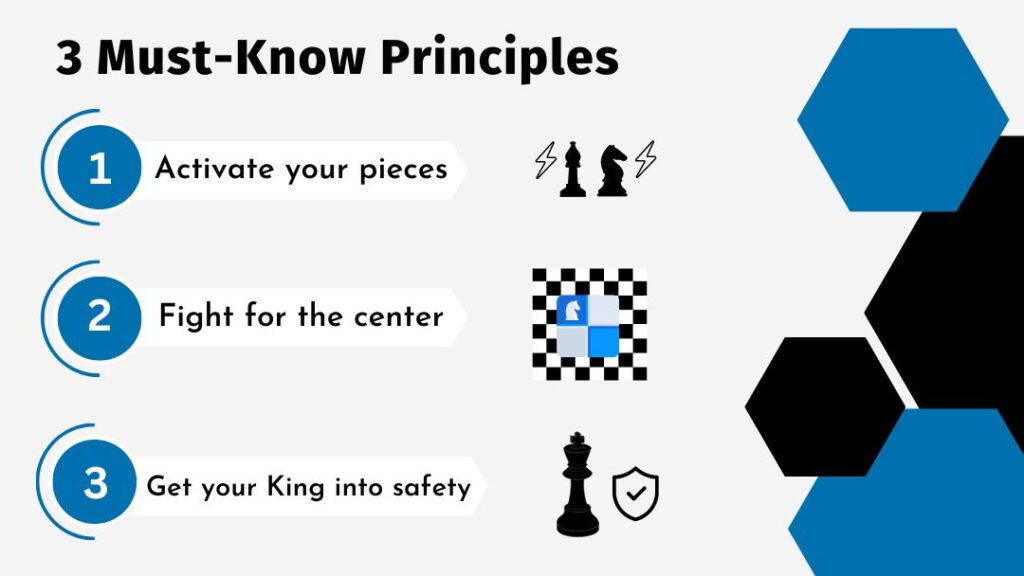
This lesson marks a shift back to the very first moves of the game. We'll cover the three core principles that should guide every move you make in the opening:
- Control the center.
- Develop your minor pieces (knights and bishops).
- Ensure your king is safe.
By mastering these principles, you'll reach the middlegame with an active, coordinated army, ready to launch the attacks we studied previously. This is a fundamental step toward playing more consistent chess and achieving your 1500 ELO goal.
A Strategic Framework for the Opening
The traditional advice is to "develop pieces, control the center, and castle early." This is good, but we can refine it into a more powerful strategic framework. Thinking about why we do these things helps us make better decisions.
A more effective way to prioritize your thinking in the opening is:
- King Safety: Your top priority. Checkmate ends the game, so all your plans must ensure your king is not in danger.
- Central Square Control: Your second priority. The center is the most important territory on the board, and controlling it gives your pieces maximum power and flexibility.
- Purposeful Development: Your third priority. Your piece development should serve the first two goals. You're not just moving pieces out; you're moving them to squares where they enhance your king's safety and fight for the center.
Let's read a short article that explains this powerful mindset.
The Complete Guide to Chess Opening Principles -"King Safety ...
The article 'The Complete Guide to Chess Opening Principles' from a Lichess blog offers an excellent perspective on prioritizing your opening goals. It argues that 'King Safety' should be your primary concern.
Please read the following sections to understand this strategic hierarchy: Start at the beginning and read the introduction, which presents the author's revised priorities. Continue with the section 'Why "King Safety" instead of the usual Early Castling recommendation?' Read 'Why think about King safety first as the major opening principle?' Finally, read 'Why Developing Pieces is the 3rd order of thinking' to see how it all connects. Focus on the idea that developing pieces isn't just about moving them off the back rank, but doing so with the purpose of securing your king and controlling the center.
This hierarchy—King Safety, Center Control, and Purposeful Development—gives you a clear decision-making process for the first 10-15 moves of any game.
Principle 1: Fight for the Center
The center consists of the squares e4, d4, e5, and d5. Why are these squares so important?
- Piece Activity: A piece in the center, like a knight on d4, controls more of the board and can move to either side quickly. A knight on the rim, like on a4, is far less powerful.
- Flexibility: Controlling the center gives you more options. You can decide whether to attack on the kingside or the queenside.
- Restriction: By controlling the center, you restrict your opponent's pieces and limit their options.
This next video provides a great explanation of why central control is so crucial.
25 Opening Principles Every Chess Player Should Know!
The video '25 Opening Principles Every Chess Player Should Know!' by Critical Chess clearly explains the importance of the center.
Watch the segment from 00:58 to 02:52. Pay attention to how pawns in the center open lines for your pieces and restrict your opponent's development.
Principle 2: Develop Your Pieces Purposefully
"Developing" means moving your pieces from their starting squares into the game. In the opening, this primarily refers to your knights and bishops.
Here are some key guidelines for effective development:
- Develop minor pieces first: Get your knights and bishops into the game before your queen and rooks.
- Develop towards the center: As we just discussed, pieces are more effective when they influence the central squares. A move like
Nf3is almost always better thanNh3. - Don't move the same piece twice (without good reason): In the opening, time (or "tempo") is a resource. Every move is an opportunity to improve your position. Moving a piece you've already developed is often a waste of time unless you are capturing a piece, avoiding a serious threat, or making a significant improvement.
- Don't bring your queen out too early: Your queen is your most powerful piece, which also makes her a valuable target. If you bring her out too early, your opponent can develop their own pieces by attacking her, forcing you to waste moves saving her while they build their position.
Let's see these ideas in action.
25 Opening Principles Every Chess Player Should Know!
Returning to the '25 Opening Principles' video, let's look at piece development and common mistakes.
Please watch these two clips: Developing Pieces (02:52 - 05:07): This section shows the difference between good and bad development squares for your knights and bishops. Premature Queen Development (13:59 - 15:54): This clip uses the famous Scholar's Mate to illustrate why bringing the queen out too early is a bad idea. Notice how Black uses the attack on the White queen to develop with tempo.
Principle 3: Ensure King Safety
Your king starts in the center of the board, where files can be opened for attack. The most common way to secure your king is by castling. Castling tucks your king away behind a wall of pawns and brings a rook into the game, helping to connect your rooks.
As a general rule, you should aim to castle within the first 10 moves. However, remember the Lichess article: the goal is safety, not just castling for its own sake.
25 Opening Principles Every Chess Player Should Know!
Let's watch a final clip from '25 Opening Principles' that covers king safety.
Watch these two segments on king safety: Castle the King (07:29 - 08:37): This explains the fundamental benefit of castling—reducing the directions from which your king can be attacked. Don't Push Pawns (30:57 - 32:25): This provides a crucial follow-up tip: avoid unnecessarily moving the pawns in front of your castled king, as this creates weaknesses that your opponent can exploit.
Practical Application: Principles in Action
Theory is great, but seeing how these principles are applied in a real game is essential. GM Daniel Naroditsky's "Speedrun" series is perfect for this, as he constantly explains his thinking based on these core ideas.
In this next video, watch how he reacts to his opponent's moves. He isn't trying to remember a specific opening line; he's applying the principles of development and king safety to find the best moves.
Sideline Strategies: Beginner Level Openings | Develop Your Instincts | GM Naroditsky's DYI Speedrun
In this clip from GM Naroditsky's series, he faces an early, aggressive-looking attack. Notice how he doesn't panic and instead calmly applies the opening principles to neutralize the threat and gain an advantage.
Watch the game from 16:26 to 20:40. Pay close attention to how he uses the move ...e6 to blunt the attack and then proceeds with calm, logical development (Bishop e7, castles, etc.). He prioritizes getting his pieces out and his king safe over grabbing material impulsively.
As you saw, Naroditsky's opponent violated the principles: they launched a premature attack with only a couple of pieces developed, leaving their own king in the center. By simply following the rules—developing pieces, controlling the center, and preparing to get the king safe—Naroditsky easily defended and emerged with a better position.
Conclusion
You now have a solid framework for navigating the opening phase of any chess game. You don't need to memorize dozens of openings; you need to understand the ideas behind good opening moves.
Key Takeaways:
- Adopt the Strategic Hierarchy: Prioritize 1. King Safety, 2. Central Control, and 3. Purposeful Development. This will guide your decisions and help you avoid early blunders.
- Fight for the Center: Use your pawns and pieces to control the key squares e4, d4, e5, and d5.
- Develop with Purpose: Bring your knights and bishops out quickly towards the center. Avoid wasting time by moving the same piece multiple times or bringing your queen out too early.
- Castle Early (Usually): Get your king to safety. This is one of the most reliable ways to avoid falling for cheap tactical shots in the opening.
Preview of the Next Lesson:
Now that you know the right way to play the opening, you'll start to notice just how often your opponents at the 1200-1400 ELO level do it wrong. In our next lesson, we will focus on identifying and punishing the most common opening mistakes, turning your opponent's poor play into a decisive advantage for you.