Introduction
Welcome back! Over the last few lessons, we've successfully built a practical and logical opening repertoire for you, covering the Italian Game for White, the Caro-Kann against 1. e4, and the Slav Defense against 1. d4. You now have a solid plan for the first 10-15 moves of any game.
But what happens next? Many players at your level find themselves in a good position out of the opening, only to ask, "Now what?" They start making moves without a clear purpose, a phenomenon often called "drifting." This lesson is designed to solve that exact problem.
Today, we will focus on bridging the gap between your opening preparation and a successful middlegame. Our goal is to learn how to recognize when the opening phase has concluded and formulate a basic middlegame plan. We will equip you with a structured way of thinking, so you can move forward with confidence and purpose in every game.
1. Recognizing the Transition: When is the Opening Over?
First, let's define our terms. The "end of the opening" isn't a specific move number. It's the moment when the primary goals of the opening have been achieved and the nature of the game shifts from development to strategic execution.
The core goals of the opening, as we've discussed, are:
- Control the center.
- Develop your minor pieces (knights and bishops).
- Castle your king to safety.
When these tasks are mostly complete for both sides, you've arrived at the middlegame. Here is a simple, practical checklist you can use to identify this moment.

Let's break down these four signals:
- All Minor Pieces are Developed: Your knights and bishops are off the back rank and participating in the game.
- King is Castled: Your king is tucked away safely, usually on the kingside or queenside.
- Rooks are Connected: With the king, queen, and minor pieces moved, your rooks on the back rank can now see each other. This is a crucial sign that your basic development is complete.
- At Least One Rook is on an Open or Semi-Open File: This is the final step. Connecting your rooks allows them to be moved to files that are clear of your own pawns, where they can become active participants in the game.
Once you see these conditions on the board, it's time to stop thinking about "opening rules" and start thinking about a middlegame plan.
To reinforce this idea, take a few minutes to read the introductory sections of the following short guide.
Opening to Middlegame Transition Guide
This guide from ChessWorld.net, 'Opening to Middlegame Transition Guide', clearly explains this shift in thinking.
Read the first two sections, titled 'When Does the Opening End?' and 'Stop Drifting: Assess the Position'. Focus on how it describes the transition as a 'moment' rather than a move number.
2. A Framework for Your First Middlegame Plan
Having a plan is what separates purposeful play from aimless drifting. Just as in your marketing or development work, a good strategy starts with analysis and leads to clear, actionable steps. We will use a simple three-step framework: Assess, Identify, and Execute.
Let's explore this framework using a comprehensive blog post from Chess.com as our guide.
The MiddleGame - A Complete Guide For Intermediate Players
The article 'The MiddleGame - A Complete Guide For Intermediate Players' provides an excellent, structured approach to planning. We'll use it as a reference for our three-step framework.
First, read the introduction, 'Beyond the Opening', to understand the importance of having a plan.
Step 1: Assess the Position (Gather Requirements)
Before you can decide where to go, you need to know where you are. Your first step is to take a mental snapshot of the board and evaluate the key features of the position.
The MiddleGame - A Complete Guide For Intermediate Players
The Chess.com article breaks this assessment down into five critical elements. This process should become a mental checklist you run every time you enter the middlegame.
Read the section titled 'Step 1: Assessing the Position – The Foundation of Your Plan'. Pay close attention to the five key areas: King Safety, Material Count, Pawn Structure, Piece Activity, and Space.
In summary, you are asking yourself:
- King Safety: Are the kings safe? Are there any immediate threats?
- Material: Who has more pieces? If you're ahead, you might want to simplify by trading. If behind, you need to create complications.
- Pawn Structure: This is the skeleton of the position. Look for weaknesses (isolated, doubled pawns) to target and strengths (passed pawns) to support. Pawn chains often point in the direction of attack.
- Piece Activity: Which pieces are good? Which are bad (passive, blocked)? Your plan will often involve improving your worst piece.
Step 2: Identify a Strategic Goal (Choose a Plan)
Your assessment will reveal the most important features of the position. Now, you can choose a plan that fits those features. Think of this as a "menu" of common middlegame plans. You don't need to do everything at once; just pick one clear goal to start with.
This next video offers a fantastic catalogue of the most effective plans.
The 10 Best Chess Plans For The Middlegame - Chess Strategy For The Middlegame - Midgame Strategy
The video 'The 10 Best Chess Plans For The Middlegame' by Chess Vibes provides a great visual overview of common strategic goals. We'll focus on a few of the most practical ones for your level.
Watch the sections explaining the following plans: Break Open the Center (00:43 - 01:42) Pawn Storm (01:42 - 02:51) Attack a Weakness (08:12 - 09:30) Improve a Piece (includes trading a weak piece and relocating a knight to an outpost) (02:51 - 03:50 and 07:12 - 08:20) Use a Rook Lift (05:49 - 07:22) Focus on understanding the conditions that make each plan a good choice.
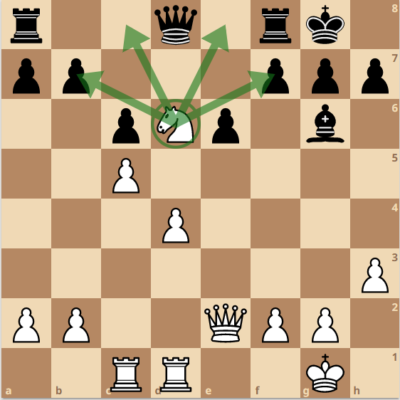
A common and powerful plan is to improve the position of your pieces, especially by placing a knight on an outpost—a square in enemy territory that is supported by one of your pawns and cannot easily be driven away.
Step 3: Execute the Plan (Take Action)
A plan is just an idea until you translate it into moves. The final step is to find the concrete sequence of moves that will advance your strategic goal.
A great default plan, especially in the openings you've learned, revolves around controlling the center with pawns.
I wasted years memorizing chess openings, until I learned this
The video 'I wasted years memorizing chess openings, until I learned this' by Pegasus Chess offers a brilliantly simple, actionable plan you can use in many of your games.
Watch from 01:20 to 03:00. The key takeaway is this simple rule: if you started with d4 (like in the Slav), your middlegame plan is to play e4. If you started with e4 (like in the Italian Game), your plan is to play d4. This 'pawn break' is often the first step in executing your plan to open lines for your pieces.
To find the right moves to execute your plan, you need to start calculating. A systematic way to do this is to consider all Checks, Captures, and Threats (CCT). This ensures you don't miss forcing moves that can achieve your goal quickly or win material.
I wasted years memorizing chess openings, until I learned this
The same video introduces the CCT method as a way to find tactical opportunities within your strategic plan.
Watch from 06:20 to 08:24, where the presenter uses the 'CCT' method to find a winning move. This is a preview of the calculation skills we will develop in a future module, but it's a great habit to start building now.
Remember, your opponent has a plan too! Be prepared to be flexible and adjust your plan based on their moves.
Conclusion
You no longer need to feel lost after the opening. By transitioning your thinking from "opening rules" to a structured planning process, you'll play more purposeful and powerful chess.
Key Takeaways:
- Recognize the Transition: The opening is ending when your minor pieces are developed, your king is castled, and your rooks are connected.
- Use the 3-Step Planning Framework:
- Assess: Systematically evaluate King Safety, Material, Pawn Structure, and Piece Activity.
- Identify: Choose a strategic goal from your "menu of plans," such as attacking a weakness, improving your worst piece, or breaking open the center.
- Execute: Find concrete candidate moves (like a key pawn break) and use the CCT method to look for forcing sequences that advance your plan.
Having any reasonable plan is far better than having no plan at all. Start applying this framework in your games, and don't be afraid to make mistakes. The goal is to develop the habit of thinking strategically.
Preview of the Next Lesson:
This lesson has set the stage for a deeper dive into middlegame strategy. One of the key assessment criteria we discussed was "Piece Activity." Our next lesson will explore this concept in more detail. We will learn how to define piece activity and identify the least active piece in a given position, which is the first step toward the powerful plan of improving your position piece by piece.