
Hello! Welcome back.
In our last lesson, we defined heuristics as the mental shortcuts our brains use to make quick, efficient decisions, especially when we're operating with limited time, information, or cognitive energy. We established that these shortcuts, while incredibly useful, come with a trade-off: they can lead to systematic errors in judgment, known as cognitive biases.
Today, we'll dive into our first specific example of these shortcuts. This lesson will address the learning outcome: Explain the availability heuristic and identify its application in product features like 'trending' sections or recent activity feeds.
We will explore how the ease with which information comes to mind can dramatically influence our perception of its importance and likelihood. You'll see how this plays out not only in the minds of your users but also within product teams during the decision-making process.
1. What is the Availability Heuristic?
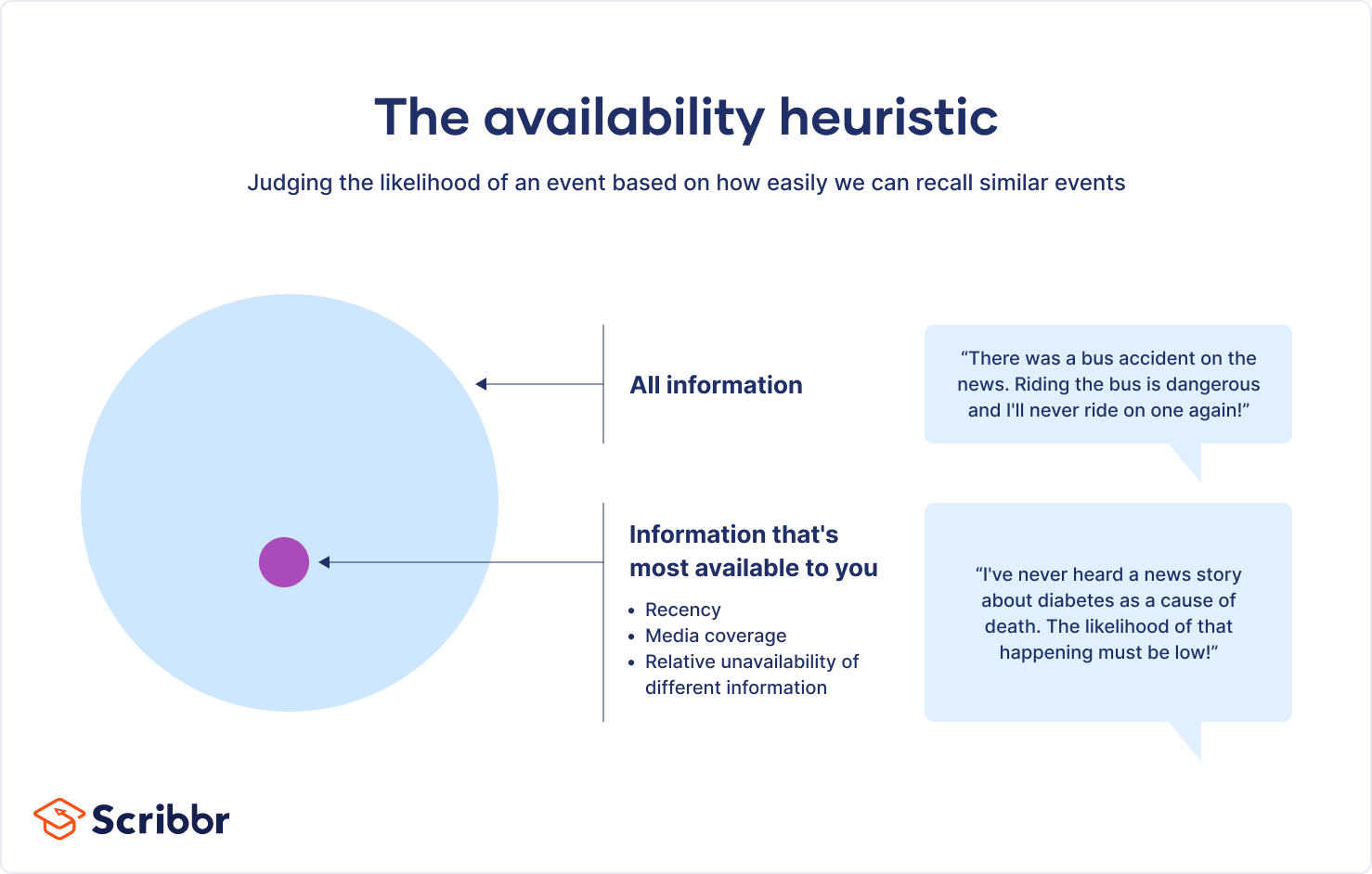
The availability heuristic is a mental shortcut that relies on immediate examples that come to a given person's mind when evaluating a specific topic, concept, method or decision. Essentially, if you can think of it easily, you're likely to believe it's more common or important than it might actually be.
This is driven by factors like:
- Recency: Something that happened recently is fresh in your memory.
- Vividness: A dramatic, emotionally charged event is more memorable than a mundane one.
- Frequency of exposure: Things we see or hear about often (like in the news) feel more prevalent.
This image provides a great visual summary of the concept.
To see this in action, let's start with a short video from the Nielsen Norman Group, a leading voice in the UX field.
This video provides a concise definition of the availability heuristic and uses a simple, tangible example—describing a Post-it note—to illustrate how both memory and immediate perception influence what's 'available' to us.
Please watch the first minute of the video (00:00 - 00:58). Notice how the description of the Post-it changes based on what is most easily recalled versus what is immediately visible.
The Post-it example is simple but effective. The "classic yellow square" is highly available in our memory. However, seeing a variety of Post-its makes a different set of information available, changing our judgment.
This heuristic, however, can lead to significant misjudgments about the world. Let's watch another quick clip that uses a more dramatic example.
Heuristics and biases in decision making, explained
This video from Learn Liberty explains how the availability heuristic can skew our perception of large-scale risks, like global violence, because of the vivid and frequent coverage of negative events in the media.
Please watch the segment from 01:00 to 01:53. This part specifically discusses the availability heuristic and contrasts the perception of world violence with statistical reality.
This example powerfully illustrates the bias. Because instances of violence are vivid and heavily reported, they are highly "available" in our minds. This leads many to incorrectly believe that violence is increasing, even when long-term data shows the opposite.
2. The Availability Heuristic in Product Design (for Users)
Now, let's connect this directly to your work. As a product designer, you can observe the availability heuristic at play in many common UI patterns. These features are often designed, consciously or not, to leverage this very tendency.
The goal is to make certain information, products, or actions more prominent and easily accessible in the user's mind, thereby increasing the likelihood they will be considered and chosen.
Here are some classic examples, as mentioned in the learning outcome:
- 'Trending' or 'Most Popular' Sections: When a user sees a list of "trending" articles on a news site or "popular" dishes on a food delivery app, those items become instantly available. The user doesn't have to expend cognitive effort searching for what's good; the platform presents them with options that are framed as common and important. This makes the user more likely to choose one of those items.
- Recent Activity Feeds: Features like "Recently Viewed," "Continue Watching," or "Searched For" all work by making the user's own past behavior highly available. This reduces the friction of re-finding something and subtly encourages the user to continue a previous line of thought or action. Your work at Perlego, offering access to academic books, likely involved features that helped users quickly return to their recent readings, making those texts more "available" than the millions of others in the library.
- Social Proof: Seeing "2,000 people bought this in the last week" or a list of recent purchases by other users makes the idea of buying that item more available and normalizes the behavior.
In essence, by curating what is visible and easily recalled, designers guide the user's attention and influence their choices.
3. The Availability Heuristic in Product Design (for Designers)
Perhaps more importantly for your role as a Product Design Lead, this heuristic doesn't just affect users—it significantly impacts the decision-making of product teams. The vivid, recent, and easily recalled information we encounter can bias our own strategic thinking.
The following article provides an excellent, in-depth example of how this can happen in a product team setting.
Bias in Product Decision-Making: Availability Heuristic
This article, 'Bias in Product Decision-Making: Availability Heuristic,' presents a realistic scenario where a product team is swayed by a single, vivid piece of customer feedback. It's a powerful cautionary tale for anyone in a product leadership role.
Please read the sections titled 'Example in product' and 'How to combat.' Pay close attention to how the story of 'Jill' and her Apple Wallet problem becomes so compelling that it overrides a more data-driven approach.
This example is critical because it highlights how a single, emotionally resonant story (a frustrated user who wants to use the product more) can become so mentally "available" that it feels more important than broader, but less vivid, statistical data (like the low base-rate adoption of Apple Wallet).
This leads to a few common traps for designers and product managers, which are also outlined in the next reading.
What is Availability Heuristic in UX? 3 Tips to minimize its ...
The article 'What is Availability Heuristic in UX?' explores how this bias can negatively affect the design process itself. It provides a good summary of the internal risks for a design team.
Please read the three subsections under the heading 'Now we know what that is we should see what does that mean in UX?': 'Focusing on extreme cases' 'Neglecting user research' 'Over-reliance on recent trends' These points detail the common pitfalls for designers influenced by the availability heuristic.
As these articles show, the availability heuristic can lead product teams to:
- Over-prioritize edge cases: A single, dramatic bug report from a vocal user can feel more urgent than a widespread, low-grade usability issue that affects many more users silently.
- Rely on assumptions: Designers might assume a UI pattern is universally understood because it's familiar to them and prominent in recent apps they've used, neglecting research into whether it's truly intuitive for their specific target audience.
- Chase trends: A new, visually exciting design trend seen on a popular website becomes highly available, and teams might be tempted to adopt it without considering if it's a good fit for their users' established workflows.
The key to mitigating this, as suggested in the "How to combat" section of the first article, is to create processes that force a more balanced view. This involves deliberately seeking out both qualitative (vivid stories) and quantitative (broad statistics) data and always questioning whether an easily recalled idea is truly representative of the bigger picture.
Conclusion
In this lesson, we've taken a close look at our first major mental shortcut, the availability heuristic.
Here are the key takeaways:
- Definition: The availability heuristic is our tendency to judge the frequency or importance of an event based on how easily it comes to mind.
- Influencing Factors: Ease of recall is driven by recency, vividness, and frequency of exposure.
- Application in UX: Features like 'trending' lists, 'recently viewed' sections, and social proof work by making certain options more mentally available to users, thus influencing their choices.
- Impact on Designers: Product teams are also susceptible. The heuristic can lead to biased decisions by over-weighting vivid anecdotes, recent trends, or personal assumptions at the expense of broader user research and data.
You now have a solid understanding of what the availability heuristic is and how to spot its influence—both on the user-facing side of a product and within the internal strategy and design process.
In our next lesson, we will explore the representativeness heuristic, another powerful shortcut that involves making judgments by comparing things to our mental prototypes or stereotypes. We'll see how this influences user perceptions of interface elements based on visual clichés and expectations.
Can't find a good explanation? Sign up and we'll make it for you
Sign up