
Hello. You have already worked on Maths, Biology and The Tempest this week; this 40-minute block shifts to the skills underneath every Investigating Science practical: deciding what was changed, what was measured, whether the data are trustworthy, and whether the investigation can actually support its claim.
This is your first focused revision of Investigating Science Module 1: Cause and Effect—Observing. By 4:25, aim to have a one-page reference sheet headed “Variables + evaluating investigations”. It should let you respond precisely to questions asking you to identify variables or evaluate accuracy, precision, reliability and validity.
| Time | Focus |
|---|---|
| 3:45–3:52 | Identify independent, dependent and controlled variables |
| 3:52–4:00 | Distinguish accuracy from precision |
| 4:00–4:10 | Connect precision, reliability and validity |
| 4:10–4:20 | Apply the terms to an investigation |
| 4:20–4:25 | Retrieval: build an evaluation checklist |
Variables: the structure of a fair cause-and-effect test
An investigation is trying to establish whether one factor has an effect on another. To make that claim, you need to know exactly what role each factor plays.
A variable is a factor that can change and may influence results. In a typical cause-and-effect investigation:
- The independent variable (IV) is deliberately changed or selected by the investigator.
- The dependent variable (DV) is the outcome measured or observed.
- Controlled variables (CVs) are other factors that could affect the dependent variable, so they are kept the same.
A useful question frame is:
What is the effect of on ?
For example:
What is the effect of light intensity on the rate of photosynthesis in an aquatic plant?
| Role | In this investigation | Why? |
|---|---|---|
| Independent variable | Light intensity | This is the factor deliberately changed. |
| Dependent variable | Rate of photosynthesis, measured as oxygen volume per minute | This is the response being measured. |
| Controlled variables | Plant species and size, temperature, carbon dioxide concentration, water volume, timing, apparatus | Each could affect photosynthesis, so it must not vary between conditions. |
The IV is not simply “the first thing mentioned,” and the DV is not necessarily the final thing measured in time. Ask two questions:
- What factor is the investigation deliberately changing? That is the IV.
- What result depends on that change? That is the DV.
Independent, Dependent and Controlled Variables
Watch Independent, Dependent and Controlled Variables from Science Ready for a fast explanation of how the three types of variables work together in an experiment.
Watch the overview to establish the three categories. Then watch IV and DV examples, especially the question about heating water: notice how the wording of the question identifies the two variables. Finish with controlled variables and connect keeping conditions constant with a fair, valid test.

Controlled variable versus control
These terms are related but not interchangeable.
- A controlled variable is a condition kept constant: for example, using the same plant species and light exposure in every treatment.
- A control is a comparison condition used as a baseline. In a fertiliser investigation, plants receiving no fertiliser could form the control group.
Both strengthen the investigation, but they do different jobs. Controlled variables remove alternative explanations; a control provides a meaningful reference point for judging the effect of the IV.
Accuracy and precision: correct versus closely grouped
The words accurate, precise and reliable are often used loosely in everyday speech. In science, each makes a different claim about evidence.
What's the difference between accuracy and precision? - Matt Anticole
Watch TED-Ed’s What’s the difference between accuracy and precision? for a visual distinction between measurements that are close to a reference value and measurements that consistently agree with one another.
Watch the definitions first. Then use the target cases to see why a consistent result can still be wrong, and why scattered results can sit around the correct value overall.
Accuracy asks: How close is the measurement to the accepted or true value?
Precision asks: How closely do repeated measurements agree with one another?
Suppose a solution’s accepted temperature is .
| Set of repeated measurements | What it suggests |
|---|---|
| Accurate and precise: close to the reference and tightly grouped | |
| Precise but inaccurate: tightly grouped, but consistently too low | |
| Results are centred near the reference overall, but not precise | |
| Neither accurate nor precise |
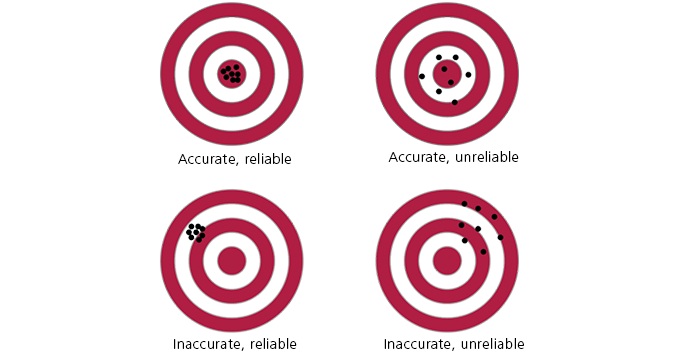
The target diagram is a useful memory aid, but write the terms carefully in an exam. The close grouping of dots represents precision within a set of measurements. In the NSW scientific-investigation framework, reliability is broader: it concerns whether findings agree when the experiment is repeated under the same or similar conditions.
Evaluating scientific investigations abridged
Read the NSW Department of Education’s concise definitions. This is the terminology to use when evaluating an investigation in Investigating Science.
In the opening overview and the “Definitions” section, read the key relationship between the four terms. Then study the four definitions. Focus particularly on the different scale of each term: one measurement compared with a reference value, repeated measurements within an experiment, repeated experiments, and the investigation’s actual question.
Errors explain the pattern
When results are precise but inaccurate, suspect a systematic error: a consistent bias in the method or equipment.
Examples include:
- a balance that was not zeroed before measuring mass
- a thermometer with a calibration fault
- reading every length from the damaged end of a ruler rather than from zero
Repeating these measurements may give an extremely consistent average, but it will still be wrong. Repetition does not correct a systematic error; the instrument or method needs correction.
Random errors vary unpredictably from one measurement to another. They cause scatter, reducing precision. Examples include judging an analogue scale slightly differently each time, reaction-time variation when using a stopwatch, or small fluctuations in room temperature. Repeating trials and calculating a mean can reduce the effect of random variation on the final estimate.
Reliability and validity: consistency is not enough
Here is the distinction to memorise:
| Term | The central question | A strong evaluation phrase |
|---|---|---|
| Accuracy | Is the value close to the accepted value? | “Accuracy was limited because…” |
| Precision | Do repeated measurements within this trial agree? | “The small spread indicates high precision.” |
| Reliability | Would repeated experiments produce similar findings? | “Reliability would improve if the investigation were repeated…” |
| Validity | Does the method actually test the stated aim? | “Validity was reduced because another variable could explain the outcome.” |
Reliability is about stability across repeated experiments. One group may obtain a clear trend in one practical, but the finding becomes more reliable when another group using the same method finds a similar trend.
Validity is the widest judgement. It asks whether the design gives evidence that genuinely answers the research question. A valid investigation needs a relevant aim, an appropriate dependent variable, and sufficient control of other possible causes.
Consider this investigation:
Aim: To investigate the effect of fertiliser concentration on the dry mass of bean plants after four weeks.
A class gives different groups different fertiliser concentrations. Their measurements are accurate and repeated carefully. However, the plants receiving the highest fertiliser concentration are placed beside a sunny window, while plants in the control condition are kept on a darker bench.
The measurements may be accurate and precise. The experiment may even be reliable if repeated in exactly the same flawed arrangement. Yet the conclusion “fertiliser caused the difference in dry mass” is not valid, because light exposure is a confounding variable. It changed with fertiliser concentration and could also have caused the difference in growth.
This is the key logic:
For validity, the method must isolate the IV sufficiently well that a change in the DV can reasonably be attributed to that IV.
A short evaluation method for exam responses
When you are given an investigation or data table, avoid writing a vague sentence such as “It was reliable because it was repeated.” Instead, make the claim, identify evidence or a methodological feature, and explain its consequence.
Use these sentence frames:
- Accuracy: “Accuracy may be reduced by ___ because this would cause measurements to be consistently/randomly different from the accepted value.”
- Precision: “The repeated values show a ___ spread, indicating ___ precision.”
- Reliability: “Reliability would be improved by repeating the entire investigation with additional trials/groups and comparing the overall trends.”
- Validity: “Validity is limited because ___ was not controlled; therefore, the observed change in ___ cannot confidently be attributed only to ___.”
For the fertiliser example, a complete validity statement could be:
The investigation has reduced validity because light intensity was not controlled between fertiliser treatments. Since light can affect plant growth, differences in dry mass cannot be confidently attributed solely to fertiliser concentration.
For your final five minutes, build this retrieval checklist without looking back at your notes:
- Write the question form: “effect of ___ on ___.”
- Label IV, DV and two CVs for a plant investigation.
- Define each of the four evaluation terms in one line.
- Write one improvement for a systematic error and one for random variation.
- Finish with: “A valid investigation tests its aim fairly.”
Wrap-up
You can now separate the ideas that are often confused:
- The independent variable is changed; the dependent variable is measured; controlled variables are held constant to reduce alternative explanations.
- Accuracy is closeness to a true or reference value.
- Precision is agreement among repeated measurements.
- Reliability is consistency of findings across repeated experiments.
- Validity asks whether the method genuinely tests the investigation’s aim and supports its causal conclusion.
The most important exam insight is that precise, repeatable data can still support an invalid conclusion if the method tests the wrong thing or leaves a confounding variable uncontrolled.
Your next Investigating Science session moves from observing cause and effect to inferences and generalisations: selecting appropriate graphs and distinguishing correlation from causation.
Can't find a good explanation? Sign up and we'll make it for you
Sign up