
Welcome to your first Biology Module 1 revision block. In the preceding Maths session, you practised showing evidence for each step and recording errors precisely; use the same approach here: identify a cell feature, state what it proves about the cell type, then connect it to a function.
For this 45-minute session, focus on two linked skills that commonly appear in Year 11 Biology short-answer and diagram questions:
- Distinguish prokaryotic cells from eukaryotic cells, and plant cells from animal cells.
- Relate major cell structures and organelles to what they allow the cell to do.
Have a blank page ready with the heading “Cell types and organelles”. You will build one comparison table and one quick organelle-function map that can become a revision sheet before prelims.
| Time | Focus |
|---|---|
| 4:40–4:45 | Retrieve the basic cell idea |
| 4:45–4:49 | Watch: prokaryotic vs eukaryotic cells |
| 4:49–4:58 | Classify cell types from their structures |
| 4:58–5:10 | Learn the major organelles through function chains |
| 5:10–5:20 | Apply the identification method to diagrams |
| 5:20–5:25 | Retrieval, marking, and error-log entry |
Begin with the biggest distinction: where is the DNA?
Cell theory states that living things are composed of cells, cells are the fundamental units of life, and cells arise from pre-existing cells. The first classification question is not “plant or animal?” It is:
Is this cell prokaryotic or eukaryotic?
The decisive feature is the treatment of DNA.
- A prokaryotic cell has DNA but no nucleus. Its main circular DNA molecule lies in a region of cytoplasm called the nucleoid. It also lacks membrane-bound organelles.
- A eukaryotic cell has DNA enclosed inside a nucleus, and it contains membrane-bound organelles with specialised functions.
Bacteria and archaea are prokaryotes. Animals, plants, fungi, and protists are eukaryotes. Therefore, both a plant cell and an animal cell are eukaryotic; they are not opposite categories.
Prokaryotic vs. Eukaryotic Cells (Updated)
Watch “Prokaryotic vs. Eukaryotic Cells (Updated)” by Amoeba Sisters for a compact visual overview of the shared features and decisive differences.
Watch the two groups to establish which organisms are prokaryotic or eukaryotic. Then watch shared features, noting that both cell types have DNA, ribosomes, cytoplasm, and a plasma membrane. Finish with key differences: nucleus, membrane-bound organelles, relative size, and chloroplasts in plant cells.
What both prokaryotic and eukaryotic cells share
Do not fall into the trap of treating prokaryotes as “cells with nothing in them.” They have essential structures:
| Structure | Present in prokaryotes? | Present in eukaryotes? | Core function |
|---|---|---|---|
| Cell or plasma membrane | Yes | Yes | Controls exchange between the cell and its environment |
| Cytoplasm | Yes | Yes | Internal fluid where many reactions occur |
| DNA | Yes | Yes | Stores genetic information |
| Ribosomes | Yes | Yes | Synthesise proteins |
Ribosomes are especially important: prokaryotes have ribosomes, despite having no membrane-bound organelles. Ribosomes themselves are not membrane-bound; they are protein-making structures found in every living cell.
Reading a cell diagram as biological evidence
Use a diagram as evidence, rather than attempting to memorise its overall shape. A bacterial cell may be drawn as a rod, a plant cell as box-like, and an animal cell as rounded, but these are simplified illustrations. In an exam, rely on labelled structures.

In the prokaryotic-cell diagram, notice the nucleoid. It contains DNA, but it is not enclosed by a nuclear membrane. This is the evidence that the cell is prokaryotic.
Some bacterial cells also have:
- a cell wall, which provides support and protection;
- a capsule, an additional protective outer layer;
- pili or fimbriae, which can help with attachment;
- a flagellum, which enables movement;
- plasmids, small rings of additional DNA.
These features are not necessarily present in every bacterium, so avoid writing that every prokaryotic cell has every labelled external structure.
Use this three-part exam sentence when identifying a cell:
This is a prokaryotic cell because it contains DNA in a nucleoid rather than in a membrane-bound nucleus. It also lacks membrane-bound organelles such as mitochondria and the Golgi apparatus.
The equivalent eukaryotic version is:
This is a eukaryotic cell because it has a nucleus enclosing its DNA and membrane-bound organelles, such as mitochondria and endoplasmic reticulum.
From eukaryote to plant or animal cell
Once you recognise a cell as eukaryotic, look for structures that distinguish plant and animal cells.
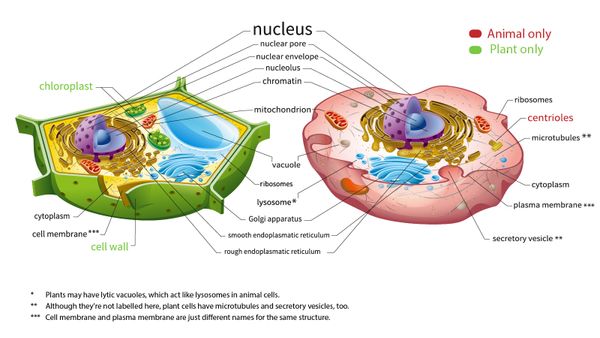
The most reliable plant-cell identifiers are:
- a cell wall outside the cell membrane;
- chloroplasts;
- a large, permanent central vacuole.
Animal cells do not have chloroplasts or cell walls. They may have smaller vacuoles, and animal cells commonly contain centrioles. However, if a question asks you to distinguish plant from animal cells, the clearest evidence is usually the presence or absence of a cell wall and chloroplasts.
Read the Macmillan Biology NSW Year 11 Teacher Support table to consolidate which structures occur in plant cells, animal cells, or both, and to connect each structure with a precise function.
Find Table 1.2.1, “Cell structures and organelles,” near the beginning of the extract. Read the full table. As you read, make three headings on your page: “both plant and animal,” “plant only,” and “animal mainly.” Pay closest attention to the wording of each function, especially for the cell membrane, mitochondrion, chloroplast, ribosome, endoplasmic reticulum, Golgi apparatus, and lysosome.
A classification table worth memorising
| Feature | Prokaryotic cell | Animal cell | Plant cell |
|---|---|---|---|
| Cell membrane | Yes | Yes | Yes |
| Cytoplasm | Yes | Yes | Yes |
| DNA | Yes, in nucleoid | Yes, in nucleus | Yes, in nucleus |
| Ribosomes | Yes | Yes | Yes |
| Nucleus | No | Yes | Yes |
| Membrane-bound organelles | No | Yes | Yes |
| Mitochondria | No | Yes | Yes |
| Cell wall | Usually present | No | Yes |
| Chloroplasts | No | No | Yes |
| Large central vacuole | No | No | Yes |
A high-value correction: plant cells have mitochondria as well as chloroplasts.
- Chloroplasts capture light energy to manufacture sugars during photosynthesis.
- Mitochondria release usable energy in the form of ATP through cellular respiration.
Plants photosynthesise, but their cells also need ATP continuously for processes such as active transport, growth, and protein synthesis.
Organelles make a cell a coordinated system
Membrane-bound organelles divide work into specialised compartments. Rather than learning an unconnected list, group organelles according to the problem they solve for the cell.
1. Controlling information and making proteins
The nucleus contains the cell’s DNA. DNA includes instructions for making proteins, which carry out or regulate most cell activities. It is reasonable to call the nucleus a control centre, but a stronger explanation is that it controls cell activity through genetic information.
The nucleolus, inside the nucleus, produces ribosomal subunits. Ribosomes then synthesise proteins.
For proteins that are used within membranes or exported from the cell, the pathway is commonly:
- Rough endoplasmic reticulum has ribosomes attached and helps synthesise, fold, and transport proteins.
- Golgi apparatus modifies, sorts, packages, and sends proteins or lipids to their destination.
- Vesicles are small membrane-bound sacs that transport materials.
This sequence explains why these organelles are often close together in a cell diagram: they cooperate in the production and delivery of cell products.
2. Releasing and storing energy
The mitochondrion is the main site of cellular respiration. It releases energy from glucose and transfers much of it into ATP, the cell’s immediately usable energy source.
Cells with high energy demands commonly contain many mitochondria. Muscle cells, for example, require substantial ATP to contract.
The chloroplast occurs in plant cells and is the site of photosynthesis. Chlorophyll absorbs light energy, allowing the cell to manufacture sugars from carbon dioxide and water.
Keep the comparison sharp:
| Organelle | Main process | Main result |
|---|---|---|
| Mitochondrion | Cellular respiration | ATP is produced for cell processes |
| Chloroplast | Photosynthesis | Sugars are manufactured using light energy |
3. Boundaries, support, digestion, and storage
The cell membrane surrounds the cell and is selectively permeable: it regulates which substances enter and leave. This function will become the focus of your next Biology session on membrane transport.
The cell wall lies outside the cell membrane in plant cells. It provides rigidity, support, protection, and a defined shape. It is not a replacement for the cell membrane: plant cells have both.
The vacuole stores water, dissolved substances, food, enzymes, and wastes. In mature plant cells, a large central vacuole also contributes to internal pressure, helping the plant remain firm.
Lysosomes contain digestive enzymes. They break down waste, foreign material, and damaged cell components. They are especially common in animal-cell diagrams; plants can perform comparable digestive functions through lytic vacuoles.
The smooth endoplasmic reticulum lacks ribosomes and is involved in producing lipids, including some steroids and hormones.
A reliable method for short-answer questions
When an exam question provides a diagram, micrograph, or description of an unknown cell, work through it in this order.
Step 1: Locate the DNA
- DNA enclosed in a nucleus: eukaryotic
- DNA in a nucleoid, with no nucleus: prokaryotic
Step 2: Identify plant-specific structures
Within a eukaryotic cell:
- Chloroplasts and a cell wall: plant cell
- No chloroplasts or cell wall: likely animal cell in a plant-versus-animal comparison
Step 3: Link one labelled structure to a specific function
Avoid vague answers such as “the mitochondrion gives energy” or “the nucleus controls the cell.” Improve them by including the biological process.
| Weak statement | Stronger exam statement |
|---|---|
| “Mitochondria give energy.” | “Mitochondria are the site of cellular respiration, producing ATP for cellular processes.” |
| “Chloroplasts help plants.” | “Chloroplasts are the site of photosynthesis, where light energy is used to manufacture sugars.” |
| “The membrane protects the cell.” | “The cell membrane is selectively permeable, controlling the movement of substances into and out of the cell.” |
| “Ribosomes make things.” | “Ribosomes synthesise proteins.” |
| “Golgi packages stuff.” | “The Golgi apparatus modifies, sorts, and packages proteins or lipids for transport.” |
For the final 5–10 minutes of this block, use your school worksheet, textbook questions, or a labelled cell diagram. Cover the labels and perform two quick retrieval passes:
- Identify the cell type using visible evidence.
- Name each major structure and state a precise function aloud or in a short phrase.
Mark any missed item with one of these error categories:
- Identification error: confused a prokaryote with a eukaryote.
- Presence error: placed a plant-only structure in an animal cell, or vice versa.
- Function error: named an organelle but could not state what it does.
- Precision error: gave a vague function rather than the process and outcome.
Wrap-up
Today’s central classification rule is:
A prokaryotic cell has no nucleus or membrane-bound organelles; a eukaryotic cell has both.
Plant and animal cells are both eukaryotic. Plant cells are distinguished most clearly by a cell wall, chloroplasts, and a large central vacuole. Both plant and animal cells contain a nucleus, mitochondria, ribosomes, endoplasmic reticulum, Golgi apparatus, a cell membrane, and cytoplasm.
For organelles, memorise functions as connected cell processes: the nucleus provides genetic instructions; ribosomes build proteins; the rough ER and Golgi process and transport them; mitochondria produce ATP; chloroplasts manufacture sugars; membranes regulate exchange; and lysosomes digest waste.
In the next Biology block, you will build directly on the cell membrane’s role by predicting membrane transport and explaining why cells need a high surface-area-to-volume ratio.
Can't find a good explanation? Sign up and we'll make it for you
Sign up