
Hello. In the previous lesson, you established Northstar Distribution Group’s transformation rationale: business drivers explain why change is needed, constraints define the boundaries, and intended outcomes describe the valuable results the enterprise expects.
This lesson adds the people and groups who give that rationale meaning. A transformation is not successful merely because workloads reach Azure or Microsoft 365 is deployed. It must address the concerns of leaders making investment decisions, warehouse teams maintaining fulfilment, security teams protecting access, operations teams supporting live services, and external parties relying on Northstar.
Focus: TOGAF Foundation terminology with direct workplace application.
Estimated study time: 40–45 minutes.
Stakeholders and concerns: the architecture communication starting point
A stakeholder is an individual, team, organization, or class of people with an interest in the architecture or its outcomes. They may fund it, govern it, build it, operate it, be affected by it, or impose obligations on it.
A concern is the particular question, risk, obligation, or desired condition that matters to that stakeholder.
These terms are deliberately broad. A stakeholder is not only an executive sponsor or a member of the IT department. For Northstar, a warehouse manager, a finance director, an application vendor, a key supplier, and a privacy adviser can all be stakeholders if the transformation affects their responsibilities or they can materially influence it.
The distinction matters:
| Item | Example | Why it is not the same thing |
|---|---|---|
| Stakeholder | Chief Operating Officer | The person or role with an interest and decision authority |
| Concern | “Will warehouse fulfilment continue safely while systems are migrated?” | The issue that matters to that stakeholder |
| Driver | Fragmented inventory data delays fulfilment decisions | The business pressure motivating change |
| Outcome | Leaders can act on trusted inventory exceptions within 30 minutes | The improved condition Northstar seeks |
| Requirement | Priority inventory updates must be available through monitored interfaces | A specific need the architecture must satisfy |
A driver may be shared by many stakeholders, but a concern is always understood through the perspective of a stakeholder. For example, Northstar’s data-center exit has different implications for different groups:
- The CFO is concerned about lease exposure, investment, and operating cost.
- The operations director is concerned about disruption to fulfilment.
- The security lead is concerned about preserving security controls during transitional hybrid operation.
- The application owner is concerned about whether a legacy system can move without unsupported changes.
The event is the same; the concerns are not.
The short introduction to Phase A below reinforces why TOGAF starts by identifying stakeholders and their concerns before detailed architecture work.
Introduction to TOGAF ADM: Phase A Architecture Vision
Watch “Introduction to TOGAF ADM: Phase A Architecture Vision” from VisualParadigm. It places stakeholder concerns in the context of Phase A, where the architecture effort seeks an agreed vision rather than an immediate technical design.
Watch the Phase A purpose to see why agreement with key stakeholders is essential before proceeding. Then watch stakeholder identification, focusing on the difference between people who can advance or block work and those who primarily need to be kept informed. We will develop influence and engagement analysis in the next module.
A practical principle follows:
Do not begin by asking which diagram to produce. Begin by asking whose decision, risk, or obligation the architecture must address.
Identify broadly before prioritizing
Early stakeholder analysis is an intentionally broad discovery activity. At this point, it is better to record a potentially relevant group and validate its significance than to omit a group whose concerns emerge later as a costly surprise.
TOGAF’s stakeholder categories provide a useful completeness check. They are not a rigid organizational chart; they prompt you to look beyond the most visible sponsors.
Module 9: Stakeholders, concerns, and viewpoints - Enterprise Architecture - Ransford's Notes
Read the relevant parts of Ransford’s Notes for a clear explanation of the stakeholder–concern relationship and a practical checklist of stakeholder categories. The later concepts of viewpoints and views are introduced only to show where this lesson fits; their detailed application comes in the next module.
In Section 9.1, read the purpose of stakeholder management. Then read the stakeholder and concern explanations in Section 9.2: the stakeholder definition and the concern definition. Use the category checklist in Section 9.3, reading the stakeholder categories. Finally, in Section 9.4, read the specificity test.
For Northstar, use five broad categories as a first pass:
| Category | Questions to uncover stakeholders |
|---|---|
| Corporate functions | Who sets strategy, owns investment, accepts enterprise risk, or must approve the transformation? |
| End-user organization | Who performs the business processes affected by new collaboration, inventory, and service capabilities? |
| Project and delivery organization | Who manages the programme, designs changes, owns work packages, and manages suppliers? |
| Systems operations | Who must support, monitor, secure, recover, and improve services after go-live? |
| External stakeholders | Who is affected through contracts, data exchange, regulation, audit, or service expectations? |
This list also exposes a common blind spot: treating “IT” as one stakeholder. The cloud platform team, service desk, security team, network team, application owners, data owners, and architecture team have related but different concerns. Combining them into one row makes the analysis less useful.
From generic labels to useful concerns
“Cost,” “security,” “risk,” and “user experience” are important topics, but by themselves they are not sufficiently precise concerns. They do not tell the architect what must be decided, evidenced, or represented.
Compare the following statements:
| Generic label | Decision-relevant concern |
|---|---|
| Cost | “Can Northstar exit the data center before lease expiry without creating an unplanned increase in cloud and supplier operating costs?” |
| Security | “Can external Microsoft 365 collaboration be enabled while preserving approved access, information protection, and auditability?” |
| Availability | “Which warehouse and order-management services require continuity during migration, and what disruption is acceptable outside peak periods?” |
| Data quality | “Can supply-chain leaders identify the authoritative inventory source and trust exception information quickly enough for fulfilment decisions?” |
| User experience | “Can distributed employees collaborate in approved workspaces without reverting to unmanaged file-sharing tools?” |
A good high-level concern has three characteristics:
- It belongs to a stakeholder or stakeholder group.
- It has a concrete decision, risk, or obligation behind it.
- It can eventually shape architecture work, such as the evidence to gather, the trade-off to make, or the requirements to derive.
At this early stage, concerns need not be phrased as detailed requirements. “Show the exact Azure configuration for identity” is too solution-specific. “Demonstrate how identities, privileged access, and external collaboration will remain governed across hybrid services” is an appropriate concern for a security stakeholder.
A practical stakeholder discovery method
Use the rationale register from the previous lesson as an input. For each driver, constraint, and intended outcome, ask four questions:
-
Who experiences the problem or expected benefit?
This identifies operational users, customers, and business owners. -
Who owns the decision, budget, or risk acceptance?
This identifies sponsors, executives, finance, and governance roles. -
Who must deliver or operate the change?
This identifies delivery teams, service owners, application owners, and IT operations. -
Who can impose an external obligation or is dependent on the outcome?
This identifies regulators, auditors, vendors, suppliers, partners, and customers.
Do not assume that one stakeholder has only one concern. The CFO may care about both cost predictability and the timing of lease commitments. A business unit leader may care about inventory visibility, staff adoption, and continuity during peak periods.
The Microsoft Teams adoption model below illustrates another important point: adoption and transformation often require both central coordination and local representation. The local champions are not merely a communications channel; they provide evidence about practical usability, training needs, and the realities of day-to-day work.
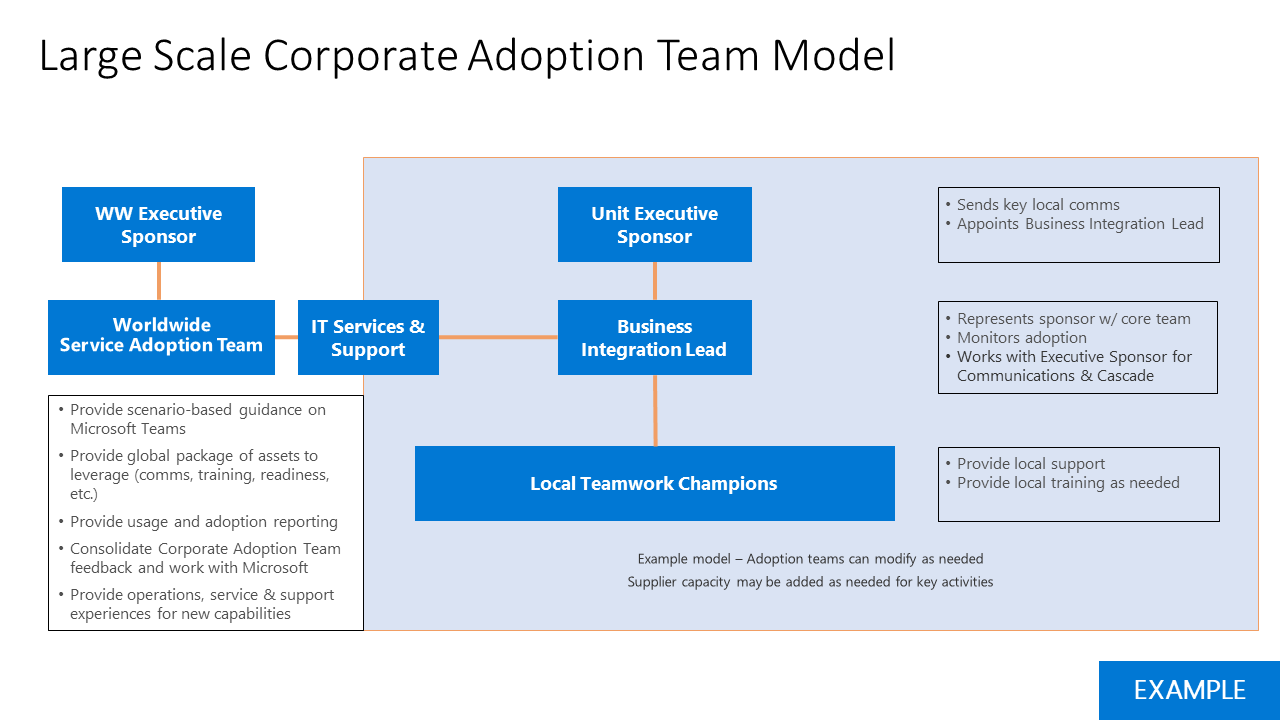
Northstar should not copy this structure literally. However, it should recognize that a Microsoft 365 transformation cannot be understood only through central IT and executive stakeholders. Business integration leads, service owners, local operational leaders, and representative users will reveal concerns that a central programme team may not see.
Northstar’s initial stakeholder and concern register
The following is a deliberately high-level register for the case study. It is not a final stakeholder map, a RACI matrix, or a communications plan. Those artifacts will be developed later. Its purpose is to ensure that the Architecture Vision begins with the people, decisions, and concerns that determine whether the transformation is viable.
| Stakeholder group | High-level concerns |
|---|---|
| Executive sponsor, board, and executive leadership | Is the transformation justified by business outcomes, risk reduction, and strategic value? What investment and disruption are being accepted? Can Northstar exit the data center before the lease deadline? |
| COO, warehouse leaders, and customer-service leadership | Will order fulfilment and warehouse operations remain reliable throughout change? Will trusted inventory information improve exception handling and customer communication? |
| CFO, finance, and procurement | What are the full transition and operating costs, including cloud consumption, contracts, support, and skills? Which benefits are measurable, and when will they be realized? |
| CIO and IT leadership | Does the target direction reduce the current technology burden without creating an unmanageable hybrid estate? Are architecture standards, delivery capability, and sequencing realistic? |
| Cybersecurity, identity, and risk management | Can Northstar protect identities, privileged access, sensitive data, and external collaboration across on-premises services, Azure, and Microsoft 365? Can risks be monitored and evidenced? |
| Privacy, legal, compliance, and internal audit | Are privacy, retention, residency, contractual, and audit obligations identified and demonstrably met for enterprise information and collaboration content? |
| Data owners and business data stewards | Which systems are authoritative for priority inventory and supplier information? How will data quality, ownership, access, and lifecycle responsibilities be governed? |
| Application owners, integration teams, and key software vendors | Which legacy dependencies prevent simple migration or retirement? Can applications integrate with shared identity, data, and monitoring services without unacceptable change risk? |
| Cloud platform, network, service-management, and support teams | Can the hybrid environment be connected, monitored, backed up, recovered, and supported using capabilities Northstar can sustain? What operational responsibilities change? |
| Microsoft 365 service owner, business users, and local champions | Will approved collaboration services be usable enough to replace inconsistent tools? How will external sharing, information protection, training, and adoption be handled in practice? |
| Suppliers, logistics partners, and customers | Will data exchange, order information, and service continuity remain dependable during transition? Will changes to collaboration or interfaces create new burdens for partners? |
| External auditors or applicable regulators | Can Northstar demonstrate that required controls, data-handling obligations, and service commitments are being met? |
Several observations are worth making.
First, some stakeholders hold potentially conflicting concerns. Operations may seek minimal disruption and maximum resilience. Finance may seek tightly controlled cost. Security may require strong governance of external sharing, while business teams may need fast, low-friction partner collaboration. Architecture makes these tensions visible so that accountable leaders can make informed trade-offs.
Second, a stakeholder group is not necessarily a single person. “Warehouse leaders” may initially be a useful group, but Northstar would eventually identify named accountable owners for priority processes and services.
Third, external stakeholders matter even if they do not attend workshops. A supplier may not join the Architecture Vision meeting, but its integration and data-exchange needs may materially constrain the design. An auditor may not decide the target architecture, but evidence expectations can affect requirements and governance.
Governance stakeholders are especially important in hybrid cloud
Hybrid-cloud transformation changes the boundary between traditional infrastructure, cloud platform teams, application teams, security functions, finance, and business owners. If their responsibilities are unclear, controls can be duplicated, omitted, or treated as someone else’s problem.
Microsoft’s Cloud Adoption Framework emphasizes that cloud governance needs participation from IT, finance, operations, security, and compliance—not only cloud engineers.
Build a cloud governance team - Cloud Adoption Framework | Microsoft Learn
Read the relevant sections of Microsoft Learn’s Cloud Adoption Framework guidance to see how cross-functional governance representation supports cloud adoption without preventing business progress.
In “1. Define the team’s function,” read the engagement rationale. Then read “2. Select team members,” from the team-composition guidance. Focus on why IT operations, cloud architecture, security, compliance, finance, and application development bring distinct perspectives. Do not attempt to design Northstar’s governance structure yet; that is a later module.
For this lesson, the central takeaway is that governance is itself a stakeholder concern. The security team may need enforceable controls; finance may need cost accountability; delivery teams may need standards that are clear enough to use without excessive delay. Effective architecture recognizes all three.
Keep the register alive
A stakeholder register is not a one-time workshop output. It should evolve as Northstar discovers dependencies, confirms constraints, and chooses transition architectures.
Maintain its quality through three habits:
- Record the source of each concern. Was it raised by a sponsor, identified in a contract, found in an operational incident review, or inferred from a baseline assessment?
- Separate facts from assumptions. “The warehouse application supports modern identity” may be an assumption requiring vendor validation, not an established fact.
- Identify the decision behind the concern. A concern is useful when it helps determine what must be approved, investigated, designed, funded, or accepted as a risk.
At this stage, do not try to satisfy each concern with a single giant enterprise diagram. Different concerns will ultimately need different architecture representations, at different levels of detail. The next module examines how to assess stakeholder influence and interest, choose engagement approaches, and later select appropriate viewpoints.
Key takeaways
- A stakeholder is an individual, team, organization, or group with an interest in, influence over, or exposure to architecture outcomes.
- A concern is the specific decision, risk, obligation, question, or outcome that matters to that stakeholder.
- Stakeholder identification must extend beyond executives and IT to end users, operations, finance, security, data owners, delivery teams, suppliers, customers, auditors, and regulators where relevant.
- Broad labels such as “cost” and “security” must be refined into decision-relevant concerns that can guide architecture work.
- Northstar’s stakeholder register connects the previous lesson’s drivers, constraints, and intended outcomes to the people who own decisions, deliver change, run services, and experience the results.
- Stakeholder concerns often conflict. Making those tensions explicit is a core contribution of enterprise architecture.
Next, you will use these stakeholder groups and concerns to draft a concise architecture problem statement for Northstar’s transformation.
Can't find a good explanation? Sign up and we'll make it for you
Sign up