
Welcome back. In the previous lesson, you used grouping to uncover a common binomial factor in a four-term polynomial. This lesson takes a different structural approach: rather than rearranging terms, you will temporarily rename a repeated expression so that a high-degree polynomial becomes an ordinary quadratic.
The goal is to recognize quadratic form, choose a useful substitution, factor the resulting quadratic using the methods you already know, and then substitute back without losing the original structure. This is a particularly important bridge toward more systematic polynomial factoring later in the module.
Seeing a quadratic hidden inside a polynomial
An expression has quadratic form if it can be viewed as
where is a repeated expression involving the original variable and .
The capital is a placeholder. It might stand for:
- a power such as , , or ;
- a binomial such as ;
- another repeated algebraic expression.
For example,
does not look like the usual quadratic
But the exponent pattern reveals the connection:
If we let
then the original expression becomes
That is a familiar quadratic trinomial.
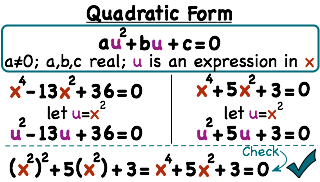
The most reliable recognition question is:
Is the variable expression in the first term the square of the variable expression in the middle term?
For powers of , this usually means the exponents follow the pattern
Thus, each of these has quadratic form:
because ;
because ;
and
because the repeated binomial is squared in the first term and appears to the first power in the middle term.
By contrast,
does not have quadratic form in a single power of : if , then , but the middle term would need to involve , not .
Read: the substitution idea
6.5.4 Factoring Trinomials Using the “ac” Method and Substitution - Algebra 1 | OpenStax
OpenStax gives a concise account of quadratic form and works through both a power substitution and a binomial substitution. Read it to reinforce the key structural test before applying the method yourself.
In the subsection “Factoring Trinomials Using Substitution,” read from the explanation that begins the recognition rule through Example 2, “Factor by substitution: x^4-4x^2-5.” Focus on why u=x^2, rather than u=x, makes the expression quadratic. Then continue to the “Try It: Factoring Trinomials Using Substitution” discussion in the next relevant section, where the repeated expression is the binomial x-2. Notice that expanding the binomial first is possible but unnecessary.
The substitution routine
Once you see quadratic form, use this consistent sequence.
- Check for a GCF first. Factor it out before doing anything else.
- Choose to be the expression in the middle term.
- Rewrite the leading term explicitly as , if helpful.
- Factor the quadratic in using ordinary trinomial methods.
- Replace every with the original expression.
- Continue factoring any factors that now fit a previous identity, such as difference of squares.
- Check by multiplying the factors back together.
The essential idea is that substitution does not change the polynomial. It only gives a repeated expression a shorter name.
Example: a non-monic quadratic form
Factor completely over the integers:
The middle expression is , and the leading variable part is its square:
Let
Then
Now factor the quadratic. Since
we need two numbers with product and sum . They are and . Split the middle term and factor by grouping:
Finally, replace with :
A check confirms the middle term:
The factoring work here was not fundamentally about an eighth-degree polynomial. After the substitution, it was the same quadratic-trinomial work you have already practiced.
When the repeated expression is a binomial
Quadratic form is not limited to even powers of . In fact, substitution is especially efficient when the repeated quantity is already grouped.
Factor:
Do not expand . The expression already advertises its repeated unit:
Substitute:
Factor the quadratic:
Now restore the original expression carefully:
Simplify each factor:
Parentheses matter during substitution back. Writing the intermediate form as
makes it clear that the whole expression , not just the , replaces .
Watch: recognizing the structure quickly
Factoring Trinomials in Quadratic Form
In “Factoring Trinomials in Quadratic Form,” Mario’s Math Tutoring gives a short visual explanation of the exponent pattern and then applies substitution to a repeated binomial.
Watch the recognition test for the idea that the middle expression has half the exponent of the leading expression. Then skip to the binomial example. Focus on the choice u=x+3, the ordinary quadratic factoring step, and the final substitution back into the factors.
Factor completely: substitution can reveal another pattern
Substitution is often only the first stage. Once you substitute back, inspect the factors using all the identities from this module.
Consider
Let
Then
Factor the quadratic:
Substitute back:
At this point, both factors are differences of squares:
Two of those new factors are differences of squares again:
Therefore, the complete factorization over the integers is
The important habit is this: a successful substitution factorization is not automatically complete. Check the factors you get back in terms of .
Combining GCF, substitution, and special products
The overall factoring strategy from this module still applies:
First look for a GCF. Then look for a structure.
Factor
Every term has a common factor of :
Now the expression in parentheses has quadratic form. Let
Then
Factor:
Substitute back:
Factor the differences of squares:
So the fully factored result is
This one expression uses several module skills in their natural order: GCF first, quadratic-form substitution second, then special-product identities.
A compact decision guide
When you face a trinomial with high exponents or repeated parentheses, use this checklist.
| Question | What to do |
|---|---|
| Do all terms share a GCF? | Factor the GCF first. |
| Is the leading variable expression the square of the middle expression? | Let equal the middle expression. |
| Does the substitution yield ? | Factor it as an ordinary quadratic. |
| Have you replaced everywhere? | Restore the original expression in every factor. |
| Do the restored factors fit a special pattern? | Continue factoring. |
| Are you unsure about signs? | Expand the final product to verify. |
A useful warning: do not choose a substitution merely because an exponent is large. The substitution has to make the entire trinomial behave like a degree-two expression in one repeated unit.
Key takeaways
A polynomial has quadratic form when it can be rewritten as
with the same expression appearing in the squared leading term and the middle term.
To factor it:
- factor out a GCF first, if one exists;
- set equal to the repeated middle expression;
- factor the resulting quadratic in ;
- substitute the original expression back in;
- inspect the result for further factoring.
For instance,
becomes
after setting , and therefore factors as
Next, you will shift from recognizing factorable patterns to identifying possible rational zeros of a polynomial using the Rational Root Theorem. That theorem gives a disciplined way to search for factors when no familiar visual pattern is apparent.
Can't find a good explanation? Sign up and we'll make it for you
Sign up