
Good to see you again. Last time, you factored quadratic trinomials with a non- leading coefficient by finding a pair whose product is and whose sum is , then using grouping. That remains an important general-purpose method. Today adds two shortcuts: patterns whose factors can be recognized directly.
The aim is not merely to memorize formulas. You will learn to diagnose when an expression is a difference of squares or a perfect-square trinomial, factor it completely, and distinguish these patterns from expressions that only look similar.
Special products, reversed
Factoring reverses expansion. The three expansions behind this lesson are:
Here and can stand for numbers, variables, or more complicated algebraic expressions. The key structural features are:
- A perfect-square trinomial has three terms. Its first and last terms are squares, and its middle term must be exactly twice the product of their square roots.
- A difference of squares has two terms, is a subtraction, and both terms are squares.
Watch this compact review from Math and Science. It treats factoring as the reverse of multiplying binomials, which is the right way to remember why the patterns work rather than treating them as unrelated rules.
07 - Factoring Perfect Square Trinomials & Factoring the Difference of Two Squares
Watch “07 - Factoring Perfect Square Trinomials & Factoring the Difference of Two Squares” from Math and Science for a focused introduction to both patterns.
Watch difference of squares to see the opposite-sign factors, then perfect squares for the two trinomial patterns. Focus especially on the source of the middle term: it is either cancelled completely or produced twice.
The expansion below makes the “twice the product” condition visible. Squaring a binomial means multiplying it by itself, so the two cross-products are equal and combine into .
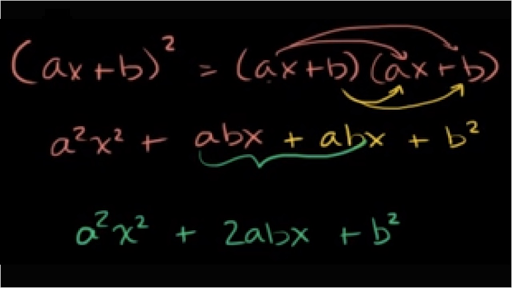
Perfect-square trinomials: the middle term is the test
The two patterns are:
To identify a perfect-square trinomial reliably, do not begin by guessing its factors. Use this three-part test:
- The first term must be a perfect square.
- The last term must be a perfect square.
- The middle term must equal twice the product of the square roots of the first and last terms, including its sign.
Consider
The first term is a square:
The last term is also a square:
Now test the middle term:
The expression’s middle term is , so the subtraction version of the identity applies:
A quick expansion confirms the result:
The sign of the middle term determines the sign inside the squared binomial:
| Original trinomial | Factored form |
|---|---|
A near miss
It is not enough for the first and last terms to be squares. For example,
has square endpoints:
But the required middle term would be
not . So this is not a perfect-square trinomial. This check prevents a common mistake: forcing , which would expand to a different polynomial.
Difference of squares: subtraction plus two squares
A difference of squares has the form
It factors as
The two binomial factors contain the same terms but opposite signs. When expanded, their cross-products cancel:
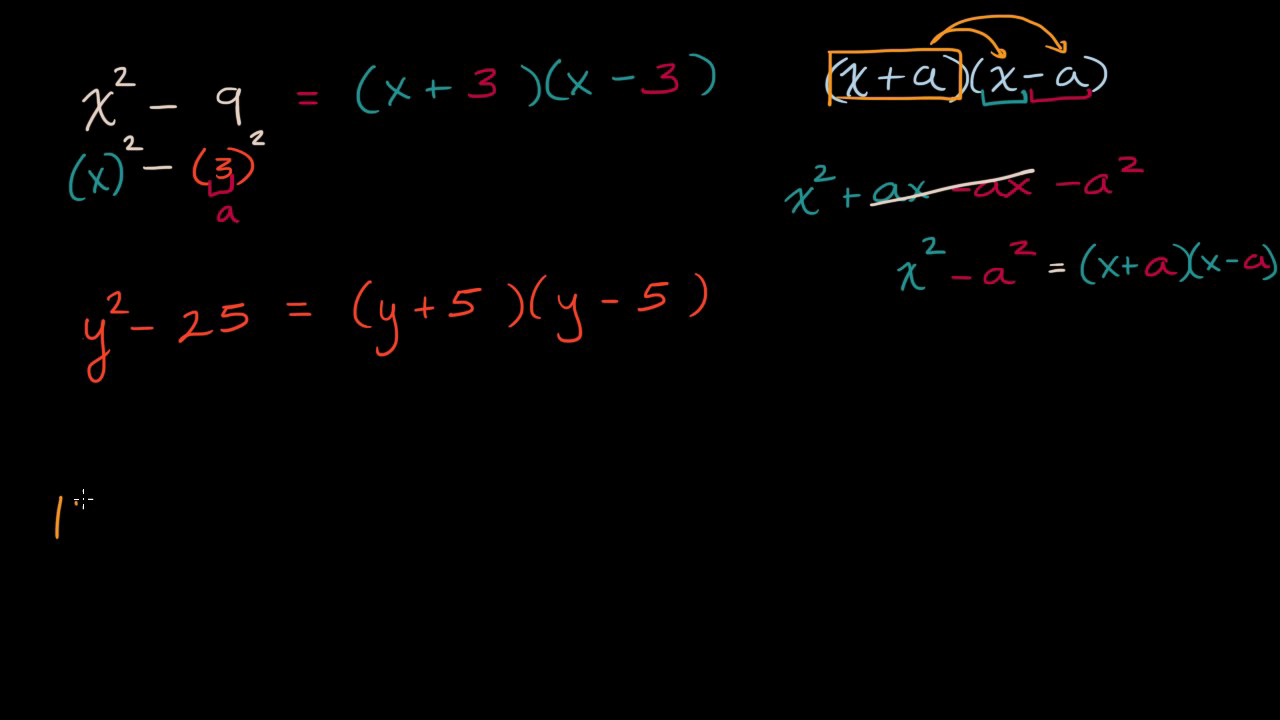
For example, factor
Write each term as a square:
Because the terms are subtracted, use one sum factor and one difference factor:
The order of those two factors does not matter.
A useful point: the “square bases” do not have to be single variables. For instance,
is also a difference of squares, with
Therefore,
What does not work
A sum of squares does not use this identity:
cannot be factored using real or integer coefficients in general. In particular,
is not
because those factors expand to
The sign is decisive:
- subtraction of squares: potentially factorable;
- addition of squares: not factorable by these identities over the integers or reals.
Factor the GCF first, then keep looking
The first principle from the previous lesson still governs every factoring problem:
Extract the greatest common factor before applying any special pattern.
Consider
The terms share a GCF of :
Now inspect the trinomial inside parentheses:
and
It is a perfect-square trinomial:
Thus the complete factorization is
Stopping at would be incomplete.
The other habit to build is to check whether a new factor can itself be factored. For example,
is a difference of squares because
The first factorization is
But the second factor is also a difference of squares:
So the complete factorization over the integers is
The factor is a sum of squares, so it stops there in the current number system.
This short segment from The Organic Chemistry Tutor reinforces both habits: take out a GCF before using a special identity, and check the resulting factors for another difference of squares.
How To Factor Difference of Squares - Algebra
Watch “How To Factor Difference of Squares - Algebra” from The Organic Chemistry Tutor for examples that require more than a single application of the identity.
Watch GCF first for the essential first move in expressions such as 3x^2-27. Then watch repeat factoring to see why expressions involving fourth powers may require a second difference-of-squares step. Pause before each worked example and identify the two square bases yourself.
A compact recognition routine
When asked to factor, use this order rather than choosing a technique at random.
-
Extract a GCF. Keep it outside the remaining factors.
-
Count the remaining terms.
- With two terms, check whether they are squares separated by subtraction.
- With three terms, check whether the endpoints are squares and whether the middle term is twice their product.
-
Apply the matching identity.
- Difference of squares gives two conjugate factors.
- A perfect-square trinomial gives one binomial squared.
-
Factor again if possible. In particular, inspect factors containing even powers or a fresh difference of squares.
-
Expand to verify. This confirms signs, coefficients, and completeness.
A quick comparison makes the patterns easier to separate:
| Expression | Classification | Factorization |
|---|---|---|
| Difference of squares | ||
| Sum of squares | Does not factor over the integers or reals | |
| Perfect-square trinomial | ||
| Perfect-square trinomial |
The last two expressions have the same first and last terms. The middle-term sign determines whether the repeated factor contains or .
Key takeaways
Two special identities make factoring much faster when their structure is present:
To use them accurately:
- factor out a GCF before looking for patterns;
- for a difference of squares, require two squares and subtraction;
- for a perfect-square trinomial, require square endpoints and a middle term equal to twice their product;
- do not mistake a sum of squares for a difference of squares;
- continue factoring after the first successful step;
- expand your final answer as a check.
Next, you will extend special-product factoring to sums and differences of cubes, whose patterns look similar at first but use a different structure.
Can't find a good explanation? Sign up and we'll make it for you
Sign up