
Hello, and welcome to the course. We begin by reinforcing a factoring habit that will support nearly every algebra topic ahead: before trying any special factoring method, first look for a greatest common factor.
In this first module, you will build a reliable factoring toolkit for polynomials. Today’s goal is narrow but foundational: extract the greatest common factor (GCF) from every term, including numerical factors, variable factors, and occasionally an entire shared binomial. This is the reverse of the distributive property, and it is the first scan to make whenever you are asked to factor.
Factoring is reverse distribution
Distribution expands a product:
Factoring reverses that process. Starting with the polynomial, we identify what every term shares and write it once outside parentheses:
The expression outside the parentheses is the greatest common factor. It must divide every term with no remainder.
A GCF can include:
- a number, such as ;
- one or more variables, such as ;
- a negative sign, when that makes the remaining expression clearer;
- an already-grouped expression, such as .
The word greatest matters. Factoring out from the example above is legal, but incomplete:
Because is still common to every term inside the parentheses, this is not fully factored with respect to the GCF. Prefer the largest shared factor, , immediately.
How to find the GCF systematically
For a polynomial with several terms, find the GCF in two layers.
- Find the GCF of the numerical coefficients.
- For each variable shared by all terms, use its smallest exponent.
- Multiply these pieces together.
For example, consider
Numerical part
The greatest common factor of , , and is .
Variable part
Every term contains , with exponents , , and . The smallest exponent is , so include .
Every term also contains , with exponents , , and . The smallest exponent is , so include .
Thus,
Now divide each entire term by :
So the factored form is
A useful way to remember the variable rule is this: a factor must fit into every term. The largest power of that fits into both and is , not .
If a variable is missing from even one term, it is not part of the GCF. For instance, is not a common factor of , because the final term has no .
A visual model: shared prime and variable factors
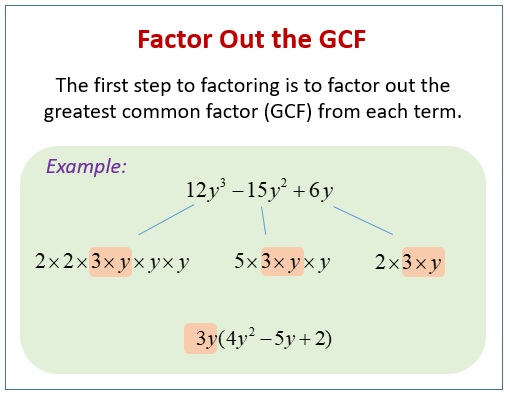
The image illustrates an important principle: a common factor is something present in every term. In
the coefficients share , while the variable portions share one . Therefore,
Notice what changes inside the parentheses:
When variable powers are divided, subtract exponents:
provided the expression is defined. Here, for example,
Watch the core method in action
How To Factor The Greatest Common Factor In a Polynomial | Algebra
Watch “How To Factor The Greatest Common Factor In a Polynomial” from The Organic Chemistry Tutor. It develops the practical routine for numerical GCFs, minimum variable exponents, multi-term expressions, and shared binomial factors.
Start with basic GCFs. Focus on the distinction between finding the greatest numerical divisor and choosing the smallest exponent shared by all terms. Then watch trinomials, where the same method is applied to expressions with three terms. Notice that extracting a GCF may be the final result for the moment; do not force a different factoring method if none is evident. Finish with shared binomials. Treat a repeated parenthetical expression as one complete factor, not as several unrelated terms.
A dependable factoring routine
Use this procedure every time, even when the expression appears to be designed for another factoring method.
1. Identify the terms
Terms are separated by addition or subtraction signs at the outermost level.
For example, the terms of
are , , and .
2. Find the numerical GCF
The GCF of , , and is .
3. Find the variable GCF
All terms contain , with minimum exponent .
All terms contain , also with minimum exponent .
Therefore, the full GCF is
4. Divide every term by the GCF
5. Write the product
A compact check is to distribute back across the parentheses. If each original term reappears with the right sign and exponent, the factorization is correct.
Choosing a negative GCF
When a polynomial begins with a negative term, it is often best to factor out a negative GCF. This is not strictly required, but it usually makes later factoring more readable because the first term inside the parentheses becomes positive.
Consider
The numerical and variable GCF is . Factoring out positive gives
This is correct. But factoring out gives
This is usually preferable because the polynomial inside begins with , rather than .
Be particularly attentive to signs while dividing:
The two negative signs in the last division produce a positive result.
The following equality confirms the result:
The GCF can be a whole expression
So far, the common factor has been a monomial, such as . But a repeated binomial or larger parenthetical expression can also be a GCF.
Consider:
There are two outer-level terms:
Both terms contain the complete factor . Factor it out:
The key is to preserve the parentheses. The shared factor is , not merely or .
A slightly richer example shows why GCF extraction should always happen first:
The shared factor is , so first write
Combine like terms inside:
There is now another GCF, , inside the remaining binomial:
This illustrates an important habit: after factoring out one common factor, look once more. Simplifying or combining terms can expose an additional factor.
“Factor out the GCF first” is a strategy, not a cosmetic rule
Later lessons will cover quadratic trinomials, difference of squares, cubes, grouping, and other patterns. Those methods are easier and less error-prone when any GCF has already been removed.
For instance, in an expression like
the first step is not to focus on its two terms as a special pattern. First extract the numerical GCF:
Only then inspect the remaining factor for a later factoring pattern.
The practical rule is:
Before using any named factoring technique, check whether every term has a nontrivial common factor.
This creates a standard form of “factored completely”: no common factor remains outside the parentheses, and any factorization method appropriate to the remaining expression can be applied afterward.
Common mistakes and fast checks
| Mistake | Why it fails | Better habit |
|---|---|---|
| Factoring out a factor that is not in every term | The expression no longer expands back to the original polynomial. | Test divisibility term by term. |
| Using the largest exponent rather than the smallest | A large power may not divide a lower-power term. | Use the minimum exponent shared across all terms. |
| Ignoring a common variable factor | The result is only partly factored. | Check numbers and variables separately. |
| Losing signs while dividing | One incorrect sign changes the expression. | Divide each signed term explicitly. |
| Stopping after a partial factor | A common factor might remain inside. | Scan the parenthetical expression once more. |
| Treating as unrelated pieces | The repeated binomial is a single shared factor. | Look for identical parenthetical groups. |
Two checks catch nearly every error:
- Division check: Does the proposed GCF divide each original term?
- Distribution check: Does multiplying the factors reproduce the original polynomial exactly?
Key takeaways
Factoring out a GCF is reverse distribution. To do it reliably:
- find the greatest common divisor of the coefficients;
- include each variable that appears in every term, using its smallest exponent;
- divide each term by the complete GCF;
- factor out a negative when it produces a cleaner leading term inside;
- recognize that a shared parenthetical expression can be the GCF;
- check for a GCF before every other factoring method.
Next, you will use this habit as a first step while factoring quadratic trinomials whose leading coefficient is not .
Can't find a good explanation? Sign up and we'll make it for you
Sign up