
Welcome back. Last time, you used the Rational Root Theorem to make a candidate list: every rational zero must appear there, but most candidates may fail. This lesson supplies the efficient testing and factoring tool: synthetic division.
The central idea is compact but powerful: once you have identified a zero , synthetic division divides the polynomial by . If the final entry is , the division is exact, and you have exposed a genuine factor. You can then factor the lower-degree quotient using the methods from this module.
This is the final lesson in the factoring-and-polynomial-fluency module. Plan on about 35–45 minutes, including the short video and writing out the examples yourself.
A zero tells you which factor to divide by
The key fact is the Factor Theorem:
A number is a zero of exactly when is a factor of .
The sign relationship deserves deliberate attention:
| Identified zero | Corresponding factor | Number used in synthetic division |
|---|---|---|
So if the known zero is , do not place in the synthetic-division setup. You use , because the divisor is
Why does the final synthetic entry matter? Polynomial division says that for some quotient and remainder ,
Substituting makes the first term vanish:
Thus, the remainder is precisely the value of the polynomial at the tested candidate. A remainder of means , so is a zero and is a factor.
Factor Theorem and Synthetic Division of Polynomial Functions
Watch “Factor Theorem and Synthetic Division of Polynomial Functions” from The Organic Chemistry Tutor for a concise visual demonstration of the zero–factor connection and the synthetic-division routine.
In the opening example, watch the division setup. Focus on why the known zero 3 corresponds to the factor x-3, and how the bottom row becomes a quadratic quotient. Then watch factoring the quotient, where the resulting quadratic is factored to complete the original cubic’s factorization.
The synthetic-division routine
Suppose you know that is a zero of
Because is a zero, must be a factor. To divide by , set up synthetic division using and the coefficients of the polynomial:
Read this in a fixed cycle:
- Bring down the first coefficient, .
- Multiply it by the number on the left, , obtaining .
- Add within the next column: .
- Repeat the multiply-and-add cycle until the final column.
The bottom row has two jobs:
- Every entry except the last is a coefficient of the quotient.
- The final entry is the remainder.
Since the original polynomial had degree , the quotient has degree :
The last entry is , confirming the exact division:
Now return to the factoring techniques already developed. The quadratic factors as
Therefore, the complete factorization is
The three zeros are consequently
Notice the efficient division of labor:
- The Rational Root Theorem helped locate or justify trying .
- Synthetic division removed the factor .
- Ordinary quadratic factoring finished the problem.
Once a quotient is quadratic, it is generally more efficient to factor it directly than to keep testing rational-root candidates.
Reading a synthetic-division result correctly
The following example tests whether is a zero of
Because the zero being tested is , the possible factor is
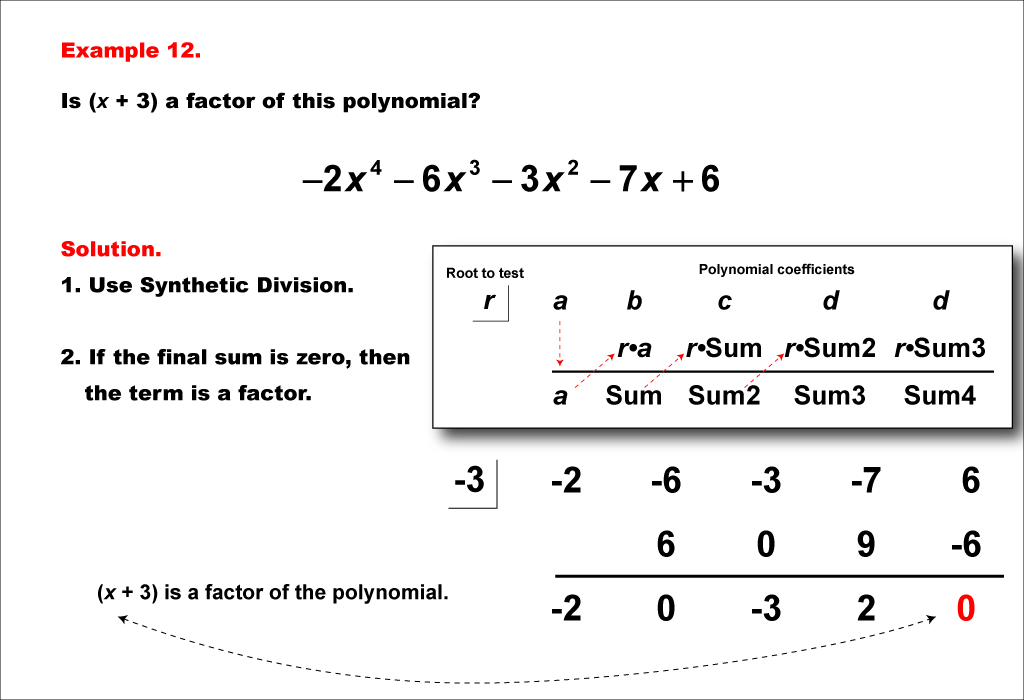
The bottom row is
The polynomial began with degree , so the first four bottom-row entries are the coefficients of a cubic quotient:
Write the zero coefficient when interpreting the result, even if you later simplify its appearance:
Since the remainder is zero, the factorization obtained from this synthetic division is
This is already a correct factorization. The cubic quotient does not factor over the integers, so there is no further integer factoring to perform.
A remainder other than zero gives a different conclusion. For example, if testing a candidate produces a remainder of , then:
so is not a zero and is not a factor. Cross that candidate off the Rational Root Theorem list and test another plausible value.
Two safeguards that prevent most errors
Include zeros for missing powers
Synthetic division works entirely with coefficients. Therefore every power must have a coefficient represented, even when that coefficient is .
Consider
There is no -term and no -term, so its coefficient list is not . It is
Suppose has been identified as a zero. The correct setup is
Therefore,
The cubic quotient can be factored by grouping:
So, over the integers,
If you omit either zero coefficient, every subsequent column is shifted and the quotient will be incorrect.
Treat fractional zeros with care
Synthetic division still works when the identified zero is a fraction. Suppose
has the zero
Use on the left:
The quotient is
The exact result supplied by synthetic division is
To write integer-coefficient factors, rewrite both parts carefully:
and
The factors and cancel, giving
Finally,
so
A common mistake is to write
That product is twice the original polynomial, so it is not a valid factorization. When clearing a fraction from a linear factor, always account for the compensating constant.
A practical workflow after the Rational Root Theorem
When you face a polynomial that does not factor visibly, use this sequence:
- Factor out a GCF first, if one exists.
- Use the Rational Root Theorem to list possible rational zeros.
- Select a candidate and test it with synthetic division.
- If the remainder is nonzero, reject that candidate.
- If the remainder is zero, write the polynomial as
- Factor using familiar methods: GCF, grouping, quadratic factoring, a special identity, or another round of synthetic division if needed.
- Check that the factor degrees add to the original degree. A cubic should end with total factor degree ; a quartic should end with total factor degree .
A concise setup checklist is:
- Use the zero at the left, not the factor’s displayed sign.
- Write all coefficients in descending-power order.
- Insert for every missing power.
- Treat the final bottom-row entry as the remainder.
- Interpret all earlier bottom-row entries as coefficients of a quotient one degree lower.
Key takeaways
Synthetic division is a compressed form of division by . Its last entry is the remainder, which is also . Therefore:
The rest of the bottom row gives the quotient, which you then factor with the methods from this module. The two procedural hazards to watch most closely are omitted zero coefficients and the scaling required when converting a fractional-root factor into integer-coefficient form.
You have now completed the core factoring toolkit for Algebra II polynomial work. The next module shifts to rational expressions, beginning with their domain restrictions: identifying the values that make a denominator equal to zero.
Can't find a good explanation? Sign up and we'll make it for you
Sign up