
Hello! Welcome to our penultimate lesson in this course.
In our last session, we examined the challenge posed by classical mechanics to the Aristotelian causal framework. We concluded that Newton's principle of inertia does not, in fact, invalidate the principle that change requires a concurrent cause. The apparent conflict dissolves when we recognize the different levels of explanation (physics vs. metaphysics) and the equivocation on the term "motion." We saw that Newton's laws are perfectly compatible with a hierarchical, sustaining cause, with the action of the mover being located in the forces that produce acceleration.
Today, we confront what is widely considered a more profound challenge to classical metaphysics. We will move from the clockwork universe of Newton to the strange, probabilistic world of quantum mechanics. Our learning outcome is to evaluate challenges to classical causal principles from quantum mechanics, such as quantum indeterminacy and virtual particles.
This topic is at the frontier where physics and philosophy meet. Given your background in statistical science and interest in epistemology, you are in an excellent position to navigate the intricate arguments involved. We will dissect the objections and explore a compelling, if counter-intuitive, line of thought: that quantum mechanics, far from refuting Aristotle, may in fact be more congenial to his metaphysics than the classical worldview it replaced.
1. The Quantum Objection: A Breakdown in Causality?
At first glance, the quantum world seems to be a realm where the classical principle of causality—that every change or effect has a cause—breaks down entirely. Several phenomena are typically cited as evidence for this.
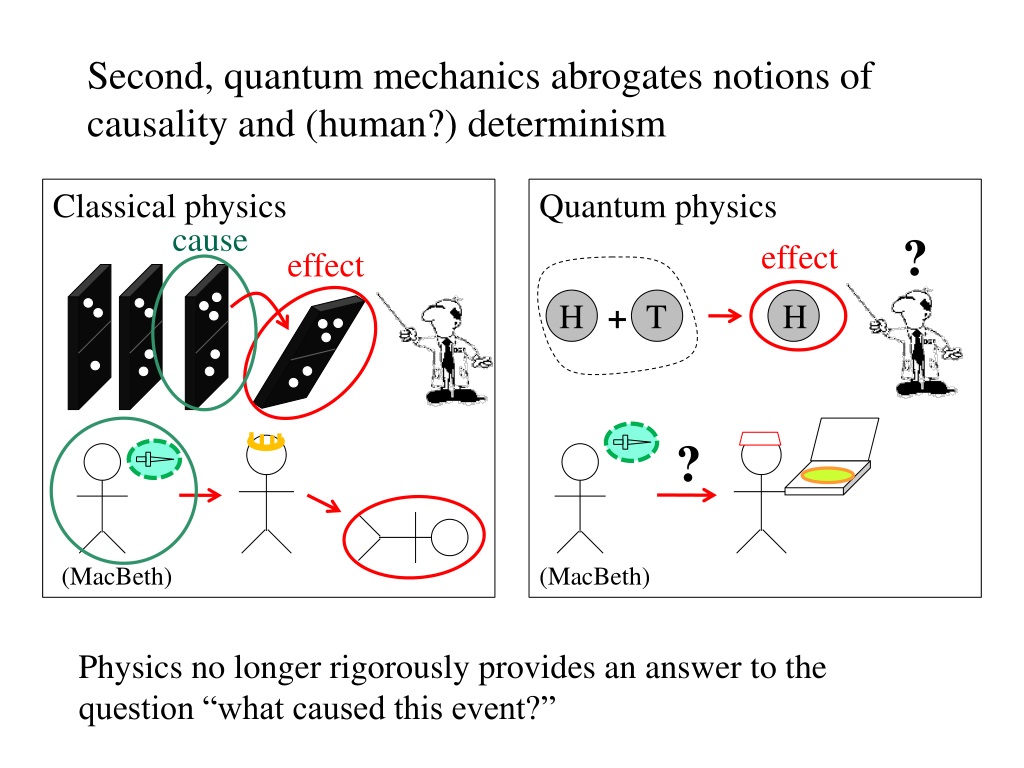
The core challenges come from phenomena that appear to be genuinely random and uncaused:
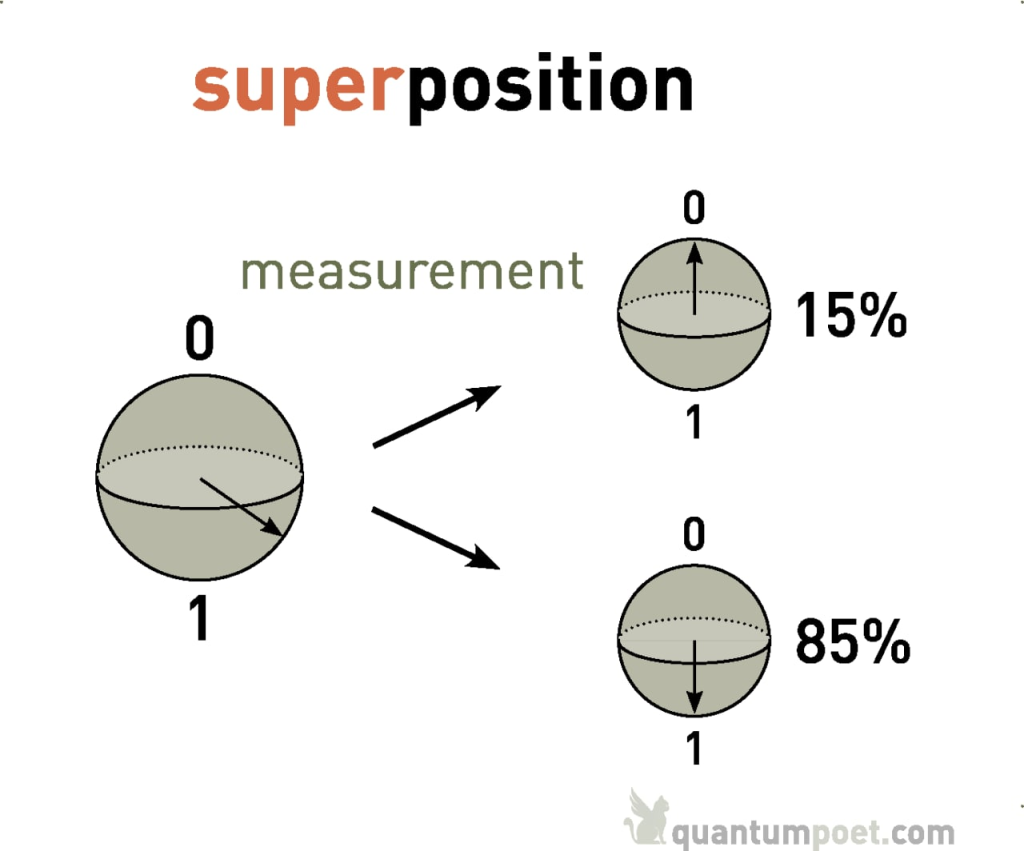
- Quantum Indeterminacy: A radioactive atom decays at a specific moment, but there seems to be no specific cause for why it decayed at that instant rather than another. When we measure the position of an electron that was in a state of superposition, it "collapses" to a specific location, but the outcome is irreducibly probabilistic. Nothing seems to determine the specific result.
- Virtual Particles: In quantum field theory, the vacuum is not empty. It's a roiling sea of "virtual particles" that pop into and out of existence for fleeting moments, seemingly from nothing and for no reason, as long as they do not violate the uncertainty principle.
- Quantum Entanglement: Two particles can be linked in such a way that measuring a property of one instantaneously influences the property of the other, regardless of the distance separating them. This "spooky action at a distance," as Einstein called it, seems to violate the principle that causes must be local and propagate at or below the speed of light.
Collectively, these phenomena suggest a world where events can happen without a determining cause, challenging the very foundation of the Aristotelian argument for a First Mover, which relies on the principle that 'whatever is changed is changed by another.'
2. Is Quantum Mechanics the Problem, or is the Mechanical Philosophy?
The Aristotelian-Thomistic response to this challenge is subtle. It does not dispute the empirical findings of quantum mechanics. Instead, it questions the metaphysical framework through which those findings are often interpreted. The standard "acausal" interpretation implicitly assumes a specific, post-Aristotelian view of nature known as the mechanical philosophy.
This is the view, developed by thinkers like Descartes, Boyle, and Locke, that sees the world as fundamentally composed of tiny, discrete particles (atoms or corpuscles) moving through a void. In this view, all causation is reduced to these particles bumping into each other. When quantum mechanics reveals phenomena that don't fit this "billiard ball" model of causality, the conclusion is often drawn that causality itself has failed.
But what if the mechanical philosophy was the wrong framework all along? A number of philosophers, most notably Edward Feser, have argued that quantum mechanics deals a fatal blow to the mechanical philosophy and, in doing so, points back toward Aristotle's hylomorphic (matter-form) conception of nature.
Let's watch a segment where Feser makes this case. He argues that the very features of QM that seem bizarre from a mechanical viewpoint—indeterminacy, potentiality, and holism—are precisely what an Aristotelian would expect.
What is Matter? | Prof Edward Feser
In this talk, 'What is Matter?', Edward Feser argues that quantum mechanics poses a severe problem for the classical mechanical worldview and actually vindicates key aspects of Aristotle's hylomorphism. Pay close attention to how he connects concepts like indeterminacy and potentiality in QM to Aristotle's metaphysics.
Please watch from 1:11:23 to 1:24:16. Feser begins this section by titling it 'the last section here and let us turn then finally to quantum mechanics'. He discusses how QM vindicates the Aristotelian notions of potentiality, prime matter, and substantial form, citing physicists like Heisenberg.
As Feser explains, drawing on the insights of physicist Werner Heisenberg, the indeterminacy of quantum systems can be understood not as an absence of cause, but as the reality of potentiality (dynamis). An electron in a superposition of states is not in no state; it is in a state of potentiality to be in various locations, a state that is just as real as actuality. This is a core Aristotelian idea that the mechanical philosophy rejected.
3. Holism and Non-Locality: The Return of Formal Causes
The challenge from quantum entanglement also dissolves under an Aristotelian lens. The mechanical philosophy is fundamentally reductionist: a system is nothing more than the sum of its individual parts and their spatial relations. Entanglement flatly contradicts this. An entangled system behaves as an irreducible whole, where the properties of the system cannot be reduced to the properties of its constituent particles.
This is precisely what Aristotle's doctrine of substantial form describes. A substantial form is not a physical part but an organizing principle that makes a substance a unified whole, with properties that transcend the sum of its material parts.
The philosopher Robert Koons has developed this line of argument in detail. Let's watch a short clip where he explains how the non-separable nature of entangled states undermines micro-physicalism and resonates with the Aristotelian concept of a composite substance.
Rob Koons: Aristotle and the Quantum [Torrey Honors Institute]
In this lecture, Robert Koons explains how quantum entanglement presents a revolutionary challenge to the classical reductionist picture of reality. He shows that an entangled system must be treated as an irreducible whole, a concept that fits comfortably within an Aristotelian framework.
Please watch the segment from 24:42 to 33:05. Koons starts by discussing the 'Revenge of teleology' and then moves into 'non-separable states and entanglement,' using the EPR thought experiment as his main example.
Koons's point is that if two particles across the galaxy can act as a single, unified system, the reductionist, "bottom-up" picture of reality is untenable. This reopens the door to a "top-down" structuring principle—what Aristotle would call a formal cause or substantial form—that unifies the system as a whole.
4. A Systematic Rebuttal
So far, we've seen the broad philosophical case that QM is more Aristotelian than not. Now, let's break down the response to the specific objection that QM events are "uncaused" into a series of more precise arguments.
The following reading provides an excellent, structured list of counter-arguments.
An Appraisal of Aquinas’ First Way: Quantum Mechanics Contra the Causal Principle?
This article, 'An Appraisal of Aquinas’ First Way: Quantum Mechanics Contra the Causal Principle?', offers seven distinct reasons to reject the claim that quantum phenomena violate the causal principle that underpins the argument for a First Mover.
Please read the 'Assessment' section. It consists of seven numbered points that systematically rebut the quantum objection. Focus on the logic of each point.
Let's summarize the key arguments you just read:
- Interpretation-Dependent: Claims of "acausality" are features of specific interpretations of QM (like the Copenhagen interpretation), not of the mathematical formalism itself. Other interpretations, like Bohmian mechanics, are fully deterministic. Since there is no consensus on the correct interpretation, QM has not proven that reality is acausal.
- Dependent vs. Demanded Effects: This is a crucial distinction. An event can be dependent on prior conditions without being fully demanded or necessitated by them. Virtual particles, for instance, don't come from utter nothingness; they depend on the pre-existing energy of a quantum field. The causal principle requires a sustaining cause (a dependent-upon reality), not necessarily a fully determining one.
- The Limits of Science: Science, by its method, can only observe empirical phenomena. It cannot, even in principle, observe "nothingness" to confirm that something came from it. Asserting that a particle came from nothing is a philosophical claim, not a scientific one.
- Spontaneity and Substantial Form: In an Aristotelian view, a thing's nature (its substantial form) can be the source of its "spontaneous" behaviors. The decay of an atom could be understood as a manifestation of its intrinsic nature, which in turn was caused by whatever generated the atom in the first place. The causality is located in the nature of the thing itself.
- Physics Describes Structure, Not Essence: This is an epistemological point. Physics provides abstract, mathematical models of the world. It abstracts away from the intrinsic nature of things to focus on their quantifiable, relational properties. To conclude that there are no underlying causes simply because they don't appear in the mathematical formalism is like concluding a banana isn't yellow because it appears gray in a black-and-white photograph. It's an artifact of the representation.
5. Quantum Causality and Structural Causal Models
Your background in statistical science and causal inference (à la Judea Pearl) provides a unique lens through which to view this problem. The challenge that quantum entanglement poses to causality is an active area of research.
As the Stanford Encyclopedia of Philosophy entry on "Causation in Physics" discusses, the correlations in Bell-type experiments violate the conjunction of several key assumptions often used in causal modeling:
- Relativistic Causality (no faster-than-light influences).
- Free Choice (experimenters can freely choose measurement settings).
- Reichenbach's Principle of a Common Cause (correlations are either due to direct causation or a common cause that screens off the correlation).
To save the quantum predictions, one must abandon at least one of these. Furthermore, work by Wood and Spekkens shows that quantum correlations are inconsistent with the conjunction of the Causal Markov Condition (a variable is independent of its non-descendants given its parents) and Faithfulness (causal dependence implies probabilistic dependence).
This is a profound result. It shows that the "weirdness" of quantum mechanics represents a fundamental challenge to the standard tools used to model causal structures. From an Aristotelian perspective, this isn't surprising. Those tools were largely developed to model systems that conform to the mechanical philosophy's assumptions of separability and bottom-up causation. The holism implied by Aristotelian formal causes—where the whole is metaphysically prior to its parts—is precisely the kind of structure that would lead to violations of principles like the Causal Markov Condition, which assumes causal relationships can be fully described by local dependencies in a graph.
Conclusion
We set out to evaluate the challenges that quantum mechanics poses to classical causal principles. While the objection is powerful and has convinced many, it is far from conclusive.
Key Takeaways:
- The claim that quantum mechanics proves events can be "uncaused" is a philosophical interpretation, not a direct scientific result. It largely depends on which interpretation of QM one adopts and presupposes a "billiard ball" view of causality.
- The Aristotelian metaphysical framework, with its distinction between actuality and potentiality, is surprisingly well-suited to describing quantum indeterminacy. What appears "uncaused" can be seen as the actualization of a pre-existing, real potential.
- The holistic nature of quantum entanglement, which refutes the reductionism of the mechanical philosophy, resonates strongly with the Aristotelian concept of a substantial form as a unifying principle that makes a system more than the sum of its parts.
- A careful analysis distinguishes between an effect being necessitated and it being dependent on prior actualities. Quantum events, while not always necessitated, are always dependent on prior conditions like quantum fields, conservation laws, and the nature of the substances involved.
Far from being a science-stopper, the Aristotelian framework provides a rich conceptual toolkit for making sense of the very phenomena that seem most bizarre from a modern perspective. It suggests the universe is not a collection of inert particles but a hierarchy of substances structured by forms, teeming with potentials waiting to be actualized.
This lesson concludes our look at the major scientific challenges to the premises of the unmoved mover argument. In our final lesson, we will synthesize everything we have covered. We will construct the strongest contemporary version of the argument and evaluate the most formidable objections it faces from both science and philosophy, bringing your journey to a comprehensive conclusion.
Can't find a good explanation? Sign up and we'll make it for you
Sign up