In our previous lessons on security, we focused on vulnerabilities arising from contract interactions, culminating in the use of ReentrancyGuard to prevent reentrancy attacks. We established that robust security relies on both sound logical patterns (like CEI) and mechanical safeguards. Today, we address another fundamental category of bugs that has been historically devastating: arithmetic errors.
This lesson explores integer overflow and underflow, a class of vulnerabilities responsible for billions of dollars in losses. Given your work with large-scale financial data systems, you'll appreciate the critical importance of mathematical precision. In smart contracts, a simple miscalculation isn't just a data quality issue—it can compromise the entire economic logic of a system.
We will explain how a crucial evolution in the Solidity language—the release of version 0.8.0—provides powerful, built-in protection against these very errors, making modern smart contracts inherently safer.
1. What are Integer Overflow and Underflow?
In computing, numbers are stored in fixed-size data types. An integer overflow occurs when an arithmetic operation, like addition, creates a number larger than the maximum value the data type can hold. An integer underflow is the opposite, occurring when a subtraction results in a number smaller than the minimum value.
Before Solidity version 0.8.0, the language handled these situations by "wrapping around."
- Overflow: Adding 1 to the maximum possible value of an unsigned integer would result in 0.
- Underflow: Subtracting 1 from 0 would result in the maximum possible value.
This behavior is similar to an old car's odometer: if it has six digits, driving one more mile after 999,999 miles makes it roll over to 000,000. While predictable, this is rarely the desired outcome in a financial application.
Arithmetic Overflows Underflows Attack: Exploit Mechanics, Real ...
This article from smartcontractshacking.com provides an excellent, concise definition of overflow and underflow, including the helpful odometer analogy.
Please read the introductory section, from the beginning down to the end of the odometer analogy. Focus on understanding the concept of "wrapping."
2. The Danger of Silent Failures: The BatchOverflow Bug
The silent, wrapping behavior of older Solidity versions was not just a quirk; it was a catastrophic security hole. Attackers could exploit it to manipulate balances, bypass checks, and even create tokens out of thin air.
The most infamous example is the BatchOverflow bug from 2018. A function designed to transfer tokens to multiple recipients at once contained a critical flaw. An attacker could provide specific inputs that caused a multiplication to overflow to zero. This tricked the contract's balance check into approving a transfer that minted an enormous number of new tokens for the attacker while debiting zero tokens from their account. The incident wiped out over $1 billion in market capitalization for affected tokens.
Arithmetic Overflows Underflows Attack: Exploit Mechanics, Real ...
The same article details this real-world exploit. Seeing how the attack worked makes the danger of overflows very clear.
Read the section titled "The BatchOverflow Bug". Pay close attention to the vulnerable code snippet and the table explaining the exploit math. Notice how amount becomes 0 due to the overflow.
This event was a major catalyst for change in the Solidity language. The "code is law" principle of blockchains is only as sound as the code itself, and this bug proved that silent arithmetic failures were an unacceptable risk.
3. The Solution: Built-in Checks in Solidity 0.8.0+
Recognizing the severity of this issue, the Solidity development team introduced a fundamental change in version 0.8.0.
Since Solidity 0.8.0, all standard arithmetic operations revert the transaction on overflow or underflow by default.
This means that instead of silently wrapping, an operation that exceeds the bounds of its data type will cause the entire transaction to fail, just as if a require() statement had failed. This behavior change is the single most effective protection against this class of attacks.
The official Solidity documentation provides the definitive explanation.
Expressions and Control Structures
The Solidity documentation explains this language feature directly.
Read the section titled "Checked or Unchecked Arithmetic". This section contrasts the pre-0.8.0 wrapping behavior with the new default reverting behavior.
The table below from the "Arithmetic Overflows Underflows Attack" article nicely summarizes this crucial difference.
Arithmetic Overflows Underflows Attack: Exploit Mechanics, Real ...
This table provides a simple and direct comparison.
Review the table under the heading "Pre-0.8.0 vs 0.8.0+ Behavior".
When an overflow or underflow occurs in modern Solidity, it generates a Panic error with a specific error code, 0x11.
Expressions and Control Structures
This section of the documentation lists the different panic codes.
In the list of Panic exceptions, locate error code 0x11. This confirms the specific error triggered by an overflow.
Let's see this protection in action.
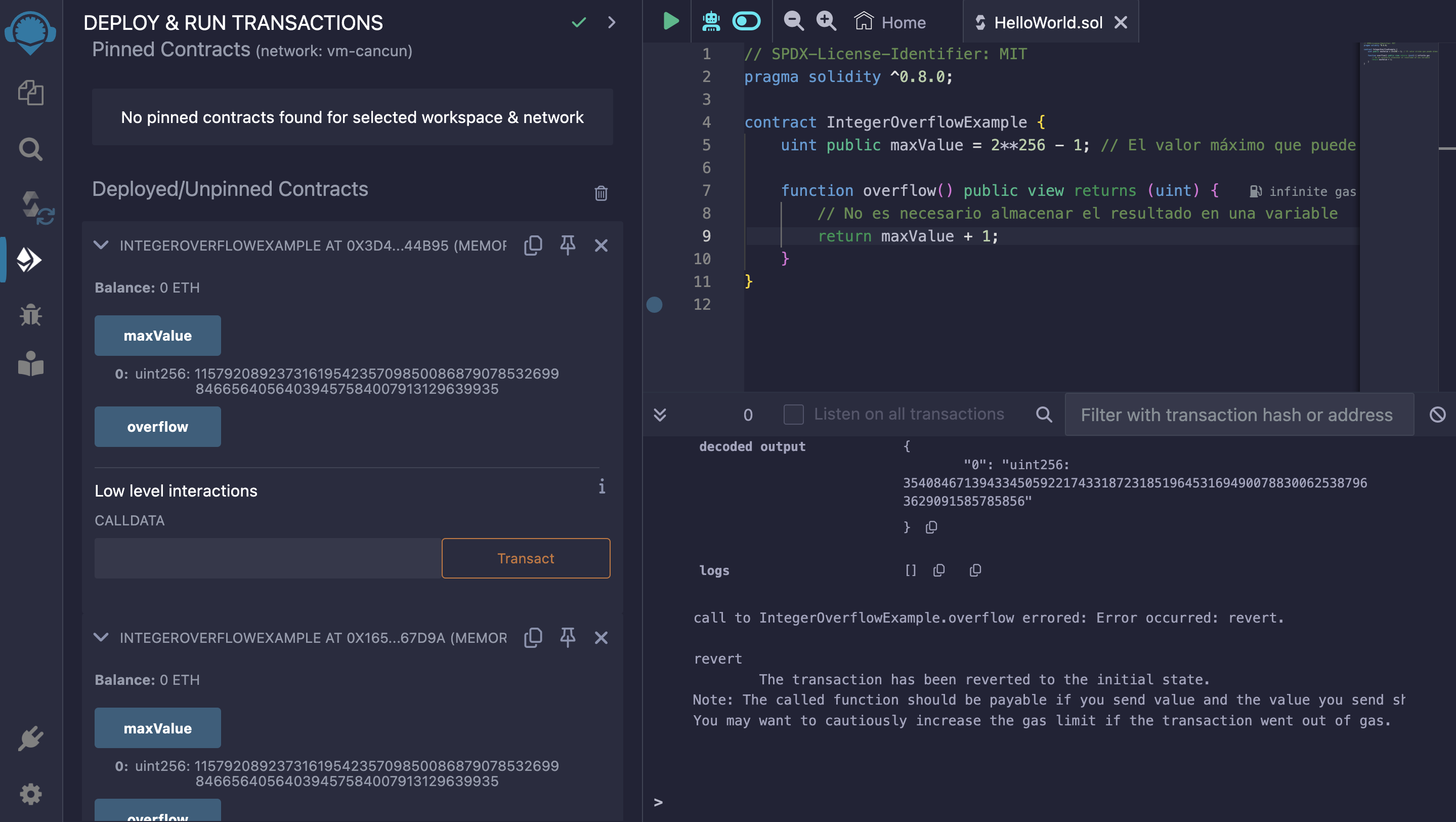

The following video provides a hands-on demonstration. The presenter first shows overflow happening in a pre-0.8.0 contract and then upgrades the version to show how the transaction automatically fails.
How to Hack Solidity Smart Contracts with Integer Overflow
This Dapp University video provides a clear, practical demonstration of overflow and how Solidity v0.8+ prevents it.
First, watch the section from this test setup. The presenter sets up a test using an older Solidity version to demonstrate how a uint8 variable wraps from 255 back to 0. Next, watch the key segment from this discussion. Here, the presenter changes the contract's compiler version to 0.8 and re-runs the test. You will see the test fail with a "reverted with panic code" error, proving that the built-in check has kicked in and stopped the overflow.
4. The Exception: unchecked Blocks
While default protection is a massive security improvement, there are rare situations where developers might need the old wrapping behavior, usually for gas optimization in highly specialized algorithms. Solidity provides the unchecked keyword for this purpose.
Any arithmetic operations inside an unchecked { ... } block will not be checked for overflow or underflow and will wrap, just as they did in older Solidity versions.
// pragma solidity ^0.8.20;

uint256 a = type(uint256).max;
uint256 b;

// This line will cause the transaction to revert.
b = a + 1;

// This code will execute, and 'c' will have a value of 0.
unchecked {
    uint256 c = a + 1;
}
Using unchecked is an advanced feature that essentially disables a critical safety mechanism. It should be used with extreme caution and only when the developer is absolutely certain that an overflow or underflow is impossible for the given logic (e.g., in a loop counter with a known small number of iterations). For building financial instruments, it is almost always safer to rely on the default checked arithmetic.
Conclusion
In this lesson, we've explored the history and solution to one of Solidity's most notorious security pitfalls. The move to default checked arithmetic in Solidity v0.8.0 was a landmark improvement, making the entire ecosystem safer. For you, as a developer aiming to build secure tokenization platforms, this is a critical piece of knowledge. Always using a modern compiler version is your first and best line of defense against these arithmetic bugs.
Key Takeaways:
- Integer overflow and underflow are arithmetic errors where calculations exceed the maximum or minimum value of a data type.
- In Solidity versions before 0.8.0, these errors caused the value to "wrap around" silently, leading to major security vulnerabilities like the BatchOverflow bug.
- Solidity v0.8.0 and later provide built-in protection by reverting the transaction whenever an overflow or underflow occurs in standard arithmetic.
- This protection makes third-party
SafeMathlibraries, which were essential for older contracts, unnecessary in modern code. - The
uncheckedblock allows developers to intentionally opt-out of these checks for gas optimization, but it reintroduces the risk and must be used with extreme care.
This lesson concludes our module on Advanced Solidity and Security Patterns. You are now equipped with knowledge of inheritance, data structures, error handling, and the two most famous Solidity vulnerabilities: reentrancy and integer overflow.
In the next module, we will apply these fundamentals to build our first financial primitive: an ERC-20 token. This will be our first major step towards your goal of creating systems for tokenized money.