Welcome to the first lesson of our fourth module, "Advanced Solidity and Security Patterns." In the previous modules, you've built a solid foundation by setting up your development environment, mastering Solidity's fundamental building blocks, and learning how to rigorously test your code. Now, we'll begin to assemble these blocks into more sophisticated and robust smart contract systems.
This lesson focuses on three fundamental concepts for creating reusable and interoperable code: inheritance, abstract contracts, and interfaces. In any complex software system, from the data warehousing pipelines you've worked with to the blockchain protocols we're studying, the ability to reuse code and define clear boundaries between components is essential. These concepts provide the tools to do just that in Solidity. By the end of this lesson, you will be able to structure your contracts in a modular way, preparing you to work with established standards like ERC-20 in our upcoming modules.
1. Inheritance: Reusing and Extending Code
At its core, inheritance is a mechanism for one contract to derive functionality from another, reducing code duplication and establishing a logical hierarchy. Think of it as creating a "base" model with common features, from which more specialized versions can be built. In Solidity, the contract that is inherited from is called the base contract, and the contract that inherits is the derived contract.
This is achieved using the is keyword.

To understand the mechanics, let's explore how Solidity handles inheritance, including the crucial keywords that enable it.
Mastering Solidity: A Comprehensive Guide to Contracts
This article from CoinMonks provides a clear explanation of inheritance and the modern keywords used to manage it.
Please read two sections: Start with the section on Inheritance. This part explains the is keyword and the concept of base and derived contracts. The ArithmeticOperations contract is a great example of multiple inheritance, where one contract combines the functionalities of several others. Next, read the section on Function Overriding. Pay close attention to the virtual and override keywords. Since Solidity v0.6, you must explicitly mark functions in the base contract as virtual if you want to allow derived contracts to change their behavior. The derived contract must then use the override keyword.
The video below from Smart Contract Programmer offers a great practical demonstration of these concepts. Watching the code in action will help solidify your understanding of how virtual and override work together.
This video walks through the process of creating a parent contract and a child contract that inherits and overrides its functions.
Watch the following segments: Code Duplication Problem: This introduces the "why" behind inheritance. Using virtual: See how to mark functions in the parent contract as overridable. Using is and override: Observe how the child contract inherits and customizes the parent's functions. Demonstration: The instructor deploys the child contract and shows that it has both its own overridden functions and the original, untouched functions from the parent. Multi-level Inheritance: A quick look at a more complex chain of inheritance (A -> B -> C).
2. Abstract Contracts: Creating a Template
Sometimes, you want to create a base contract that is intentionally incomplete. It might define some core logic but leave other functions unimplemented, requiring any derived contract to provide the implementation. This is the purpose of an abstract contract. They act as a template, enforcing a certain structure on any contract that inherits from them.
An abstract contract is declared with the abstract keyword. It cannot be deployed on its own; it can only be inherited from.
Mastering Solidity: A Comprehensive Guide to Contracts
This same article also covers abstract contracts.
Read the section on Abstract Contracts. Note the key characteristic: an abstract contract is created when at least one of its functions is declared without an implementation (just the signature). The article correctly points out their value in decoupling a contract's definition from its implementation.
For example, a contract standard might define that all compliant contracts must have a function called getOwner(), but it doesn't care how that function is implemented. An abstract contract could define some shared logic and declare function getOwner() external view returns (address); without a function body, forcing any child contract to implement it.
3. Interfaces: Defining a Public API
Interfaces take the concept of abstraction a step further. An interface is a collection of function definitions without any implementation. It defines a public Application Programming Interface (API) that a contract must adhere to. Think of it as a strict contract that only specifies what functions can be called, their parameters, and what they return, but says nothing about how they work.
This is one of the most powerful features for enabling interoperability between smart contracts. If you know a contract's address and you have its interface, you can interact with it without needing its full source code.
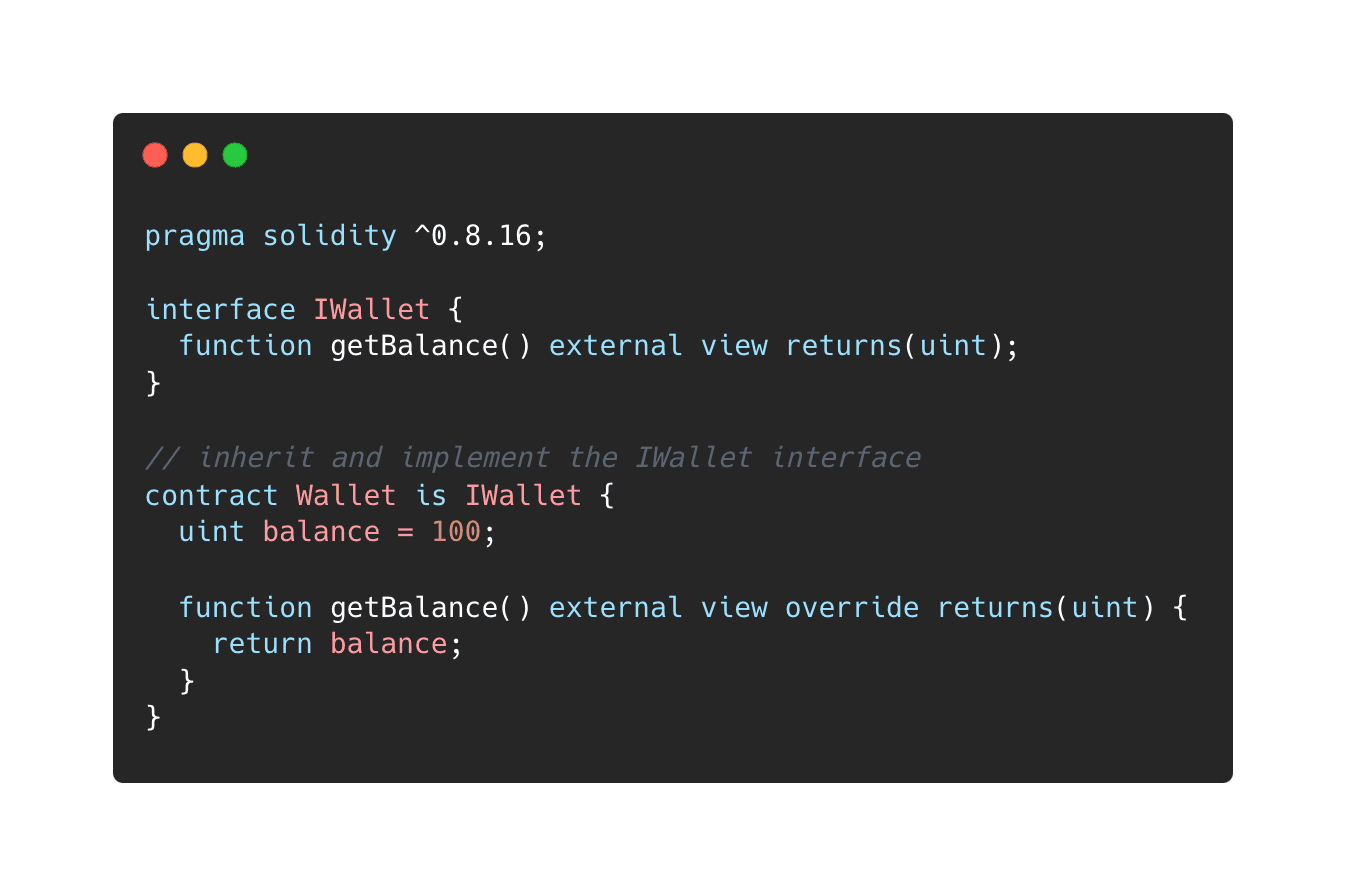
Interfaces have several restrictions compared to abstract contracts.
Mastering Solidity: A Comprehensive Guide to Contracts
Finally, let's cover interfaces using the same guide.
Read the section on Interfaces. Focus on the list of restrictions that distinguish interfaces from abstract contracts (e.g., no state variables, no constructors, all functions must be external).
The most common use case for an interface is to call functions on a contract that is already deployed on the blockchain. The following video provides an excellent walkthrough of this exact scenario.
This video demonstrates the primary purpose of an interface: interacting with an external, deployed contract.
Watch these key parts: The "Why": Explains why you would use an interface to call a contract without having its source code. Defining an Interface: Shows how to write an interface with only the function signatures, ending in semicolons. Note the I prefix, which is a common naming convention (e.g., ICounter). Using the Interface: See how another contract instantiates the interface with the deployed contract's address and then calls its functions.
4. A Real-World Example: The ERC-4626 Tokenized Vault
Let's tie these three concepts together with an example that is highly relevant to your goal of working with tokenized money: the ERC-4626 Tokenized Vault Standard. This standard defines a contract that manages deposits of one token (the asset) and issues another token (the share) that represents a claim on those assets. This is the basic structure of a money market fund or a yield-bearing strategy.
The OpenZeppelin implementation of this standard begins with this line of code:abstract contract ERC4626 is ERC20, IERC4626 { ... }
Let's break this down:
abstract contract ERC4626: It is an abstract contract. This tells us it's a template, not a finished, deployable product. It provides most of the core logic, but developers must implement a few key functions (like how the vault generates yield) to create a specific vault.is ERC20: It uses inheritance. An ERC-4626 vault is also a fully compliant ERC-20 token. The shares it issues are standard tokens that can be transferred, approved, etc. It inherits all this functionality from a base ERC-20 contract, avoiding massive code duplication.is IERC4626: It implements an interface. By includingIERC4626, the contract promises to provide a standard set of functions for interacting with vaults (deposit,mint,withdraw,redeem, etc.). This ensures that any application, like a decentralized exchange or a portfolio tracker, can interact with any ERC-4626 vault in a standardized way.
This single line of code is a perfect illustration of how these concepts work together to create powerful, standardized, and reusable components for DeFi.
ERC4626 Interface Explained - RareSkills
This short article from RareSkills highlights how ERC4626 combines these concepts.
Read the sections An ERC4626 contract is also an ERC20 token and ERC4626 Solidity declaration. This will reinforce how inheritance (is ERC20) and interfaces are used in a real-world token standard.
Conclusion
In this lesson, you've moved into the realm of advanced contract architecture. You've seen how to build relationships between contracts to create systems that are both organized and extensible.
Here are the key takeaways:
- Inheritance (
is ...) is used for code reuse, creating an "is-a" relationship where a derived contract gets functionality from a base contract. Function overriding requiresvirtualandoverride. - Abstract Contracts (
abstract contract ...) act as templates that cannot be deployed directly. They mix implemented logic with unimplemented function declarations to enforce a structure on child contracts. - Interfaces (
interface ...) define a strict public API. They contain only function signatures and are crucial for enabling different contracts to interact with each other in a predictable way.
These patterns are the backbone of the entire smart contract ecosystem, from token standards to complex DeFi protocols.
In our next lesson, we will continue building our toolkit for creating sophisticated contracts by learning how to use structs and enums to model complex, domain-specific data. Now that you know how to structure your contracts, we'll focus on how to structure the data within them.