Welcome to the next lesson in our journey through advanced Solidity. In our previous discussions, we've focused on optimizing contracts for gas, particularly by choosing the right data locations (storage, memory, calldata). We've also seen how require statements are used to enforce conditions within functions. A common pattern you'll encounter is needing to apply the same condition—like checking if the caller is the contract owner—across multiple functions. Repeating this check everywhere is not just tedious; it violates the "Don't Repeat Yourself" (DRY) principle and creates more room for error.
Today, we'll address this by learning how to write and apply function modifiers. Modifiers are a powerful feature in Solidity that allow you to encapsulate and reuse these checks, leading to cleaner, more readable, and more secure code. For someone with your background in designing data systems and ETL pipelines, you can think of modifiers as reusable validation rules or pre-processing steps that are automatically applied to a function before its main logic is executed. Just as you might have a standard procedure to verify data integrity before loading it into a warehouse, a modifier verifies conditions before a smart contract function alters the state of the blockchain.
By the end of this lesson, you will be able to define your own modifiers and apply them to enforce common patterns, with a special focus on access control—a cornerstone of secure smart contracts.
1. What is a Function Modifier?
A function modifier is a reusable piece of code that can be attached to a function definition to change its behavior. Its primary use is to run checks before a function's body is executed. If the conditions in the modifier are not met, it can stop the function's execution entirely, typically by using a require statement.
The image below illustrates the typical structure of a smart contract. Notice the "Modifiers" section, which includes examples like onlyContractOwner() and onlyTenant(). These are classic access control modifiers that gatekeep who can call certain functions.
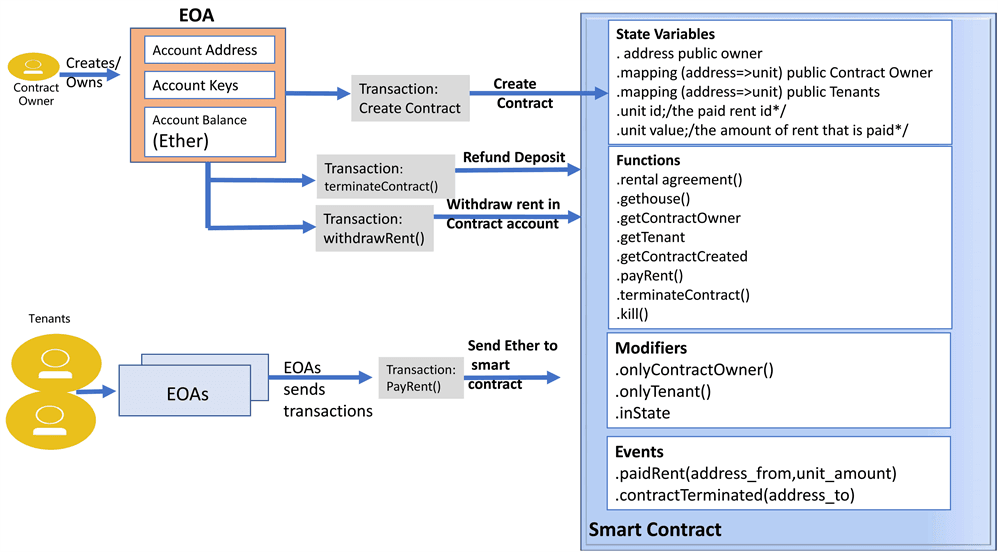
Let's dive into the mechanics of how they are defined and used.
Function Modifier | Solidity 0.8
This video from Smart Contract Programmer provides an excellent introduction to the concept and syntax of modifiers.
Watch the first segment on the basic example. The whenNotPaused modifier is a perfect illustration of how a modifier can extract a repetitive require statement into a single, reusable block of code.
As the video demonstrates, there are two key elements to a modifier:
- The
modifierkeyword is used to declare it. - The special placeholder
_(underscore followed by a semicolon) is used to specify where the body of the modified function should be executed.
If the require statement in the modifier fails, the function execution halts, and the code within the function body (represented by _) is never reached.
2. The Anatomy of a Modifier
The _ placeholder is the heart of a modifier. While it's most common to see it at the end of a modifier's body, you can actually place code after it as well. This allows you to "wrap" or "sandwich" a function's logic between pre-execution and post-execution code.
Solidity Functions — Everything You Need to Know About ...
This article from Thrackle.io offers a clear written explanation of modifier syntax and the role of the _ placeholder.
Read the first two sections, starting from the top of the page down to just before the "doubleLogicModifier" example. Focus on the definition of modifiers and the explanation of the _ placeholder. The onlyOwnerAndFunded example shows how code can be executed after the function runs.
This ability to run code before and after a function is extremely powerful. While pre-function checks are common for access control and input validation, post-function checks are crucial for more advanced patterns, such as guarding against reentrancy attacks, which we will cover in the next lesson.
Function Modifier | Solidity 0.8
The "Smart Contract Programmer" video also has a great visualization of this "sandwich" pattern.
Watch the final segment of the video on the sandwich modifier. It clearly demonstrates how code before the _ runs first, then the function body, then the code after the _.
3. Advanced Modifier Patterns
Modifiers can be made even more versatile by accepting parameters and by being chained together.
Modifiers with Parameters
Sometimes, the check you want to perform depends on one of the function's arguments. For example, you might want to ensure a withdrawal amount is not zero. Instead of creating a separate modifier for every possible check, you can pass arguments into the modifier itself.
Function Modifier | Solidity 0.8
Let's return to the "Smart Contract Programmer" video one last time.
Watch the middle segment on modifiers with inputs. The cap(uint x) modifier shows how you can pass a function's argument directly into the modifier to perform a check on it.
Chaining Multiple Modifiers
You can apply multiple modifiers to a single function. They are evaluated in the order they are listed in the function signature. The execution flow nests them: the first modifier executes its pre-check, then it passes control to the second modifier. The second modifier runs its pre-check and passes control to the function body. After the function body completes, control unwinds back through the modifiers in reverse order for any post-execution logic.
Solidity Functions — Everything You Need to Know About ...
The Thrackle.io article explains this nesting behavior clearly.
Read the section on multiple modifiers and modifiers with parameters. The withdraw function example, with onlyOwner onlyEOA, is a great illustration of chaining.
4. Application: Access Control with Modifiers
The most common and critical use case for modifiers is access control—restricting who can execute certain functions. This is paramount for the tokenized assets you aim to build, where you'll need to control actions like minting new tokens or pausing trading.
Simple Ownership: Ownable
For contracts with a single administrator, the "ownership" model is standard. One account (the "owner") has special privileges. OpenZeppelin, an industry-standard library for secure smart contracts, provides a base contract called Ownable that implements this pattern using the onlyOwner modifier.
The OpenZeppelin documentation is the canonical source for understanding these patterns.
Read the section Ownership and Ownable. The code example shows a contract inheriting from Ownable and using the onlyOwner modifier to protect the specialThing() function. This is a pattern you will use frequently.
Role-Based Access Control (RBAC): AccessControl
Simple ownership doesn't scale for more complex systems. In a tokenized security platform, you might have different roles:
- Admins: Who can assign roles to others.
- Minters: Who can issue new tokens.
- Burners: Who can destroy tokens.
- Compliance Officers: Who can freeze accounts.
This requires a more granular system known as Role-Based Access Control (RBAC). OpenZeppelin's AccessControl contract provides a robust implementation of this, centered around the onlyRole modifier.
First, let's see how an onlyRole modifier can be built from scratch to understand the underlying logic.
This video from Smart Contract Programmer builds an access control contract from the ground up, showing exactly how onlyRole works.
Watch the segment from creating the modifier. It demonstrates defining the onlyRole modifier, which takes a role as an argument and checks if msg.sender has that role. This perfectly captures the essence of RBAC.
Now, let's see how to use OpenZeppelin's production-ready AccessControl contract. It handles all the underlying logic for granting, revoking, and checking roles, allowing you to simply apply the onlyRole modifier.
This part of the OpenZeppelin documentation demonstrates their RBAC solution.
Read the sections on Role-Based Access Control and Using AccessControl. Pay close attention to the second code example, where onlyRole(MINTER_ROLE) and onlyRole(BURNER_ROLE) are used to protect the mint and burn functions respectively. This is a direct implementation of the kind of access control needed for token contracts.
Conclusion
In this lesson, we've elevated our ability to write secure and maintainable Solidity code by mastering function modifiers. They are the standard way to implement reusable checks, making your contract logic cleaner and easier to audit.
Key Takeaways:
- Modifiers are reusable code blocks that modify function behavior, primarily used for pre-execution checks (
require). - The
_placeholder dictates where the function's body is executed, allowing for both pre- and post-execution logic. - Modifiers can accept parameters and be chained together, enabling flexible and complex validation pipelines.
- Access control is the primary use case, with standard patterns like
Ownable(onlyOwner) for simple ownership andAccessControl(onlyRole) for more granular, role-based permissions.
In our next lesson, we will delve into one of the most infamous smart contract vulnerabilities: reentrancy. We'll see how the pre- and post-execution capabilities of modifiers, which we touched on today, are used to implement the "Checks-Effects-Interactions" pattern and the nonReentrant modifier—the primary defense against this dangerous attack.