Welcome to the fifth module of our course. Having established a solid foundation in advanced Solidity patterns and security, we are now ready to apply that knowledge to build our first, and arguably most fundamental, financial primitive on the blockchain: a fungible token.
In our last lesson, we saw how Solidity v0.8+ provides crucial built-in protection against arithmetic errors, a vital safeguard for any contract handling value. This lesson transitions from general security principles to a specific, standardized application. We will explore the ERC-20 standard, the universal blueprint for creating fungible tokens on Ethereum. Your background in asset management and data systems will provide a valuable perspective here, as ERC-20 is essentially a standard for representing and managing fungible assets—be they currencies, shares, or other securities—in a decentralized, interoperable way.
Today, we will focus on the purpose and the core components of the ERC-20 standard. By the end of this lesson, you will understand why this standard is so critical to the Ethereum ecosystem and be familiar with the exact functions that every compliant token must implement.
1. The Purpose of a Token Standard
Before diving into the technical details, it's essential to understand why a token standard like ERC-20 exists. At its core, ERC-20 is a standard for fungible tokens. Fungibility means that each unit of a token is identical to and interchangeable with every other unit. A one-dollar bill is fungible with any other one-dollar bill; a share of a company's common stock is fungible with any other share of the same class.
This fungibility allows ERC-20 tokens to represent a vast array of assets, a concept that's central to your goal of working with tokenized money.
The following video provides an excellent explanation of what these tokens can represent and uses a powerful analogy to illustrate why a technical standard is indispensable for building a robust ecosystem.
ERC20 Token Standard Explained
This video from the Moralis for Developers channel clearly explains the rationale behind token standards.
Please watch the segment from the beginning. Pay close attention to the list of assets an ERC-20 token can represent and the "electrical plug" analogy, which perfectly captures the need for interoperability between wallets, exchanges, and other applications.
As the video explained, without a standard, every new token would require custom integration work by every wallet provider, every decentralized exchange (DEX), and every other application that wanted to support it. This would create a fragmented and inefficient ecosystem. The ERC-20 standard solves this by defining a common interface, or a set of rules, that all fungible tokens must follow.
This standardization ensures that any ERC-20 token can be seamlessly "plugged into" any compatible platform. This principle is not unlike how standardized data formats (like FIX for trading messages or SWIFT for payments) enable interoperability in traditional finance.
The name itself, ERC-20, stands for Ethereum Request for Comment #20. It was the 20th proposal in a series of Ethereum Improvement Proposals (EIPs) and was formally adopted after community discussion.
The Complete Guide to ERC-20 Tokens and Solidity (2025)
This article from Alchemy further elaborates on why this standardization is so important for the developer ecosystem.
Read the section titled "Why is the ERC-20 token standard important?" to solidify your understanding of how a shared interface accelerates development and enhances the network.
2. The ERC-20 Interface: Functions and Events
Now that we understand the "why," let's look at the "what." The ERC-20 standard is formally defined as a set of mandatory functions and events that a smart contract must implement. Think of it as a public API for a token.
This image provides a great high-level overview of the six core functions.
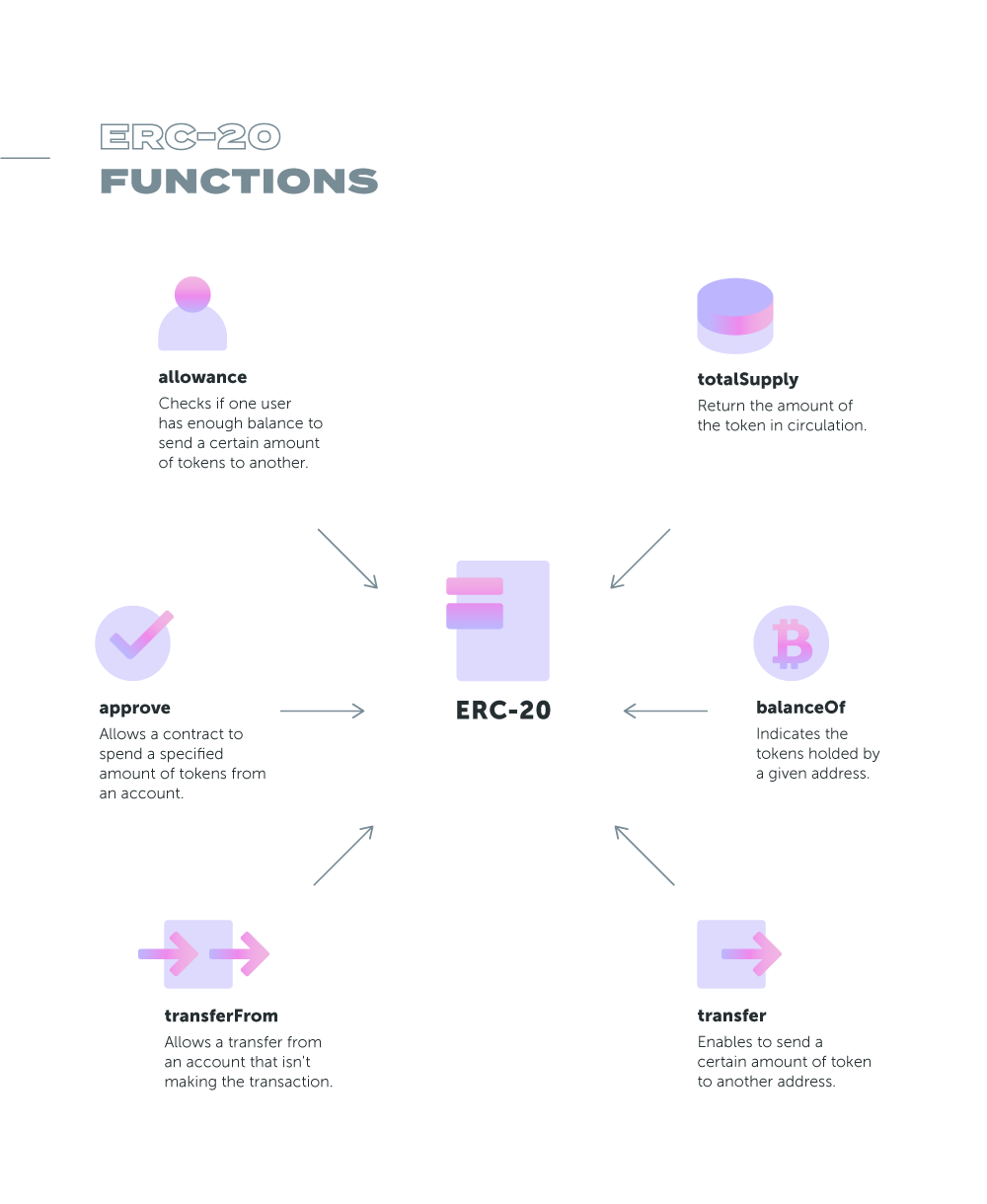
In Solidity, these requirements are best represented as an interface. As we learned in a previous module, an interface defines function signatures without providing their implementation. Any contract that claims to be ERC-20 compliant must provide a concrete implementation for every function in this interface.
How to Interact with ERC-20 tokens in Solidity | Alchemy Docs
This Alchemy documentation presents the ERC-20 standard in its native form: a Solidity interface. This is the precise technical specification.
In this article, find the code block under the heading "Step 2: Define the Interface". Read through the IERC20 interface definition carefully. We will break down each of these functions next.
Let's examine these functions in more detail, grouping them by their purpose.
Core Data Functions
These functions provide basic information about the token.
totalSupply(): Returns the total number of tokens in existence. This value can be fixed at creation or can change over time if the token supports minting (creating new tokens) or burning (destroying existing tokens).balanceOf(address account): Returns the token balance of a specific Ethereum address. This is how you check how many tokens a particular person or contract holds.
Direct Transfer Function
This is the most straightforward function for moving tokens.
transfer(address recipient, uint256 amount): Transfers a specifiedamountof tokens from the caller's balance to arecipientaddress. It emits aTransferevent upon success and should revert the transaction if the caller's balance is insufficient.
Delegated Transfer Functions (The "Allowance" Mechanism)
This is a powerful but slightly more complex mechanism that allows a contract to spend tokens on behalf of a user. This is crucial for interacting with decentralized applications. For instance, when you want to trade Token A for Token B on a decentralized exchange (DEX), you don't send your Token A to the DEX. Instead, you grant the DEX's smart contract permission to withdraw a certain amount of Token A from your account to execute the trade.
This is a two-step process:
-
Approval: The token owner gives permission.
approve(address spender, uint256 amount): The token owner calls this function to authorize aspender(typically a smart contract) to withdraw up to a certainamountof tokens from their account. This sets or updates an "allowance."
-
Transfer: The approved spender executes the transfer.
transferFrom(address sender, address recipient, uint256 amount): Thespendercalls this function to moveamounttokens from thesender's (the owner who gave approval) balance to arecipient. This transaction will only succeed if thesenderhas previously approved thespenderfor an allowance that is greater than or equal to theamount.
A complementary function lets anyone check the allowance:
allowance(address owner, address spender): Returns the remaining number of tokens that thespenderis still allowed to withdraw from theowner's account.
Mandatory Events
Events are crucial for tracking token activity. They create logs on the blockchain that can be easily queried by off-chain applications, such as block explorers, analytics platforms, or your own data warehousing solutions.
Transfer(address indexed from, address indexed to, uint256 value): This event MUST be emitted when tokens are transferred, including for zero-value transfers. This applies to bothtransferandtransferFrom.Approval(address indexed owner, address indexed spender, uint256 value): This event MUST be emitted wheneverapproveis successfully called.
3. Optional (But Standard) Metadata
In addition to the mandatory functions, the ERC-20 standard also suggests a few optional functions for usability. While not strictly required for compliance, they are implemented by virtually every token.
The Complete Guide to ERC-20 Tokens and Solidity (2025)
This part of the Alchemy guide covers the optional but universally adopted metadata functions.
Please read the section titled "What Solidity functions are optional for all ERC-20 tokens?".
name(): Returns the human-readable name of the token (e.g., "Tether USD").symbol(): Returns the token's ticker symbol (e.g., "USDT").decimals(): Returns the number of decimal places the token uses. This is critically important for financial calculations. Most ERC-20 tokens, following the precedent of Ether itself, use 18 decimals. This means that a token balance is typically stored as a large integer, and the UI layer is responsible for dividing it by to display the user-friendly value.
Conclusion
In this lesson, we've dissected the ERC-20 standard, the bedrock of fungible assets on Ethereum. You now understand its purpose as a driver of interoperability and are familiar with the specific functions and events that define its interface.
Key Takeaways:
- Purpose: The ERC-20 standard ensures that fungible tokens on Ethereum are interoperable, allowing them to work seamlessly with wallets, exchanges, and other decentralized applications.
- Fungibility: Each unit of an ERC-20 token is identical and interchangeable, making them suitable for representing currencies, shares, and other divisible assets.
- Core Functions: A compliant contract must implement
totalSupply,balanceOf,transfer,approve,transferFrom, andallowance. - Allowance Mechanism: The
approveandtransferFrompattern is a key feature that enables smart contracts to securely interact with user funds in a controlled manner. - Events: The
TransferandApprovalevents provide an essential on-chain log of all significant token activities. - Metadata: Functions like
name,symbol, anddecimalsare optional but standard practice for user-friendliness.
We have laid the theoretical groundwork. In our next lesson, we will put this knowledge into practice. You will use the industry-standard OpenZeppelin library to create, compile, and test your very own ERC-20 token, bringing these function signatures to life.