
Interpreting Skeletal Structures: Atoms and Lone Pairs
Hello, and welcome to organic chemistry’s visual language. This first module builds the bookkeeping habits that make mechanisms, acidity, resonance, and reaction prediction manageable rather than mysterious. Today’s target is foundational: read a skeletal (also called bond-line or line-angle) drawing and reconstruct the carbon atoms, hydrogen atoms, and lone pairs that have been left implicit.
A skeletal structure is not a less complete molecule. It is a compressed notation. Your job is to decompress it reliably—without guessing from the shape of the drawing.
The three rules that unlock skeletal structures
Most organic molecules contain many carbons and even more hydrogens. Writing every C and every C–H bond would obscure the chemically important parts, so skeletal notation omits them by convention.
Bond Line Structures | Line Angle Structures | 2.2 Organic Chemistry
Watch “Bond Line Structures | Line Angle Structures” from Chad’s Prep for a direct visual conversion from skeletal notation to complete Lewis structures. It establishes the conventions you will use throughout the course.
Watch the basic rules first. Focus on the distinction between an unlabeled corner or endpoint, which represents carbon, and a written element symbol, which represents that actual element. Then watch heteroatoms and pairs, where oxygen and nitrogen are completed with their missing lone pairs.
The rules are simple:
- Every unlabeled line end and every unlabeled corner is a carbon atom.
- Hydrogens attached to carbon are omitted. Add enough only when you need to expand the structure or count atoms.
- All atoms other than carbon and hydrogen are written explicitly. These are often called heteroatoms: O, N, S, F, Cl, Br, and so on.
A line is a bond. Two parallel lines are a double bond, and three parallel lines are a triple bond. The number of lines matters because it determines how many bonds carbon already has.
1.12 Drawing Chemical Structures - Organic Chemistry | OpenStax
Read OpenStax’s “Drawing Chemical Structures” for the standard written rules of skeletal notation and a worked interpretation strategy.
On the page’s discussion of skeletal structures, read the rules immediately before Table 1.3. Start at the sentence containing the three rules. Then continue into “Worked Example 1.4,” paying attention to its strategy for counting implied hydrogens. Its endpoint/intersection shortcuts apply most directly to structures containing only single bonds; shortly, you will generalize that method to double and triple bonds.
Here is the central distinction to keep in mind:
- An unlabeled endpoint is carbon.
- A line that ends at O, N, or Cl ends at that written atom—not at a hidden carbon beyond it.
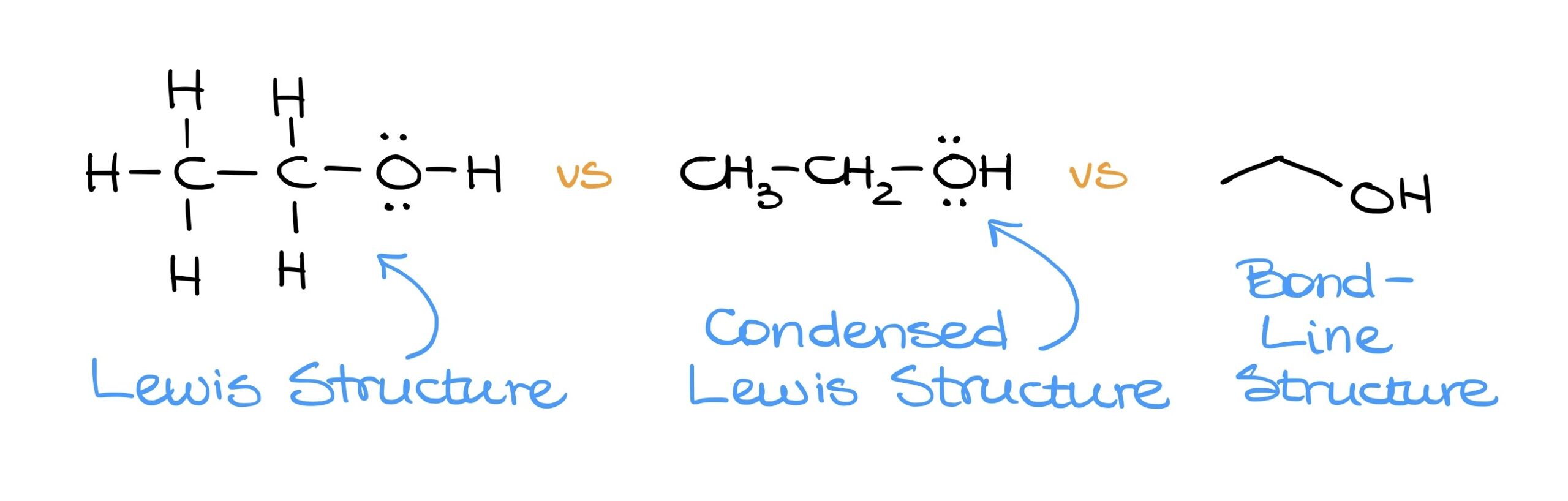
In the ethanol bond-line structure, the short zigzag contains two carbons. The O is written because oxygen is not omitted, and its H is written because it is bonded to oxygen rather than carbon.
First pass: find the atom framework
Before counting hydrogens, identify the atoms that are already present. This prevents the most common mistake: counting lines rather than positions.
For an unbranched zigzag with three segments:
- The starting endpoint is carbon 1.
- The first corner is carbon 2.
- The second corner is carbon 3.
- The final endpoint is carbon 4.
So, three connected line segments represent four carbons, not three.
Branches and rings
A branch is not a decorative mark. Its unlabeled endpoint is also carbon. At a branching corner, all lines meet at the same carbon atom.
For a ring, each unlabeled corner is carbon, including the corners where the drawing closes back on itself. A six-sided unlabeled ring therefore represents six carbons.
Use this atom-finding order every time:
- Mark each unlabeled endpoint as C.
- Mark each unlabeled corner and intersection as C.
- Keep every written atom exactly as written.
- Trace branches and ring closures before adding any hydrogens.
This first pass answers: What atoms are connected to what? Only then should you ask how many hydrogens are missing.
Second pass: restore the hydrogens on carbon
In the usual neutral structures you will see at this stage, carbon has a total bond order of four. A single bond contributes one, a double bond contributes two, and a triple bond contributes three.
Count the bond orders already attached to that carbon, including bonds to carbon and to any written heteroatom. The remaining bonding capacity is filled by hydrogen.
| Carbon’s visible bond-order total | Implied hydrogens on a neutral carbon | Typical situation |
|---|---|---|
| 1 | 3 | A terminal carbon with one single bond |
| 2 | 2 | A carbon with two single bonds, or an end carbon in a double bond |
| 3 | 1 | A branching carbon with three single bonds, or a carbon with one double and one single bond |
| 4 | 0 | A carbon with four bond-order units |
Example 1: a saturated four-carbon chain
Take a three-segment zigzag with no multiple bonds and no branches.
- Each endpoint carbon has one visible C–C single bond, so each is CH3.
- Each inner corner has two visible C–C single bonds, so each is CH2.
The expanded grouping is CH3CH2CH2CH3.
Example 2: why “end of a line means CH3” is not always true
Now consider a three-carbon skeletal structure with a double bond between the first two carbons.
- The terminal carbon at the left has a double bond: bond-order total 2. It is CH2.
- The middle carbon has one double bond and one single bond: total 3. It is CH.
- The right endpoint has one single bond: total 1. It is CH3.
The structure expands to CH2=CHCH3.
So an endpoint is always an implied carbon if it is unlabeled, but it is only CH3 when it has one single bond and nothing else. Multiple bonds change the hydrogen count.
Example 3: branches
Imagine a carbon at a three-way junction of three single lines. Its visible bond-order total is 3, so it has one hydrogen: it is CH.
Each unbranched endpoint coming off that junction has a visible bond-order total of 1, so each is CH3. This is why branches must be included before you assign hydrogens: a branch consumes one of the central carbon’s four bonds.
A fast exam routine
When asked to “draw all hydrogens,” do not try to visualize the entire molecule at once. Work carbon by carbon:
- lightly number the carbons;
- count each bond order around one carbon;
- add the missing H atoms;
- move systematically to the next carbon;
- check that every neutral carbon has four total bond-order units.
For a long structure, this is faster and much safer than trying to memorize whether a particular corner “looks like” CH or CH2.
Heteroatoms: explicit labels, hidden lone pairs
Carbon-bound hydrogens are omitted; hydrogens on heteroatoms are normally shown. Thus, an alcohol is written with O–H, and an amine commonly shows N–H bonds.
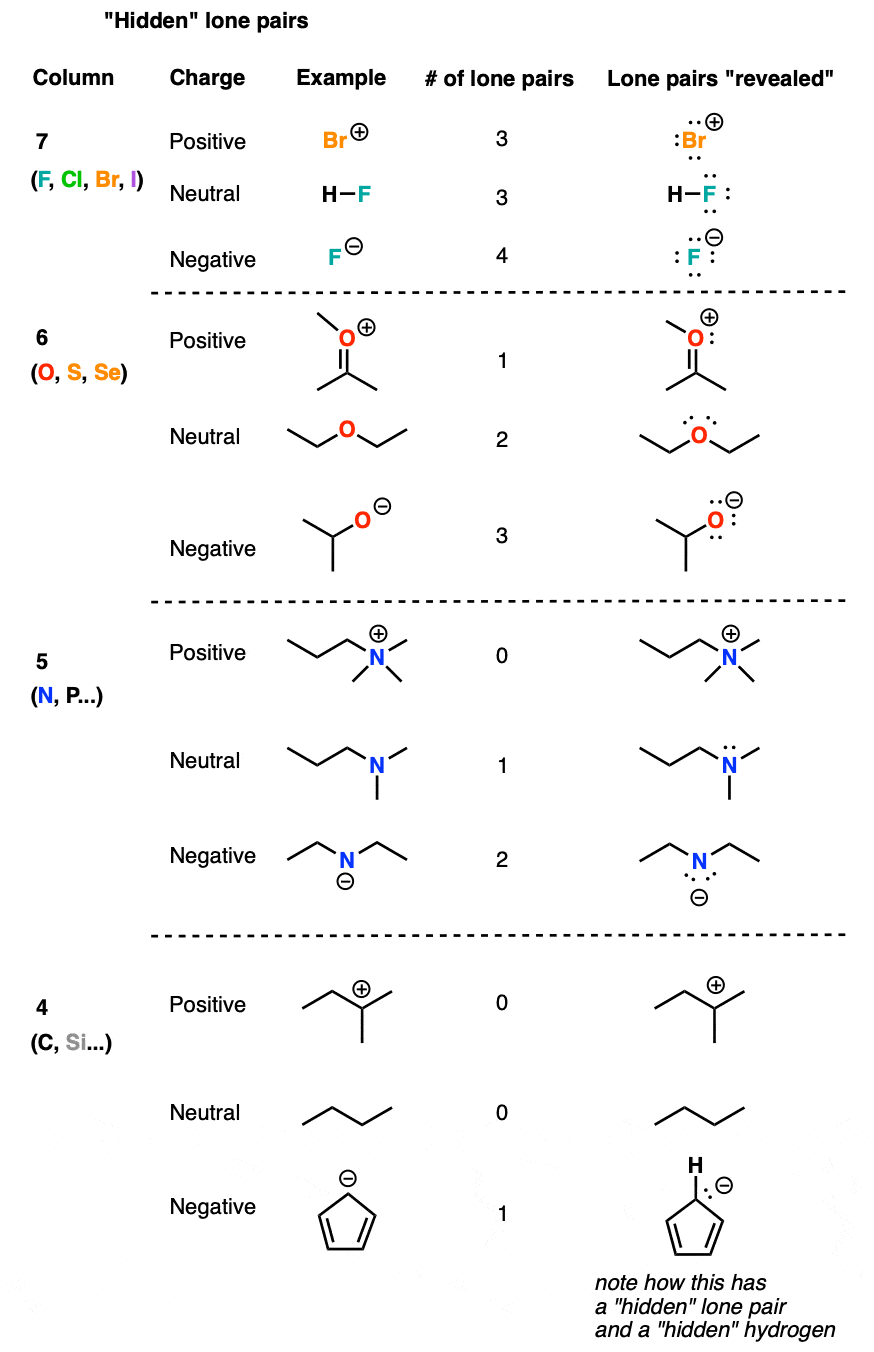
Lone pairs, however, are often omitted from ordinary skeletal drawings. When an assignment asks you to supply them—or when you are drawing a mechanism—add them explicitly.
For the common neutral atoms in introductory organic chemistry, use these defaults:
| Atom | Usual neutral bonding pattern | Lone pairs to add |
|---|---|---|
| O | 2 total bond-order units | 2 |
| N | 3 total bond-order units | 1 |
| F, Cl, Br, I | 1 single bond | 3 |
| C | 4 total bond-order units | 0 |
A double bond counts as two bond-order units, but it does not change the familiar result that a neutral carbonyl oxygen has two lone pairs. Likewise, neutral nitrogen with three bonds has one lone pair.
Return to ethanol from the earlier image:
- The first carbon has one visible bond, so it is CH3.
- The second carbon has two visible bonds, one to carbon and one to oxygen, so it is CH2.
- Oxygen has two single bonds, one to carbon and one to hydrogen.
- A neutral oxygen with two bonds has two lone pairs.
The skeletal drawing may leave those lone pairs invisible, but they are still present—and later they will matter directly when deciding where electron pairs move in a mechanism.
A necessary caution about charges
The neutral shortcuts above are powerful, but only when no charge is shown. If you see a written or , do not force the atom into its neutral pattern. A positively charged nitrogen, for example, does not have the same lone-pair count as neutral nitrogen.
For now, recognize a written charge as a signal that the normal shortcut has changed. In the next lesson, you will calculate the formal charge and check the octet explicitly.
A complete decoding checklist
When you encounter any skeletal structure, use this sequence:
-
Identify all atoms.
Every unlabeled end, bend, or intersection is C. Written symbols are the atoms they name. -
Copy all connectivity.
Preserve branches, ring closures, single bonds, double bonds, and triple bonds. -
Add H atoms to neutral carbon.
Give each carbon four total bond-order units. -
Preserve shown heteroatom hydrogens.
Hydrogens on O, N, and other heteroatoms should not disappear just because carbon-bound hydrogens do. -
Add lone pairs to neutral heteroatoms.
O usually receives two, N one, and halogens three. -
Perform a final local check.
Each ordinary neutral carbon should have four bond-order units; each ordinary neutral O or N should have an octet once lone pairs are included.
This is electron bookkeeping in its simplest form. It may feel mechanical initially, and that is useful: reliable mechanics free up your attention for the chemistry that comes later.
Key takeaways
Skeletal notation hides carbon symbols and hydrogens attached to carbon, but it does not remove those atoms from the molecule. Unlabeled ends and corners are carbons; written O, N, and halogens are explicit atoms rather than hidden carbons. To restore carbon hydrogens, count visible bond orders and fill each neutral carbon to four. Finally, add the normally omitted lone pairs on neutral heteroatoms when the problem requires a complete Lewis-style structure.
Next, you will build directly on this skill by assigning formal charges and checking octets. That will explain precisely why charged atoms require modified hydrogen and lone-pair bookkeeping.
Can't find a good explanation? Sign up and we'll make it for you
Sign up