
¡Hola de nuevo! In the previous lesson, you practised the Spain Spanish contrast between s and the th-like sound written z, ce, and ci. This lesson develops another contrast that can change a word’s meaning: the light, single-contact r in pero and the vibrating rr in perro.
By the end, you should be able to hear and produce the difference in common words, identify which sound Spanish spelling calls for, and practise it in short, useful sentences. Allow about 40 minutes, including several short aloud-practice rounds.
1. Two Spanish r sounds, two different movements
Spanish does not use the English r sound of red or car as its standard target. Instead, it has two tongue-tip sounds made just behind the upper front teeth:
| Sound | What the tongue does | Common spelling | Example | Meaning |
|---|---|---|---|---|
| single tap | Touches once, extremely quickly | r | pero | but |
| trill | Vibrates against the same area several times | rr | perro | dog |
The essential contrast is:
pero — but
perro — dog
In pero, the tongue makes one quick contact. In perro, the tongue tip vibrates repeatedly. The written rr is not two separate English-style r sounds; it represents one trilled Spanish sound.
Other high-value pairs include:
| Tap: single r | Meaning | Trill: rr | Meaning |
|---|---|---|---|
| caro | expensive | carro | cart; car in much of Latin America |
| pera | pear | perra | female dog |
| para | for | parra | grapevine |
For a Spain Spanish context, coche is the everyday word for “car,” while carro often refers to a cart or trolley. Still, caro / carro is an excellent pronunciation pair because the vowel pattern stays the same.
How to pronounce R and RR in Spanish - pero or perro?
Watch How to pronounce R and RR in Spanish – pero or perro? by Learn Spanish with Daniel. It gives you a compact listening model for the tap–trill contrast and shows how a single spelling change can create a different word.
Begin with the two sounds to hear pero and perro and locate the tongue’s contact point. Continue with trill basics, focusing on the fact that the tongue movement repeats for the trilled sound. Then watch word pairs and pause after each pair to imitate it aloud. Finish with initial r for the important spelling rule that a word beginning with r has the trilled sound.
When you imitate the pairs, avoid turning the difference into simple loudness. The tap is not merely a “quiet r,” and the trill is not merely a “strong r.” What matters is the number of tongue contacts: one for the tap, several produced by vibration for the trill.
2. Find the right place, then change the movement
Both sounds use the alveolar ridge: the firm bump on the roof of your mouth immediately behind your upper front teeth. You can find it by slowly saying t, d, n, and l. Your tongue already knows the general location.
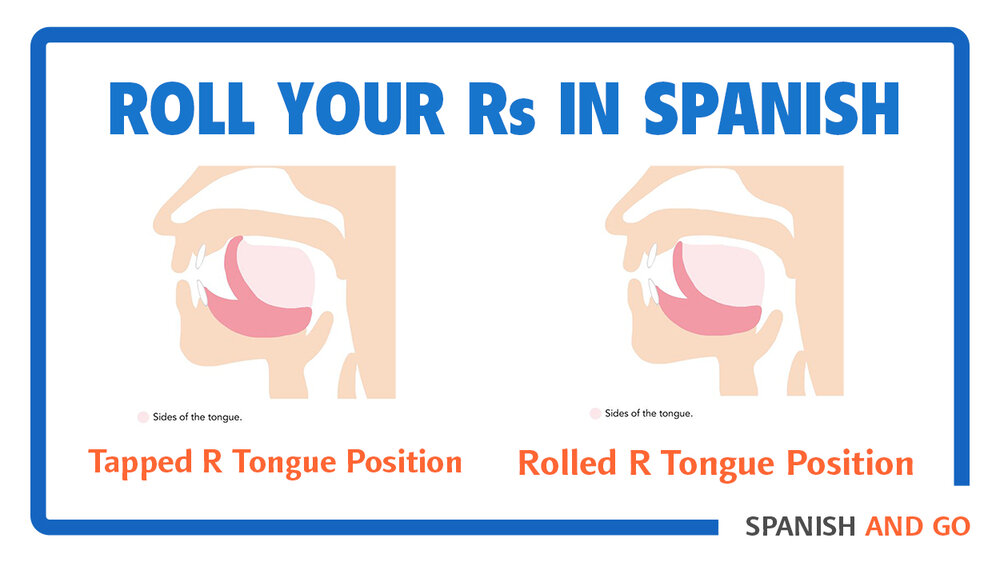
The single-tap r
For the tap in pero, cara, or María:
- Bring the tip of your tongue briefly to the alveolar ridge.
- Let it touch and release immediately.
- Keep your jaw and tongue relaxed.
Think of it as one quick flick, not a held d, l, or English r.
If you speak an American variety of English, the middle sound in water, better, or ladder may be close to this Spanish tap. That comparison does not work for every English accent, but the physical principle remains the same: one brief, voiced tongue contact.
Try these slowly:
a-ra, e-re, i-ri, o-ro, u-ru
pero, cara, María, barato, ahora
Do not pause before the r. The tap belongs smoothly inside the word.
The trilled r
For the trill in perro, carro, or rojo, the tongue goes to almost the same place, but it must not press firmly against the roof of the mouth. Instead:
- Keep the tongue tip close to the ridge and free to move.
- Let the sides of the tongue rest lightly against the upper side teeth.
- Send a steady, gentle stream of voiced air through the centre.
- Keep the jaw loose.
The airflow causes the tongue tip to vibrate. You do not create a trill by consciously making several separate taps. That usually makes the result tense and uneven.
A productive sequence is:
ra, re, ri, ro, ru
rra, rre, rri, rro, rru
perro, carro, barrio, torre
At first, a reliable trill may take time. Do short attempts of a few seconds, rest, and try again. Forcing a large amount of air is not the solution: if you hear only breath or a hiss, adjust the tongue’s distance from the ridge slightly rather than blowing harder.
Common adjustments
| What happens | Likely cause | Adjustment |
|---|---|---|
| It sounds like an English r | Tongue is pulled back or curled | Bring the tongue tip forward to the ridge behind the teeth. |
| It sounds like d or l | Tongue contact lasts too long | Make the contact shorter and release immediately. |
| No vibration happens | Tongue is pressed against the ridge | Relax the tip; it needs room to move. |
| You hear only air | Tongue is too far from the ridge or airflow is unfocused | Move the tip slightly closer and use gentle, steady airflow. |
| Your tongue or jaw feels sore | You are using too much tension | Stop, relax, and return later for a short practice round. |
For now, prioritise a clean tap and a relaxed trill attempt. Clear speech develops through repetition, not through straining.
3. Predict the sound from the spelling
The most visible contrast is r versus rr between vowels:
| Spelling pattern | Pronunciation target | Examples |
|---|---|---|
| one r between vowels | tap | pero, caro, María, para |
| rr between vowels | trill | perro, carro, barrio, torre |
But a single written r can also represent the trill. Spanish uses rr only inside a word; it does not begin words with rr. At the start of a word, one r is enough to signal the trill.
| Position of written r | Pronunciation target | Examples |
|---|---|---|
| beginning of a word | trill | rojo, rosa, rápido, restaurante |
| after l, n, or s | trill | alrededor, Enrique, Israel |
| after other common consonants in a group | tap | brazo, precio, drama, frase, grupo, primo, tren |
Compare these carefully:
pero: tap, because the r is between vowels.
perro: trill, because it is written rr.
rojo: trill, although it is written with only one r, because it begins the word.
Enrique: trill, because the r follows n.
primo: tap, because pr is a common consonant-plus-tap group.
Word-final r, as in hablar or comer, can vary somewhat in detail among speakers and regions. It is not the main contrast for this lesson. Concentrate on the highly predictable positions above: r between vowels, rr, initial r, and r after l, n, or s.
4. Make the contrast audible in speech
Begin with pairs. Say the first word with exactly one light touch; say the second with a sustained tongue vibration. Leave a short pause between the two words at first.
pero — perro
caro — carro
pera — perra
para — parra
Then remove the pause and alternate:
pero, perro, pero, perro
caro, carro, caro, carro
Now practise the sounds among other words. Read each sentence three times: first slowly, then comfortably, then with natural rhythm.
Pero mi perro es muy caro.
But my dog is very expensive.
El perro corre por el barrio.
The dog runs through the neighbourhood.
Enrique quiere un coche rojo.
Enrique wants a red car.
In the final sentence, notice three trills:
- Enrique: the r follows n;
- quiere: this r is a tap, because it occurs between vowels;
- rojo: the r begins a word.
That is the practical skill: not merely “rolling an r,” but choosing the appropriate sound quickly enough that pero does not become perro, and caro does not become carro.
For a short self-recording, say the four contrast pairs followed by the three sentences. Listen back for only two things:
- Does every tap have one quick contact rather than an English-style r?
- Is each trill noticeably different through repeated vibration, especially in perro, barrio, Enrique, and rojo?
Key takeaways
Spanish has two related but distinct tongue-tip r sounds:
- A written r between vowels is usually a single tap, as in pero, caro, and para.
- Written rr signals a trill, as in perro, carro, and barrio.
- A word-initial r is also trilled: rojo, rosa, restaurante.
- A single r after l, n, or s is trilled: alrededor, Enrique, Israel.
- Both sounds occur at the ridge behind the upper teeth. The key difference is one contact versus airflow-driven vibration.
Next, you will practise the rough, breathy sound written j and g before e or i, another feature that strongly shapes clear Spain Spanish pronunciation.
Can't find a good explanation? Sign up and we'll make it for you
Sign up