
¡Hola! In the previous lesson, you learned how Spanish spelling signals word stress, so that words such as jardín, teléfono, and fácil can be read aloud with more confidence. Clear pronunciation matters, but real conversation also requires a way to keep going when you miss something, need a moment to think, or notice that you have said the wrong word.
This lesson gives you a small, practical set of repair phrases for Spain Spanish. The goal is not to speak without pauses or errors. It is to handle those moments calmly in Spanish, so the conversation continues.
1. Repair is a conversation skill, not a failure
In a first language, people constantly pause, ask “sorry?”, reformulate an idea, or correct a date they have just said. Spanish speakers do the same. These moves are called repair strategies because they fix a small problem before it becomes a larger misunderstanding.
There are three core situations:
| Situation | Your conversational need | Useful Spanish |
|---|---|---|
| You need time to answer | Keep your turn while you think | Pues... a ver... / Déjame pensar un segundo. |
| You did not catch something | Ask the speaker to repeat, slow down, or explain | ¿Puedes repetirlo? / No he entendido. |
| You said something inaccurate | Replace the error immediately | Perdón, quise decir... |
At this stage, learn these as complete spoken units. You do not need to analyse every verb form before using them.
2. Buying a few seconds to think
A silent pause can feel long when you are learning, so use a brief marker to show that you are still preparing your answer.
Two very common options are:
- Pues... — “well...”
- A ver... — literally related to “let’s see,” but often used as “let me think...”
They are often combined:
Pues... a ver... creo que me gusta mucho España.
The words do not add important factual information. Their job is to hold the conversational floor while you plan the next phrase.
For a clearer request for time, use:
- Déjame pensar un segundo. — “Let me think for a second.”
- Déjeme pensar un segundo. — the more formal version.
- Un momento, por favor. — “One moment, please.”
Notice the difference in tone:
Pues, a ver... normalmente estudio por la tarde.
Un momento, por favor. Déjeme pensar un segundo.
The first is a light, natural hesitation in an ordinary conversation. The second is more explicit and is useful when someone has asked you a question and you genuinely need a little more time.
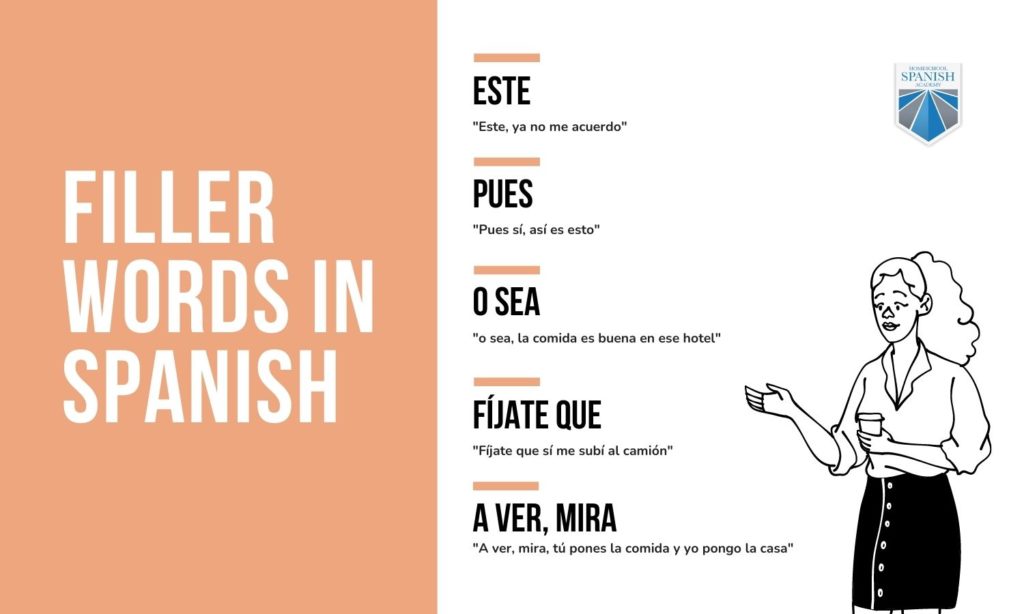
A useful caution: do not try to fill every silence with este... or o sea.... One short pues, a ver is enough. The aim is clarity, not imitating every native-speaker habit.
3. Asking for repetition, slower speech, or clarification
When you miss something, identify the actual problem. Did you not hear the sound? Was the speaker too fast? Or did you hear the words but not understand the meaning? Each situation has a better response than simply saying no entiendo.
When you want the same words again
With a friend, classmate, or someone you address as tú:
- Perdona, ¿puedes repetirlo?
“Sorry, can you repeat that?”
A more polite or formal version:
- Perdón, ¿podría repetirlo, por favor?
“Sorry, could you repeat it, please?”
The ending -lo means “it,” referring to what was just said. For now, remember repetirlo as a chunk.
If you caught most of the message, name the part you missed:
Perdona, no he entendido la última parte. ¿Puedes repetirla?
This is much more helpful than asking the other speaker to restart everything.
When the pace is the problem
Ask for a slower repetition:
- ¿Puedes repetirlo más despacio, por favor?
- ¿Podría repetirlo más despacio, por favor?
Use más despacio for “more slowly.” Do not use it when the real issue is an unfamiliar word; in that case, ask what the word means.
When you heard the words but need the meaning
Use these phrases to ask for explanation rather than repetition:
- ¿Qué significa “trayecto”?
- ¿A qué te refieres con “eso”?
- ¿Puedes decirlo de otra manera?
- Entonces, ¿quieres decir que... ?
The last phrase checks your interpretation. For example:
—El tren está retrasado.
—Entonces, ¿quieres decir que llega tarde?
—Sí, exactamente.
This is a powerful repair strategy because you actively show what you think you understood. The other person can then confirm it or adjust it.
¿Cómo pedir que nos expliquen o repitan algo?
Watch “¿Cómo pedir que nos expliquen o repitan algo?” from Hablamos español. It models polite ways to say that you have not understood and to request slower speech.
Begin with not understanding, focusing on the contrast between saying you did not understand and asking for repetition. Then watch slower repetition, and repeat each request aloud twice: once at the speaker’s pace and once at your own comfortable pace. Listen especially for the polite softening added by por favor.
The phrase No he entendido means “I haven’t understood” or, more naturally here, “I didn’t catch that.” You have not yet studied the grammar in he entendido; treat it as a useful fixed expression for now. Later, when you study past tenses, its structure will make sense in more detail.
4. A compact repair toolkit
The following phrases are enough for many everyday conversations. Start by making them automatic.
Guided conversation | AP Spanish Lang U4 | PrepGo
Read PrepGo’s “Guided Conversation: Clarification and Repair” for a compact bank of repetition, clarification, thinking-time, and self-correction phrases.
In the section “Requesting Clarification and Repair,” read the brief explanation beginning with the rationale for repair. Then study the “Organization Tools” table and the “Language and Strategy Bank.” Focus on choosing a phrase that matches the problem: repetition, a slower pace, clarification, time to think, or correction. The table appears again in the later “Organization Tools” section; you only need to study it once.
Here is a streamlined version to keep available in your notes:
| Purpose | Informal / familiar | Polite or formal |
|---|---|---|
| Gain time | Pues... a ver... | Un momento, por favor. |
| Ask for repetition | Perdona, ¿puedes repetirlo? | Perdón, ¿podría repetirlo, por favor? |
| Ask for slower speech | ¿Puedes repetirlo más despacio? | ¿Podría repetirlo más despacio, por favor? |
| Ask about a word | ¿Qué significa “...”? | ¿Qué significa “...”, por favor? |
| Ask for another explanation | ¿Puedes decirlo de otra manera? | ¿Podría explicarlo de otra manera? |
| Check your understanding | Entonces, ¿quieres decir que...? | Entonces, ¿quiere decir que...? |
The informal and formal patterns are not separate vocabularies; they express the same communicative needs. For now, use puedes with friends, classmates, and people you know well. Use podría or puede when you want a more respectful tone. A later module will develop the wider tú, usted, and group-address system used in Spain.
5. Correcting yourself without stopping the conversation
An error becomes less important when you repair it quickly. You do not need a long explanation or repeated apology.
The most useful pattern is:
Perdón, quise decir [correct information], no [incorrect information].
For example:
La clase es el jueves. Perdón, quise decir el viernes.
“The class is on Thursday. Sorry, I meant Friday.”
Vivo en Barcelona; perdón, quise decir que vivo cerca de Barcelona.
“I live in Barcelona; sorry, I meant that I live near Barcelona.”
You can also use:
- Mejor dicho... — “rather,” or “more precisely...”
- No, perdón... — a quick restart
- Me refiero a... — “I mean...”
Compare their uses:
| Phrase | Best use |
|---|---|
| Perdón, quise decir el viernes. | You stated a clearly wrong fact and replace it. |
| Mejor dicho, el viernes por la tarde. | You make your first statement more precise. |
| No, perdón, no trabajo allí; estudio allí. | You immediately replace the wrong verb or idea. |
| Me refiero a la estación de Atocha. | You clarify which person, place, or thing you mean. |
A natural correction often has a small pause in the middle:
Voy a Madrid el lunes... perdón, el martes.
That pause is not a problem. It gives you time to notice the mistake and replace it.
A complete repair sequence
Put the pieces together in a short exchange:
—La reunión empieza a las ocho y cuarto.
—Perdona, no he entendido la hora. ¿Puedes repetirlo más despacio?
—Sí, empieza a las ocho y cuarto.
—Ah, a las ocho y cuarto. Gracias.
—De nada.
And a self-correction:
—¿Cuándo vas a viajar?
—Pues, a ver... voy a viajar en junio. Perdón, quise decir en julio.
In both examples, the speaker remains in Spanish throughout. That is the central habit to build.
6. A short spoken routine
For five minutes, rehearse the toolkit aloud rather than only reading it.
- Say Pues, a ver... and pause for two beats before giving any simple answer you already know, such as where you live or what you like.
- Practise one repetition request with puedes and one with podría.
- State a simple fact, deliberately change one detail, and repair it with Perdón, quise decir...
- Finish each request with a brief response such as Ah, vale, gracias or Ahora entiendo.
Keep the correction short. The useful skill is not producing a perfect first attempt; it is recovering smoothly when the first attempt needs adjustment.
Key takeaways
Repair phrases keep a Spanish conversation moving:
- Use pues... a ver... or déjame pensar un segundo to gain thinking time.
- Ask for repetition with ¿puedes repetirlo? and for a slower pace with ¿puedes repetirlo más despacio?
- Ask for meaning or a different explanation when repetition alone will not solve the problem.
- Check your interpretation with Entonces, ¿quieres decir que...?
- Correct yourself promptly with Perdón, quise decir... or mejor dicho...
Next, you will use these tools inside a longer personal exchange: expanding brief answers, adding a relevant detail, and asking a follow-up question so that a conversation can last beyond a few isolated sentences.
Can't find a good explanation? Sign up and we'll make it for you
Sign up