Introduction
Welcome to your next lesson! In our last session, we dove into the concept of knight outposts—powerful squares deep in enemy territory where a knight can thrive because it's safe from pawn attacks. We saw that these "holes" are a specific type of weakness created by pawn moves.
Today, we'll expand on this theme by exploring the broader world of pawn weaknesses. The pawn structure is the skeleton of a chess position; learning to read it is like learning to read a map that shows you where the strategic targets are. Your goal for this lesson is to learn to identify three of the most common pawn weaknesses—backward, isolated, and doubled pawns—and formulate a clear plan to exploit them.
Mastering this skill will give you a powerful method for finding good plans in quiet middlegame positions where no immediate tactics are available.
1. The Core Principle: A Weakness is a Target
Before we dive into specific types of weak pawns, it's crucial to understand a universal principle. In chess, a weakness is not a weakness unless it can be attacked. Identifying a structural flaw is only half the battle; the other half is creating a concrete plan to exploit it.
How to Identify and Exploit WEAKNESSES - Chess Strategy Deep Dive #1
This video from Dr. Can's Chess Clinic drives home this exact point. It demonstrates that even when weaknesses exist, your moves must be geared towards making them exploitable targets.
Watch the section from 02:14 to 03:47. Pay close attention to the difference between recapturing with the rook versus the f-pawn. Why does one choice create an exploitable target while the other doesn't?
This idea of looking for targets is a fundamental part of strategic thinking. The Chessmood article, "The 7Q Method," which we'll reference again, frames this as the very first question you should ask yourself in any position: "What problems does the opponent have?" Often, the answer is a weak pawn.
2. The Backward Pawn
A backward pawn is one of the most significant and common structural weaknesses. It acts as a permanent hook for you to hang your attack on.
Definition: A backward pawn is a pawn that cannot be defended by a neighbouring pawn. Furthermore, the square in front of it is typically controlled by an enemy piece, preventing it from advancing.

So, how do you identify and, more importantly, exploit a backward pawn?
How to Identify and Exploit WEAKNESSES - Chess Strategy Deep Dive #1
Let's return to Dr. Can's video. He provides a crystal-clear demonstration of identifying a backward pawn and then executing a simple, powerful plan against it.
Watch the two clips from 00:27 to 02:14. First, you'll see how to spot the backward pawn. Then, observe the step-by-step plan Black employs to attack it. Notice how simple and logical the plan is: place your rooks on the open file to put pressure on the weakness.
The plan against a backward pawn is one of the most straightforward in chess strategy:
- Blockade: Place a piece, ideally a knight, on the square directly in front of the pawn. This stops it from ever advancing and increases the pressure. This square is often an outpost!
- Pressure: Use your rooks and queen to attack the pawn along the open or semi-open file.
- Attack: As your opponent ties their pieces down to defend the weak pawn, they will have fewer defenders for other parts of the board, often leading to tactical opportunities elsewhere.
Sometimes, you can even create a backward pawn for your opponent through a simple recapture.
How to Identify and Exploit WEAKNESSES - Chess Strategy Deep Dive #1
One last clip from Dr. Can's video shows a brilliant example from former World Champion Mikhail Botvinnik. Watch how his choice of recapture (e takes d5) is not random but is specifically designed to create a long-term weakness in the opponent's camp.
Watch from 05:16 to 07:37. The key takeaway is understanding why e takes d5 is so much stronger than c takes d5. It's all about creating that backward e7-pawn as a permanent target.
3. The Isolated Pawn
An isolated pawn, often called an "Isolani," has a dual nature: it can be a source of attacking strength or a critical weakness, depending on the phase of the game.
Definition: An isolated pawn is a pawn that has no friendly pawns on adjacent files.
Top 5 Pawn Structures You Should Know
Levy Rozman (GothamChess) gives a concise overview of the isolated pawn in this clip. He explains its characteristics and the general strategies for both sides.
Watch from 17:30 to 18:24. Focus on understanding why the pawn is weak and what the player with the isolated pawn needs to do to compensate.
Playing against an Isolated Pawn:
- Goal: Your primary goal is to trade pieces and steer the game towards an endgame.
- Plan:
- Blockade: Just like with a backward pawn, control the square in front of the isolated pawn to prevent it from advancing. A knight is the ideal blockader.
- Trade Pieces: The fewer pieces on the board, the harder it is for your opponent to generate an attack. In an endgame, the isolated pawn becomes a simple, vulnerable target that often requires the enemy king to defend it passively.
- Attack: Once pieces are traded, you can often win the pawn by force.
Playing with an Isolated Pawn:
- Goal: Use the open files and central control provided by the pawn to launch an attack.
- Plan:
- Avoid Trades: Keep pieces on the board to support your attack.
- Attack: Use the open c- and e-files for your rooks and the outpost squares (like e5 or c5 for a d4-pawn) for your knights.
- Advance: At the right moment, you can push the pawn forward (
d4-d5) as a sacrifice to break open the enemy king's position.
4. Doubled Pawns
Doubled pawns are perhaps the most visually obvious weakness, but their evaluation is highly contextual.
Definition: Doubled pawns are two (or even three) of your own pawns on the same file.
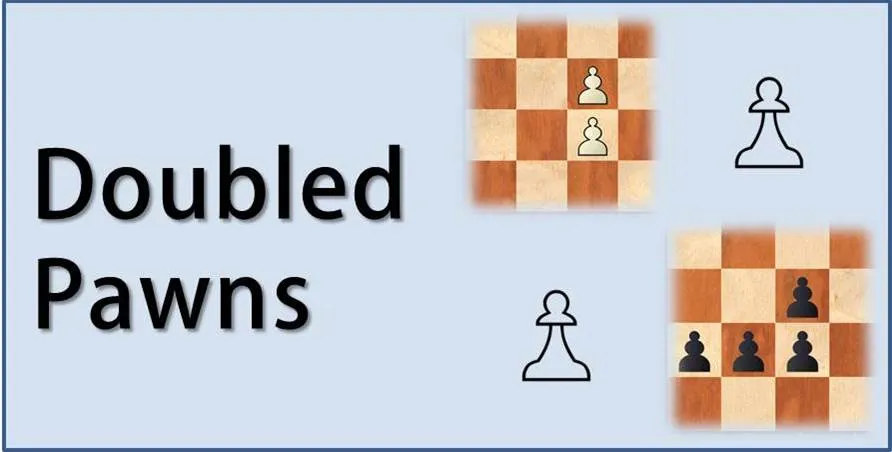
Top 5 Pawn Structures You Should Know
Let's turn to GothamChess again for a look at doubled pawns. He explains how they can arise and discusses the strategic pros and cons.
Watch from 08:11 to 12:24. Notice that doubled pawns aren't always bad. They can open a file for a rook and strengthen control over central squares. The key is to understand the specific context.
Playing against Doubled Pawns:
- Weaknesses: They are inherently clumsy. The front pawn can't be defended by the one behind it, making it a target. They also control fewer squares than two pawns on separate files.
- Plan:
- Attack the Front Pawn: The forward pawn is the weakest link. Focus your pieces on it.
- Exploit Weak Squares: The absence of a pawn on its original file can create weak squares around the doubled pawns for your pieces to use.
- Prevent "Undoubling": Keep the pawns fixed in their awkward structure.
Practice Problem
Now, let's apply these concepts. Look at the position below. It's White to move.
White to move. Analyze the pawn structure.
Your Task:
- Identify Weakness: What is the main, long-term pawn weakness in Black's position?
- Formulate a Plan: Based on this weakness, what is a simple, effective strategic plan for White? What kind of pieces would you use, and where would you put them?
.
.
.
Solution
- Identify Weakness: Black has a backward pawn on d6. The pawn on e6 cannot defend it, and the pawn on c5 has moved past it. It is a permanent target.
- Formulate a Plan:
- The plan is to increase pressure on the d6 pawn.
- White should play 1. Rad1, putting a rook on the semi-open d-file to directly attack the weakness.
- The knight on c3 can be maneuvered to the d5 outpost (via
Ne2-d4-f5or similar routes) to blockade the pawn and intensify the attack. - By tying Black's pieces to the defense of d6, White can build an advantage and look for opportunities on other parts of the board.
Conclusion
You've now learned to identify and form plans against three fundamental pawn weaknesses. Seeing these structures will help you navigate the middlegame with greater confidence and purpose.
Key Takeaways:
- Pawn weaknesses are strategic targets. Your plan should be to make them exploitable.
- Backward Pawn: A fixed target. The plan is to blockade and attack it with heavy pieces on the corresponding file.
- Isolated Pawn: A double-edged sword. To play against it, blockade it, trade pieces, and attack it in the endgame.
- Doubled Pawns: Often awkward and immobile. The plan is to attack the front pawn and exploit the surrounding weak squares.
Preview of the Next Lesson:
We've examined individual pawn weaknesses. In the next lesson, we will zoom out and look at the pawn structure as a whole. You will learn to distinguish between open, closed, and semi-open positions and select an appropriate strategy for each. This will add another crucial layer to your strategic understanding, helping you decide whether to seek piece exchanges, launch a pawn storm, or maneuver patiently.