
Hello! Welcome to the first lesson of Module 6: Implementing CQRS and Resilient Persistence.
Introduction
In our previous module, we concluded our study of Event Sourcing by analyzing its strategic trade-offs. A key architectural consequence we observed was the natural separation between the write side (appending events to a log) and the read side (building projections from that log). This separation is the perfect entry point for today's topic.
This lesson addresses the learning outcome: Analyze the Command Query Responsibility Segregation (CQRS) pattern, explaining when its complexity is justified.
We will dissect the CQRS pattern, starting from its conceptual roots, and then build a framework for deciding when to adopt it. We will explore how CQRS allows for independent scaling and optimization of read and write operations, a common requirement in the high-throughput financial systems you've worked on. Crucially, we will also analyze the costs—namely, increased complexity and eventual consistency—to understand when this powerful pattern is a strategic choice versus an unnecessary complication.
1. From CQS to CQRS: Separating Responsibilities
The CQRS pattern is an architectural evolution of a simpler programming principle called Command Query Separation (CQS). Understanding CQS is the first step.
To get a clear definition, please watch the first part of the following video.
CQS and CQRS: Command Query Responsibility Segregation
This video from the Drawing Boxes channel provides a very clear and concise explanation of CQS, the principle that underpins CQRS.
Please watch the first section, 'CQS: Command Query Separation', from the beginning until 01:26. Focus on the core idea: asking a question should not change the answer.
As the video explains, CQS, proposed by Bertrand Meyer, states that every method should be either:
- A Command: Performs an action, changes the state of the system, but does not return data.
- A Query: Returns data, but does not change the state of the system (i.e., has no side effects).
CQRS takes this principle and applies it at the architectural level. Instead of just separating methods, we separate the entire model. There will be one model for handling commands (writes) and a separate model for handling queries (reads).
Now, watch the next brief segment of the same video, which introduces CQRS itself.
CQS and CQRS: Command Query Responsibility Segregation
Let's continue with the same video to see how CQS is extended to CQRS.
Watch the section 'CQRS: Command Query Responsibility Segregation' from 01:26 to 02:08. Note how the separation moves from methods to distinct models.
This separation is visualized in the following diagram:
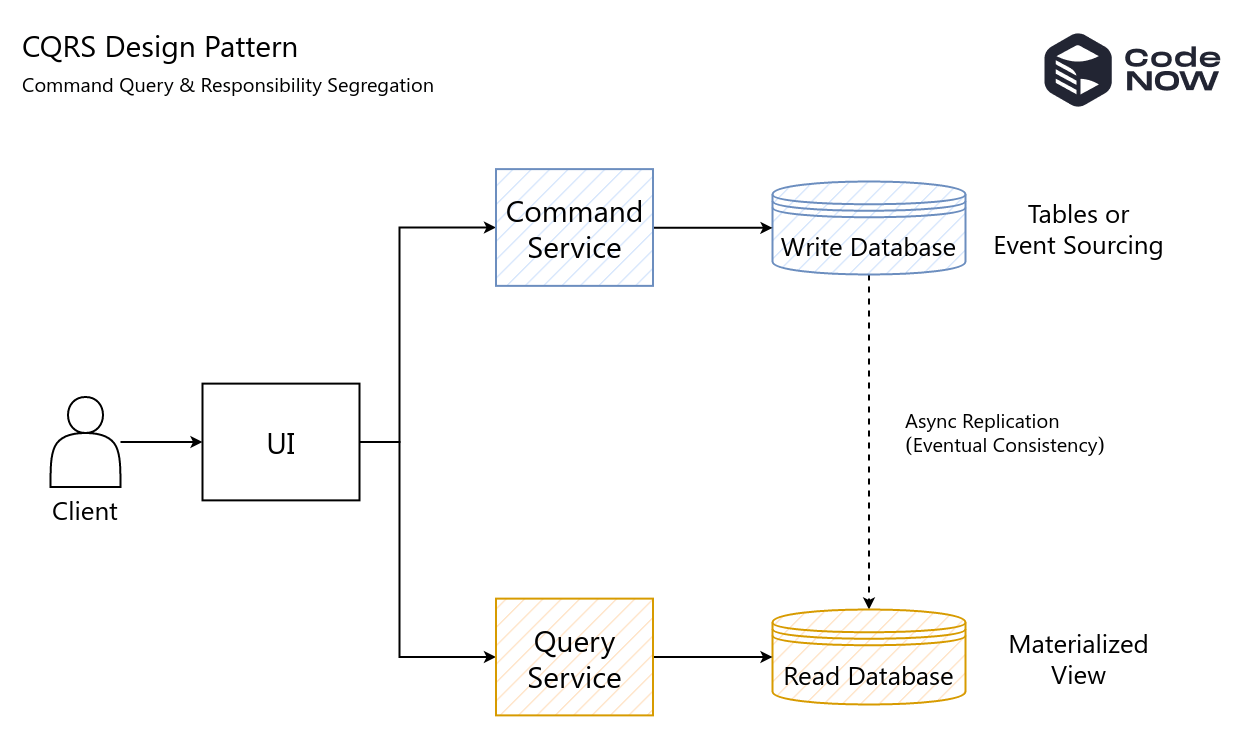
This structure should look familiar. It formalizes the architecture we discussed with Event Sourcing, where the event log is the Write Database and projections are the Read Databases (or "Materialized Views"). However, it's critical to remember: CQRS and Event Sourcing are separate patterns. You can use CQRS without Event Sourcing (e.g., with a standard relational database for writes), and you can use Event Sourcing without a fully separate read model (though it's less common). They are often used together because they are highly complementary.
2. The Problem: Why a Single Model Fails at Scale
Before we analyze the benefits of CQRS, we must understand the problems it solves. A traditional CRUD (Create, Read, Update, Delete) architecture uses a single data model for both reads and writes. While simple and effective for many applications, it begins to break down under certain pressures.
To understand these pressures, please read the following article from Microsoft's Azure Architecture Center.
CQRS Pattern - Azure Architecture Center
This article, 'CQRS pattern', clearly outlines the context and problem that CQRS is designed to solve.
Please read the section 'Context and problem'. Focus on the four challenges it identifies: Data mismatch, Lock contention, Performance problems, and Security challenges.
Let's consider these challenges in the context of a financial system, like an FX trading platform:
- Data Mismatch: The data model needed to execute a trade (a command) is complex, involving validation, risk checks, and transactional integrity. The model needed to display a user's trade history (a query) is much simpler and presentation-focused. Forcing one model to serve both purposes leads to compromises.
- Conflicting Performance Requirements: The write side (placing trades) needs to be fast and consistent. The read side (viewing price charts, account balances) might involve a massive volume of requests that require different optimization strategies (e.g., caching, denormalization). Optimizing for one often degrades the other.
- Lock Contention: In a high-throughput system, many users reading from and writing to the same data tables can lead to database locks, creating performance bottlenecks.
The Confluent article on CQRS provides an excellent example from banking that illustrates this conflict perfectly.
Command Query Responsibility Segregation (CQRS)
This article from Confluent provides a practical example that highlights the tension between read and write optimization in a single model.
Please read the sections 'Why CQRS?' and 'An Example of CQRS'. The example contrasts the ideal storage for transactions (writes) with the ideal storage for account balances (reads).
This example crystallizes the core issue: a single model forces a compromise. CQRS is about refusing to make that compromise.
3. The Justification: When is CQRS Worth the Complexity?
CQRS introduces complexity, so its adoption must be justified by significant benefits. These benefits directly address the problems of a single-model architecture.
The primary justifications for CQRS are:
- Independent Scaling: Read and write workloads often have vastly different profiles. In an exchange, there are orders of magnitude more price-tick reads than trade-execution writes. CQRS allows you to scale the read fleet of servers independently from the write fleet, optimizing resource allocation and cost.
- Optimized Data Schemas & Polyglot Persistence: The write model can use a database optimized for transactional integrity (like PostgreSQL or a dedicated event store). The read models can be stored in databases optimized for their specific query patterns—a document database like MongoDB for flexible user profiles, a search index like Elasticsearch for full-text search, or an in-memory cache like Redis for low-latency lookups.
- Performance Optimization: Read models can be pre-calculated, denormalized materialized views. Instead of performing complex
JOINs on the fly for every request, the query simply reads from a table that is already shaped exactly as the UI needs it. This dramatically improves query performance and reduces load on the write database. - Separation of Concerns: The complex business logic, validation, and transaction management are isolated on the command side. The query side is simple, often containing no business logic at all. This can improve maintainability and allow development teams to specialize and work more independently.
The following resources provide more detail on these benefits.
CQS and CQRS: Command Query Responsibility Segregation
The 'Drawing Boxes' video summarizes the key benefits succinctly.
Watch the section 'Justification and Benefits of CQRS' from 02:08 to 04:08. Pay attention to how it connects CQRS to independent evolution and performance optimization.
CQRS Pattern - Azure Architecture Center
The Azure article also provides a concise list of the primary benefits.
Read the 'Benefits of CQRS' section. This list serves as a good summary of the main selling points.
4. The Cost: Analyzing the Drawbacks
The benefits of CQRS are not free. Adopting the pattern introduces its own set of challenges that must be carefully considered.
- Increased System Complexity: This is the most significant drawback. You now have at least two models to develop and maintain. You also need a mechanism to synchronize the read model(s) from the write model, often involving a message bus and event handlers.
- Eventual Consistency: When the read and write models are in separate databases, updates to the read side are asynchronous. This means there will be a delay (from milliseconds to seconds) between when a command is processed and when its effects are visible in queries. The system, especially the UI, must be designed to handle this data staleness. For a financial application, you must analyze which operations can tolerate this delay and which cannot. For instance, is it acceptable for a user's portfolio balance to be a few seconds out of date after a trade?
- Development and Operational Overhead: More moving parts mean more code, more infrastructure to manage, and a steeper learning curve for the development team.
The following reading provides a balanced view of these challenges.
Command Query Responsibility Segregation (CQRS)
The Confluent article does a great job of outlining the challenges associated with CQRS.
Please read the section 'CQRS Challenges'. Pay close attention to the discussions on Complexity and Eventual Consistency.
5. A Decision Framework: To CQRS or Not to CQRS?
Given the trade-offs, CQRS is not a pattern to be applied universally. It should be used surgically, within specific bounded contexts where the benefits clearly outweigh the costs.
CQRS is highly justified when:
- You have highly divergent and demanding read/write workloads (e.g., many more reads than writes).
- Performance and scalability are critical business requirements, and you need to optimize reads and writes independently.
- The domain logic for commands is significantly more complex than the logic for queries.
- You are working in a collaborative domain where multiple actors change the same data, and managing write contention is a priority.
- You are already using Event Sourcing, as CQRS is a natural fit for creating queryable projections.
CQRS is likely not justified when:
- The application is simple, with basic CRUD-like operations.
- The read and write patterns are similar and do not have demanding performance requirements.
- The development team is small or unfamiliar with distributed system patterns.
- The business requirements have a zero-tolerance policy for eventual consistency across the entire system.
To help solidify this decision-making process, the Confluent article provides an excellent summary table.
Command Query Responsibility Segregation (CQRS)
Finally, let's review a practical decision matrix that summarizes when to use CQRS.
Read the sections 'When is CQRS worth it?', 'When to avoid CQRS', and review the 'Decision Matrix Table With Examples'. This will provide you with a concrete framework for evaluating the pattern.
Conclusion
In this lesson, we have analyzed the Command Query Responsibility Segregation pattern. We've seen that it is a powerful architectural choice for managing complexity and achieving high performance in demanding systems, but it comes at the cost of increased complexity and the need to manage eventual consistency.
Key Takeaways:
- Core Principle: CQRS separates the model used for writing data (commands) from the model(s) used for reading data (queries).
- Justification: The pattern is justified when read and write workloads are significantly different, enabling independent scaling, optimization, and technology choices for each.
- Primary Cost: The main trade-offs are a significant increase in architectural complexity and the introduction of eventual consistency between the write and read models.
- Decision Criteria: The decision to use CQRS should be a deliberate one, based on a clear analysis of performance requirements, domain complexity, and tolerance for eventual consistency. It is not a one-size-fits-all solution.
Preview of the Next Lesson:
Having established the "why" and "when" of CQRS, our next lesson will move to the "how." We will begin to apply this theory by addressing the next learning outcome: Design separate write (command) and read (query) models for the financial scenario modeled in the previous module. This will involve defining the structure of commands and designing denormalized read models to serve specific query needs.
Can't find a good explanation? Sign up and we'll make it for you
Sign up