Introduction
Hello! In our last lesson, we explored how to initiate an attack by sacrificing a piece on the weak f7/f2 squares. You learned that these sacrifices are not random gambles but calculated investments designed to expose the enemy king. However, an investment only pays off with the right follow-through. A sacrifice is just the opening move; to win, you must follow it up with overwhelming force.
Today's lesson focuses on exactly that: how to formulate a plan to bring your reserve forces—your queen and rooks—into an ongoing attack. An attack with only one or two pieces is easily repelled. A successful attack is like a wave, with reinforcements continuously joining the fray until the defense collapses. We will learn how to identify your inactive pieces and create clear pathways for them to join the battle.
The Principle of Superior Force: The "+2 Rule"
The most fundamental principle of any attack is to have more attackers than defenders at the point of contact. If you have three pieces attacking the king and your opponent has only one defender, you are very likely to succeed. If the numbers are even, your attack will probably stall.
A great practical guideline for this is what IM Levy Rozman (GothamChess) calls the "+2 Rule": for a decisive attack on the king, you want at least two more active attackers than your opponent has defenders.
To see this principle in action, let's watch a short, focused video that explains and demonstrates this rule.
Chess Tips: Attacking The King, Rule of +2
The video 'Chess Tips: Attacking The King, Rule of +2' explains this simple but powerful concept. Pay attention to how he counts the attackers and defenders and uses this calculation to justify a sacrifice.
Watch the entire video (it's about 7 minutes). Notice in each example how the attack is preceded by an assessment of the forces involved. The final example is particularly important, as it shows that 'bringing in reserves' can sometimes mean making a pawn move to open a line for a piece far from the action.
The key idea is that the value of a piece is relative. A rook sitting on a1, doing nothing, is not contributing its five points to the game. But a bishop actively involved in an attack on the enemy king might be worth more than its standard three points. Your goal is to activate your passive pieces and make them count.
Bringing in the Reinforcements: Rooks and Queen
Your queen and rooks are your "heavy pieces" and represent your greatest attacking potential. However, they often start the game far from the action. Your task as an attacker is to create pathways for them to join the fight.
Let's explore the primary methods for activating them.
Unleashing Your Queen and Rooks in Chess Middlegames
The article 'Unleashing Your Queen and Rooks in Chess Middlegames' provides an excellent overview of how to bring your major pieces into the game. We'll read specific sections on activating both the queen and the rooks.
Please read the following sections: The Queen's Mobility Makes Her Mighty: Focus on how Alekhine repositions his queen to increase its attacking potential. Making Use of the Queen's Long-Range Ability in Chess: Note the Qd8-b8-a7 maneuver. This idea of rerouting the queen to an undefended part of the board is a powerful strategic concept. Rooks Come to Life on Open Files: This covers the most fundamental way to use your rooks. Pay attention to the idea of placing a rook behind a pawn to support its advance. The Swinging Rook Is a Powerful Attacker: This explains the 'rook lift' or 'rook swing', a crucial technique for bringing a rook into a kingside attack.
Key Maneuvers for Your Reserve Forces
From the reading, let's crystallize the most important techniques:
-
Queen Repositioning: Don't be afraid to spend a move or two to bring your queen to a more active square (e.g., from d1 to g4 via e2). A powerful queen on an attacking square is worth the time it takes to get there.
-
Rooks on Open Files: This is the rook's natural highway to the enemy position. An open file allows a rook to penetrate to the 7th rank, where it can wreak havoc on your opponent's pawns and tie their pieces down.
-
The Rook Lift: This is a maneuver you absolutely must add to your toolkit. It typically involves moving a rook to the 3rd (for White) or 6th (for Black) rank and then sliding it across the board to join an attack. For example, a rook might travel from f1 to f3 and then to h3 to attack the h7-pawn.

Developing a Plan: From Assessment to Execution
Knowing the techniques is one thing; applying them is another. How do you formulate a plan in a real game?
This process can be broken down into a few steps, which are summarized well in the "Attacking Chess Principles" article.
Attacking Chess Principles: The Art of Winning Attacks | The Chess ...
This article provides a structured framework for planning an attack. We'll focus on the preparation phase.
Please read two key sections: Find the heading 'Building Attack Foundations'. Read the subsections 'Piece Mobilization' and 'Line Opening'. These points directly relate to our topic. Find the heading 'Attack Development Phases'. Read the part about 'Phase 1: Preparation'. Focus on the objectives: identifying the target, mobilizing your pieces, and securing your own king.
Based on what we've learned, here is a practical thought process for bringing in reinforcements:
- Assess: Your attack has started. Who are the attackers and defenders? Do you have superior force (+2)?
- Identify Reserves: Which pieces are not participating? Usually, it's a rook on a1/h1 or the queen.
- Find Pathways: How can these pieces join in?
- Is there an open file for a rook? If not, can you create one with a pawn break?
- Is there a safe square to lift a rook to (e.g., e3, f3, g3)?
- What is the best route for your queen to enter the attack without getting exposed?
- Execute: Play the sequence of moves to bring the piece into the game. Remember, preparation is key. Don't rush.
Test Your Knowledge
Let's work through some positions. The goal isn't to find an immediate checkmate, but the best move to reinforce the attack.
Puzzle 1
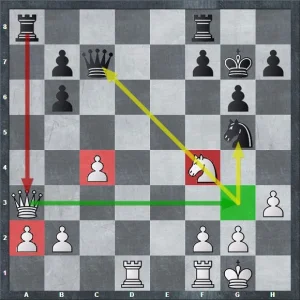
Solution
The best move is **`1. Ra3!`**. This is a classic rook lift. The rook on a8 was passive, but from a3 it prepares to swing over to the b- or c-file to attack the weak pawns around Black's king. It also adds another powerful attacker to the queenside, adhering to the principle of superior force. A move like `Ng6+` is tempting, but it allows Black to trade pieces and relieve the pressure. `Ra3` builds the attack patiently and decisively.Puzzle 2
You are playing White. You've sacrificed a piece to open up Black's king, but you need more firepower to finish the job. Your queen on d1 and rook on a1 are currently spectators.
White to move. How can you most effectively bring your reserves into the attack?
Solution
The plan is to bring the queen and then the rook to the kingside. The most effective move is **`1. Qe2!`**. This prepares to swing the queen to g4 or h5, where it will put immense pressure on the exposed black king. After `1. Qe2`, Black has a very difficult time defending. For example, if Black plays `1...f5` to block the bishop, White can continue with `2. Qh5` and the attack is crushing. A slower plan might be a rook lift like `Re1-e3-g3`, but bringing the queen in first is much faster and stronger here.Conclusion
Excellent work! You've learned one of the most important skills of an attacking player: how to sustain an attack by bringing in reinforcements. An attack is rarely won by the pieces that start it; it's won by the reserves that join mid-battle to deliver the final blow.
Key Takeaways:
- Attack with Superior Force: Always aim to have more attackers than defenders. The "+2 Rule" is a fantastic mental shortcut.
- Activate Your Queen: Use repositioning and rerouting maneuvers to bring your most powerful piece to the most dangerous squares.
- Unleash Your Rooks: Master the use of open files and the Rook Lift. A rook on the 3rd rank, ready to swing to the g- or h-file, is one of the most powerful attacking weapons in chess.
- Plan Your Reinforcements: Before launching an attack, or during one, always ask: "Which pieces are not playing?" and "How can I get them into the game?"
Preview of the Next Lesson:
In this module, we've covered specific attacking patterns like the Greek Gift, f7-sacrifices, and now, bringing in reserves. In our next lesson, we will put it all together. You will be challenged to solve puzzles focused on finding the decisive attacking move in a complex position, requiring you to use all the principles you've learned to land the knockout punch.