
Introduction
Welcome to our final lesson on the Quimbaya! In the previous session, we unpacked the core themes of their worldview—shamanism, duality, transformation, and their vision of the afterlife. We established a kind of "symbolic dictionary" for their culture.
Now, we will put that dictionary to use. This lesson fulfills the learning outcome: Connect Quimbaya mythology to the symbolism found in their sophisticated goldwork, such as the Poporo Quimbaya. We will conduct a "design analysis" of some of the most iconic Quimbaya artifacts. For you, as a product designer and visual storyteller, this is like studying a master's portfolio to understand how they embedded deep meaning and narrative into their creations. We'll see how abstract beliefs were translated into a tangible, powerful, and beautiful design language.
1. A Case Study: The Poporo Quimbaya
Let's begin with the single most famous artifact of Quimbaya culture, an object so significant it has become a national symbol of Colombia.
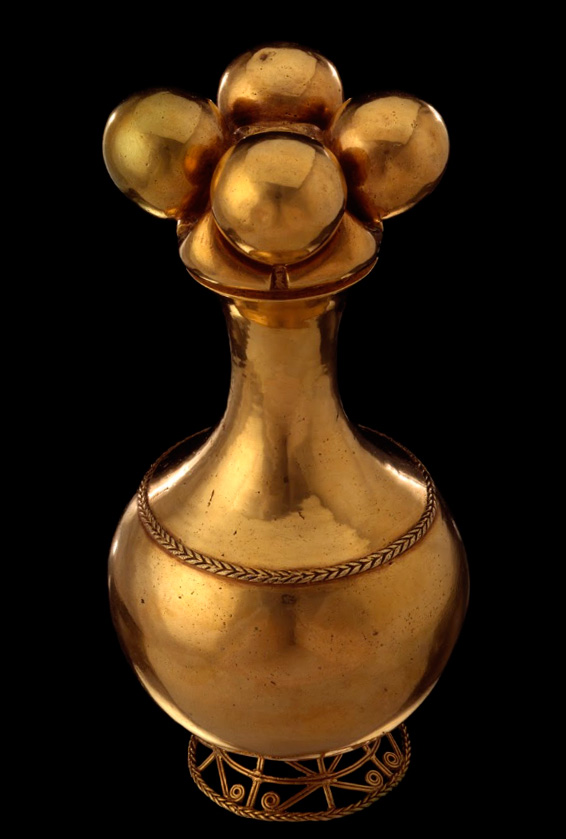
To understand its layers of meaning, let's turn to a description from the Banco de la República's cultural encyclopedia.
The following text from 'Quimbaya (english version)' describes the context and symbolic meaning of goldwork from the Early Quimbaya Period, with a specific focus on poporos.
Please read the section titled 'Early Quimbaya Period'. Focus on how the text connects the forms of poporos (inspired by fruits and female figures) and their material qualities (colors, brightness) to the concepts of fertility and the role of the leader in sacred ceremonies.
As you've just read, every design choice in the Poporo Quimbaya is deliberate and meaningful:
-
Form & Fertility: The object’s shape is not arbitrary. It evokes natural forms like gourds, pumpkins (
calabazos), and totumas. These are direct symbols of agricultural abundance and, by extension, the fertility of the land and the community. The overall shape can also be seen as representing a womb, linking it to human reproduction and the cycle of life. -
Material & Vitality: The artifact is made of
tumbaga, a gold-copper alloy. The radiant, sun-like gleam of the gold was associated with vital energy, divine power, and life itself. The reddish hue from the copper further enriched this symbolism. -
Ritual & Duality: As we touched upon previously, the function of the poporo is a ritual performance of duality. The vessel (poporo) is the feminine element, the container. The stick used to extract the lime is the masculine, activating element. The coca leaf itself is from the earth. The act of chewing the mixture brought these cosmic forces together within the shaman or leader, reinforcing their role as the maintainer of cosmic balance.
In one single object, the Quimbaya managed to encode their core beliefs about life, nature, and the cosmos. It's a perfect fusion of function, form, and meaning.
2. The Human Form as Sacred Vessel
While some poporos symbolized fertility through natural forms, others did so more explicitly by taking the shape of human figures. These artifacts give us a direct window into how the Quimbaya perceived their spiritual and political leaders.
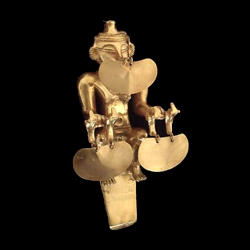
These figures are stunning examples of the "Meditative Shaman" theme we discussed. They represent leaders not as warriors, but as conduits of spiritual power.
Gold and Power in Ancient Costa Rica, Panama, and ...
The paper 'Gold and Power in Ancient Costa Rica, Panama, and Colombia' gives a fantastic description of this 'Meditative Shaman' theme, specifically referencing the Quimbaya poporos as the best-known examples.
Please reread the first paragraph of the section 'Meditative Shaman'. Pay attention to the description of the figure’s posture, attire (or lack thereof), adornments, and the objects they hold. This description perfectly matches the artifact in the image above.
By analyzing these figures as "user personas" of the Quimbaya elite, we can see how they projected their own identity and power:
- A State of Being: The figures are shown nude, with semi-closed eyes and a tranquil expression. This isn't a portrait of a person in daily life; it's an image of someone in a ritual state, deep in communication with the spirit world.
- Symbols of Power: The figures wear ornaments like helmets and nose rings. As noted in the
Quimbaya (english version)resource, these were not just decorations but "emblems of prestige and as a source of spiritual power." They marked the individual as a leader with a special connection to the divine. - Agents of Transformation: The figure in the photo holds bars with birds, a direct reference to shamanic flight and the ability to travel between the earthly and spiritual realms.
These poporos transform a functional object into a representation of the ideal leader: a being who, through ritual, embodies the connection between the community and the cosmos.
3. Transformation as a Visual System
The symbolic language of the Quimbaya was not confined to poporos. It was a coherent system applied across different types of artifacts, especially those worn by leaders to display their power. In the Late Period (c. 900-1600 AD), the theme of shamanic transformation became even more prominent, particularly on large chest ornaments called pectorals.
Let's return to the 'Quimbaya (english version)' resource to see how this symbolic system evolved. This section discusses the shift in goldwork during the Late Period.
Please read the section 'Lizard Men and Feline Lords: The Power of Transformation in the Middle Cauca in the Late Period'. Focus on how the iconography changes from female/fruit shapes to male/animal-hybrid figures, and how these new figures represent the shaman's ability to transform.
This reading demonstrates the consistency and evolution of the Quimbaya design language. While the poporos of the Early Period often emphasized fertility and meditative states, the pectorals of the Late Period made the leader's transformative power explicit.
The "lizard-man" figures, with human heads and reptile bodies, are a direct visual statement: the wearer is not entirely human. They possess the power of other beings. The inclusion of feline ears further layers this identity, combining human intellect, the otherworldly nature of the reptile, and the predatory power of the jaguar.
This is a powerful storytelling device. By wearing such a pectoral, a leader visually declared their shamanic abilities and their authority, which stemmed from the ability to harness the powers of the animal world.
Test your understanding!
Imagine you are sketching ideas for an illustration of a powerful Quimbaya leader from the Late Period. You want to convey that this leader is seen as both a political authority and a shaman capable of transformation.
Which of the following artifacts would you have them wear, and why?
- A poporo shaped like a pumpkin.
- A large, circular pectoral with a "lizard-man" design.
- A simple pair of golden earrings.
Show answer
The most effective choice would be 2. A large, circular pectoral with a "lizard-man" design.
Here's why:
- The pumpkin-shaped poporo (1) is more associated with the Early Period and themes of fertility. While important, it doesn't convey the specific theme of shamanic transformation as explicitly.
- The simple earrings (3) could be worn by anyone and don't carry the symbolic weight needed to signify the unique status of a transformative leader.
- The "lizard-man" pectoral (2) is a direct and powerful symbol from the Late Period that explicitly communicates the leader's ability to cross the boundaries between human and animal, a core aspect of their shamanic power and authority. It's a clear statement of their supernatural capabilities.
Conclusion
In this lesson, we've treated Quimbaya goldwork not just as treasure, but as a sophisticated form of communication. By analyzing iconic artifacts through the lens of their mythology, we've seen how a complex worldview can be encoded in physical objects.
Key Takeaways:
- The Poporo Quimbaya as an Icon: This masterwork uses form (gourds, wombs), material (gleaming gold), and function (ritual) to create a dense symbol of fertility, life, and cosmic duality.
- The Human Figure as a Symbol: Anthropomorphic poporos depict the "Meditative Shaman," representing leaders as spiritual conduits whose power came from their connection to the sacred, not just from earthly might.
- A Coherent Symbolic System: The themes of shamanism and transformation are consistently applied across different artifacts and periods. The "lizard-man" pectorals of the Late Period are a powerful evolution of this visual language, explicitly stating the leader's ability to transform.
Preview of the Next Module:
We have now concluded our journey through the world of the Quimbaya in the Cauca River Valley. In the next module, we will travel south to the high-altitude Andes to meet the Pasto and Nasa peoples. We will explore how their dramatic environment of volcanoes and páramos shaped a completely different set of myths, including stories about the origin of the moon and the spiritual power of fire.
Can't find a good explanation? Sign up and we'll make it for you
Sign up