
Hello again. You already know the most important number on an element tile: the atomic number tells you the number of protons, and for a neutral atom it also tells you the number of electrons.
Now we will learn to read the entire tile rather than just one number. By the end of this lesson, you should be able to point to any ordinary element square and identify its name, symbol, atomic number, and relative atomic mass—and explain what each one means.
An element tile is an information card
The periodic table is a large reference chart, but each individual square is a compact information card for one element. Layouts differ slightly among periodic tables, so do not rely only on exact placement. Instead, identify each field by its usual appearance:
- A small whole number, often near the top: the atomic number.
- One or two large letters in the centre: the chemical symbol.
- The element’s written name, often below the symbol.
- A larger decimal number, often near the bottom: relative atomic mass.
Use the magnified hydrogen tile in the image below. It labels each of these four pieces explicitly.
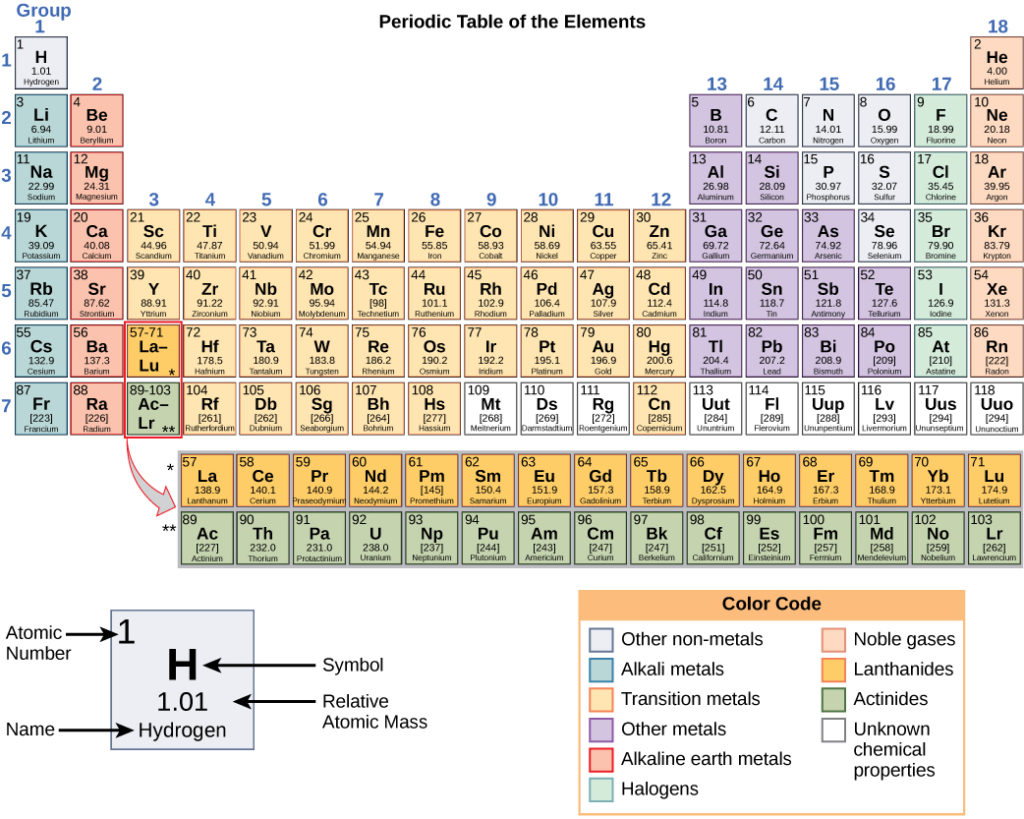
For hydrogen, read the tile as:
| Tile information | Value for hydrogen | Meaning |
|---|---|---|
| Name | Hydrogen | The full name of the element |
| Symbol | H | Chemistry’s short, universal label for hydrogen |
| Atomic number | 1 | Every hydrogen atom has 1 proton |
| Relative atomic mass | 1.01 | The average mass of naturally occurring hydrogen atoms |
The tile does not show four unrelated facts. They all describe the same element. If a tile says O, 8, Oxygen, and 16.00, each label is giving a different kind of information about oxygen.
Name and symbol: the element’s labels
The name is simply the element’s full spoken and written name: carbon, oxygen, iron, gold, and so on.
The chemical symbol is a standardized abbreviation used internationally by scientists. It contains either one or two letters.
- A one-letter symbol is capitalized: H for hydrogen, C for carbon, O for oxygen.
- A two-letter symbol has a capital first letter and a lowercase second letter: He for helium, Mg for magnesium, Ca for calcium.
Capitalization is part of the symbol, not decoration. For example:
- Co means cobalt.
- C means carbon.
- O means oxygen.
So writing CO does not mean cobalt; in chemical writing, it represents carbon and oxygen together. You will encounter chemical formulas later, but it is worth building the capitalization habit immediately.
Most symbols resemble English names:
| Name | Symbol |
|---|---|
| Hydrogen | H |
| Nitrogen | N |
| Oxygen | O |
| Carbon | C |
| Aluminium | Al |
| Calcium | Ca |
A few symbols seem surprising because they come from older names, often Latin. For example, sodium is Na, from natrium; iron is Fe, from ferrum; and gold is Au, from aurum. Do not try to explain every symbol from spelling. For memorization, treat each as a precise pairing: iron, Fe; sodium, Na.
How to read the periodic table | Poster | RSC Education
Read the Royal Society of Chemistry’s concise guide to reinforce the conventions for symbols and the meanings of the two numbers on a tile.
In the section “Reading and writing chemical symbols,” first read the explanation of capitalization. Then read the paragraph on the two numbers. Focus on the contrast between the small atomic number, which is fixed for an element, and the relative atomic mass, which is usually larger and may be a decimal.
Atomic number: the identity number
The atomic number is the small whole number. It is often written as in chemistry.
This is the identity rule from the previous lessons. Every oxygen atom has 8 protons, so oxygen’s atomic number is always 8. Every magnesium atom has 12 protons, so magnesium’s atomic number is always 12.
For a neutral atom, you can extend that reading:
Consider the calcium tile:
| Field | Calcium’s value |
|---|---|
| Name | Calcium |
| Symbol | Ca |
| Atomic number | 20 |
| Relative atomic mass | 40.08 |
From the atomic number alone, you can state:
- Every calcium atom has 20 protons.
- A neutral calcium atom has 20 electrons.
Atomic number is always a whole number because an atom cannot have part of a proton. It also never changes for that element. If a particle has 20 protons, it is calcium; with 21 protons, it is scandium instead.
A useful tile-reading sentence is:
“Calcium, symbol Ca, has atomic number 20, so it has 20 protons—and 20 electrons if it is neutral.”
Relative atomic mass: why the bottom number is usually a decimal
The number near the bottom of a tile is usually called relative atomic mass or simply atomic mass on classroom periodic tables. Unlike atomic number, it is often a decimal:
- Hydrogen:
- Carbon:
- Magnesium:
- Calcium:
It tells us about the mass of atoms of that element. At a beginner level, the central interpretation is:
A larger relative atomic mass means that atoms of that element are, on average, more massive.
This number is not the number of protons. Carbon’s tile might show 6 and 12.01:
- is the atomic number, so carbon has 6 protons.
- is the relative atomic mass, describing mass, not proton count.
Why is it a decimal?
Atoms of the same element always have the same number of protons, but they can have different numbers of neutrons. These versions are called isotopes.
For example, every carbon atom has 6 protons. But one carbon atom might have 6 neutrons, while another might have 7 or 8. They are all still carbon because their proton count remains 6. However, they have slightly different masses.
A standard periodic table therefore gives a weighted average of the masses of the isotopes found in nature. “Weighted” means common isotopes influence the average more than rare isotopes. That is why carbon appears as , rather than exactly 12 or 13.
You do not need to calculate isotope averages for this course right now. The essential distinction is enough:
| Question | Use which number? |
|---|---|
| What element is this? | Atomic number |
| How many protons? | Atomic number |
| How many electrons in a neutral atom? | Atomic number |
| How massive are its atoms on average? | Relative atomic mass |
| Is it normal for the number to be decimal? | Yes, for relative atomic mass |
Be especially careful with the tempting but incorrect statement “atomic mass equals protons plus neutrons.” For one particular isotope, a whole-number mass number is the total of protons and neutrons. But the decimal on the periodic-table tile is normally a weighted average across isotopes. It is not the exact particle total for one individual atom.
Elements and atomic number | Chemistry | Khan Academy
Watch Khan Academy’s “Elements and atomic number” for a visual walk-through of what appears in a tile, followed by two examples of retrieving facts from a periodic table.
Watch reading a tile. Notice the nitrogen example: the atomic number, symbol, written name, and atomic-mass entry serve different purposes. Then watch two lookups, pausing briefly before the answers to identify the missing tile facts yourself.
A four-part method for any tile
When looking at a new element tile, read it in the same order every time:
- Identify the name. Say the full name.
- Read the symbol exactly, including capitalization.
- Read the atomic number and translate it into a proton count.
- Read the relative atomic mass as an average mass, not a particle count.
Here are three examples using the table image.
Oxygen
The oxygen tile shows:
- Name: Oxygen
- Symbol: O
- Atomic number: 8
- Relative atomic mass: 16.00
Interpretation: every oxygen atom has 8 protons. A neutral oxygen atom has 8 electrons. Its listed average atomic mass is 16.00.
Magnesium
The magnesium tile shows:
- Name: Magnesium
- Symbol: Mg
- Atomic number: 12
- Relative atomic mass: 24.31
Interpretation: magnesium is identified by 12 protons. A neutral magnesium atom also has 12 electrons. The 24.31 number is its relative atomic mass, so do not call it “24.31 protons.”
Gold
The gold tile shows:
- Name: Gold
- Symbol: Au
- Atomic number: 79
- Relative atomic mass: 196.97
Interpretation: gold has 79 protons. The unfamiliar symbol Au is one of the historical symbols worth learning as a fixed name-symbol pair. Its mass entry, 196.97, is much larger than 79 because it refers to atomic mass, not the count of protons.
Make the distinctions automatic
A tile gives you two types of information:
- Identity information: name, symbol, atomic number.
- Mass information: relative atomic mass.
The atomic number has priority because it defines the element. The name and symbol label that identity in words and shorthand. Atomic mass is a useful additional property, but it does not define which element the tile represents.
Use this brief spoken routine whenever you first meet a tile:
“This is [name], symbol [symbol]. Its atomic number is [number], so it has [number] protons. Its relative atomic mass is [decimal], an average mass.”
For example:
“This is chlorine, symbol Cl. Its atomic number is 17, so it has 17 protons. Its relative atomic mass is 35.45, an average mass.”
For a five-minute independent review, choose five tiles from the provided table—preferably hydrogen, carbon, oxygen, magnesium, and chlorine. Cover the labels with your hand one at a time, uncover each tile, and say all four fields aloud. On a second pass, add the neutral-atom electron count from the atomic number.
Key takeaways
An element tile usually contains four core facts:
- Name: the full element name.
- Symbol: a one- or two-letter scientific abbreviation; first letter capitalized, second letter lowercase.
- Atomic number: a whole number equal to the number of protons.
- Relative atomic mass: usually a decimal average mass based on the element’s isotopes.
Keep the two numbers separate:
For a neutral atom, the atomic number also gives the electron count. Next, you will move from reading a single tile to locating tiles in the table by learning about groups (columns) and periods (rows).
Can't find a good explanation? Sign up and we'll make it for you
Sign up