
Welcome. This course begins with the cellular basis of biology: before studying organelles, membranes, or DNA, it is essential to know what counts as a cell and why cells are considered the fundamental units of life.
In this lesson, you will use the three principles of cell theory to decide whether an example is cellular or acellular, and—most importantly—justify your decision with biological evidence. By the end, you should be able to distinguish a bacterium, yeast cell, plant, animal, or amoeba from acellular agents such as viruses and prions.
The three principles of cell theory
Cell theory is a powerful scientific generalisation: it connects organisms as different as bacteria, mushrooms, oak trees, and humans by identifying their shared basis in cells.
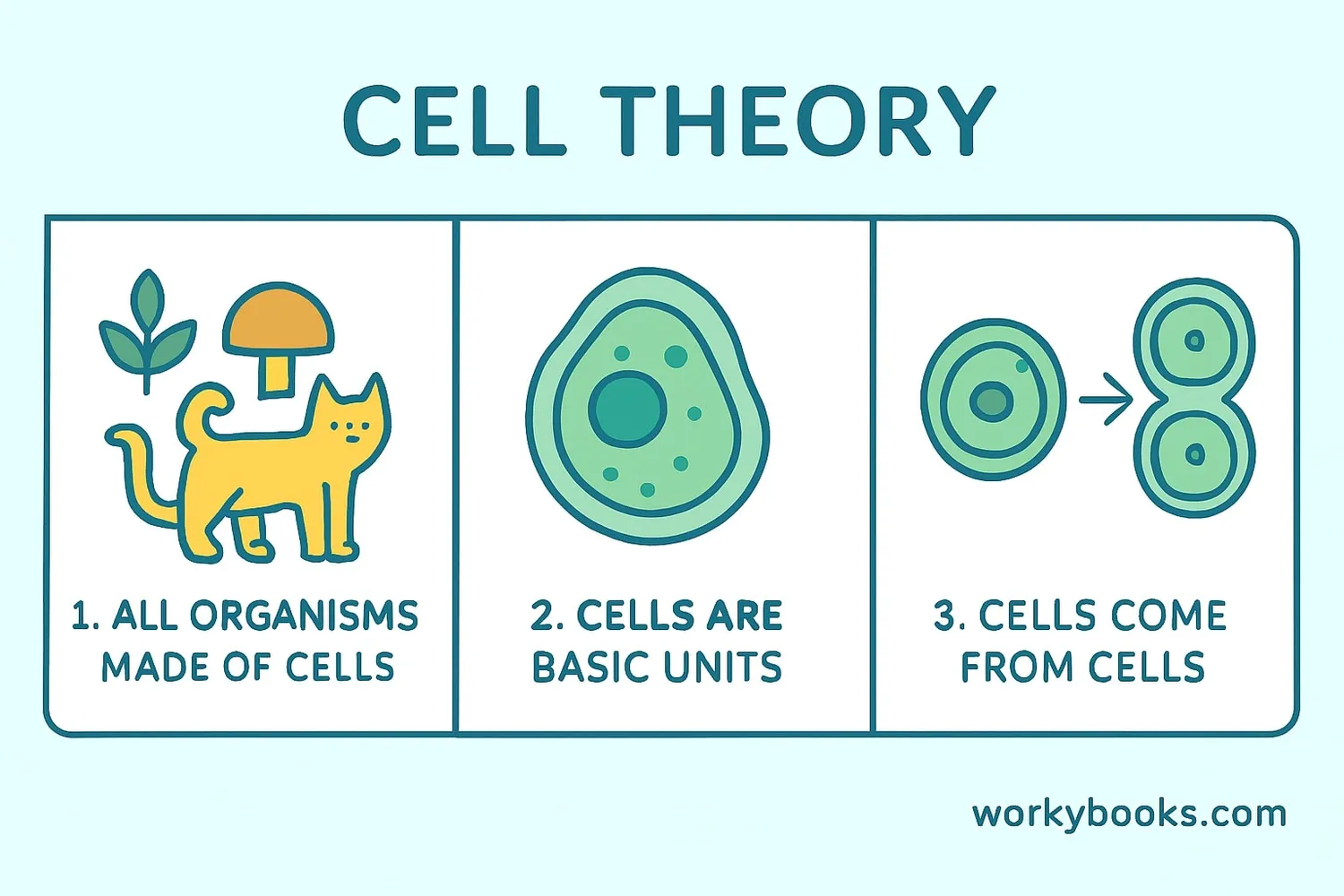
The three core principles are:
- All living organisms are made of one or more cells.
- Cells are the smallest units of structure and function in living things.
- All cells come from pre-existing cells.
The word cellular means “made of cells” or “consisting of cells.” A bacterium is cellular because it is one cell. A human is cellular because the body contains many cells. A leaf is cellular because it is made of plant cells, even though the leaf itself is only one part of a larger organism.
Learn: The cellular basis of life (article) | Khan Academy
Read Khan Academy’s overview to establish the three principles in their precise form. Focus especially on the difference between an organism made of one cell and one made of many cells, and on why a cell is more than simply a small piece of matter.
In the section “Cells are the basis of life on Earth,” read the explanation of unicellular and multicellular organisms. Then, in “Cells are the smallest unit of life,” read the account of what cells can do. Continue into “All cells come from other cells” for cell division. Finally, read the three-point summary under “Cell theory summarizes the cellular basis of life,” beginning with the theory itself.
The second principle needs careful wording. Cells are the smallest structures that can carry out the processes of life: using energy, maintaining an internal environment, using genetic information, and performing chemical reactions. An organelle, such as a nucleus or mitochondrion, has an important job inside a cell, but it is not independently a living cell.
The third principle means that cells do not appear from nonliving matter during an organism’s normal life cycle. A bacterial cell can divide to form two bacterial cells. In a multicellular organism, repeated cell divisions produce the cells needed for growth, repair, and development.
A useful distinction: cellular is not the same as “one cell”
| Description | Example | Classification |
|---|---|---|
| One complete cell that carries out life processes | A bacterium or amoeba | Cellular; unicellular |
| An organism made of many cells | A cat, mushroom, or tree | Cellular; multicellular |
| A body part made of cells | A leaf or human skin | Cellular material, but not a whole organism |
| A structure inside a cell | A nucleus or chloroplast | Not a cell itself |
| A biological agent not made of cells | A virus or prion | Acellular |
Do not use the presence of a nucleus as your test for whether something is cellular. Bacteria are cells, but they do not have nuclei. The nucleus will become important in a later lesson when distinguishing prokaryotic from eukaryotic cells.
Turning cell theory into a classification method
When an exam question asks whether an example is cellular, do not merely name it. Build a short justification. The most reliable structure is claim, evidence, reasoning.
Step 1: State the classification
Use precise language:
- “This example is cellular.”
- “This example is acellular, meaning it is not made of cells.”
- “This is a cellular structure, but not an entire organism.”
Step 2: Identify structural evidence
Look for evidence that the object is a complete cell or consists of cells. Common clues include:
- a cell membrane enclosing cytoplasm,
- genetic material inside a cell,
- a description of cells dividing,
- cells performing life processes,
- evidence that the organism is described as unicellular or multicellular.
A diagram does not always label every cell structure, so combine the visible evidence with the information supplied in the question.
Step 3: Link the evidence to cell theory
Choose the principle that actually supports your decision:
| Evidence in the example | Best cell-theory connection |
|---|---|
| A mushroom consists of many microscopic units called cells | All organisms are made of one or more cells |
| An amoeba lives as one membrane-enclosed cell | Cells are the basic units of structure and function |
| One bacterium splits into two bacteria | All cells come from pre-existing cells |
| A particle contains genetic material inside a protein coat and needs a host cell to reproduce | It is acellular, rather than a cell-based organism |
A strong answer does not need all three principles every time. Use the principle that best matches the evidence, then add another if it gives meaningful support.
Worked example: bacterium
Claim: A bacterium is cellular and unicellular.
Evidence: It is one membrane-enclosed cell containing cytoplasm and genetic material. It can grow and divide to produce new bacterial cells.
Reasoning: Because a bacterium is itself a complete cell, it fits the principle that cells are the basic units of structure and function. Its division also supports the principle that new cells arise from pre-existing cells.
Worked example: a leaf
Claim: A leaf is cellular, but it is not a single cell and not an independent organism.
Evidence: A leaf is a plant structure made of many plant cells arranged into tissues.
Reasoning: The leaf supports the first principle because its structure is built from cells. However, it is only part of the plant organism.
This distinction prevents a common mistake: calling everything made of cells “a cell.” A tree, a leaf, and a bacterium are all cellular, but only the bacterium is one cell.
The critical counterexample: viruses are acellular
Viruses are biologically important, contain genetic material, and can cause disease. These facts can make them seem “alive” at first glance. However, viruses are not composed of cells.
1.3 Types of Microorganisms - Microbiology | OpenStax
Read OpenStax Microbiology for a clear comparison between cellular microorganisms and acellular viruses. This is especially useful because viruses can reproduce only by using a host cell, which is different from cellular reproduction.
First read the final paragraph of the introductory material, beginning “Microorganisms differ from each other not only in size,” through the distinction between cellular microbes and acellular viruses. Then find the “Viruses” section. Read from the sentence explaining that viruses are not composed of cells, and focus on how they use a host cell’s machinery to multiply.
A virus typically consists of genetic material enclosed in a protein coat. It does not have the full cellular machinery needed to perform life processes independently. Instead, it enters or attaches to a host cell and uses that host cell’s machinery to make more viruses.
A bacteriophage is a virus that infects bacteria. The diagram shows a capsid, viral genome, sheath, and tail fibers. Notice what is absent: it is not a membrane-enclosed unit of cytoplasm able to carry out its own metabolism and reproduction. Its genetic material alone does not make it a cell.
Watch Amoeba Sisters’ “Viruses (Updated)” for a concise comparison of viruses with cellular organisms such as bacteria and fungi.
Watch the cellular contrast. Focus on the distinction between a virus and an organism made of cells, and note why viruses cannot be classified as either prokaryotes or eukaryotes.
A careful classification is:
A virus is acellular. It contains genetic material, but it is not made of a cell and cannot independently perform the full functions of life. It reproduces only by taking over a host cell.
Whether viruses should be described as “living” can be discussed in more depth, because they have some life-like features, such as genetic material and evolution. For this course outcome, the key conclusion is clear: viruses are not cellular.
Prions provide an even more extreme example. A prion is an infectious abnormal protein with no cells and no genetic material. It is therefore also acellular.
Applying the method to common examples
Here are model classifications you can use to check your reasoning.
| Example | Cellular or acellular? | Justification |
|---|---|---|
| Bacterium | Cellular | It is a complete unicellular organism that carries out life processes and divides to produce new cells. |
| Amoeba | Cellular | It is one eukaryotic cell that functions as an entire organism. |
| Yeast | Cellular | A yeast organism is a single fungal cell. |
| Mushroom | Cellular | It is a multicellular fungus made of many cells. |
| Human | Cellular | A human is a multicellular organism composed of specialised cells. |
| Plant leaf | Cellular structure | It is made of plant cells, although it is a part of a plant rather than a complete organism. |
| Chloroplast | Not independently cellular | It is a specialised structure within a plant cell, not a complete cell. |
| Virus | Acellular | It has genetic material and proteins but is not made of cells and depends on a host cell to multiply. |
| Prion | Acellular | It is an abnormal infectious protein, not a cell. |
A few patterns are worth memorising:
- Bacteria, archaea, protists, fungi, plants, and animals are cellular.
- An organism can be unicellular or multicellular.
- Viruses and prions are acellular.
- A nucleus is not required for something to be a cell.
- Being microscopic does not make something acellular. Most bacteria are microscopic, yet each bacterium is a complete cell.
A short memory routine
To retain the theory, use the phrase “Made, Main, More.”
- Made: living organisms are made of cells.
- Main: the cell is the main, smallest unit that performs life functions.
- More: new cells make more cells through division.
When you see an unfamiliar biological example, silently run this check:
- Is it made of one or more complete cells?
- Can those cells carry out life processes?
- Does the description show cells arising through cell division, or instead show an acellular particle relying on a host?
Then write a conclusion using the vocabulary cellular, acellular, unicellular, or multicellular, followed by evidence and a link to cell theory.
Key takeaways
Cell theory states that all living organisms are made of cells, cells are the smallest functional units of life, and all cells come from pre-existing cells. These principles allow you to classify bacteria, fungi, plants, animals, and protists as cellular—even when they are microscopic or consist of only one cell.
Viruses and prions are acellular. A virus may contain genetic material and reproduce inside a host, but it is not itself a cell and depends on a host cell’s machinery.
Next, you will use microscope images, measurements, and scale bars to calculate actual specimen size or magnification.
Can't find a good explanation? Sign up and we'll make it for you
Sign up