Hello! Welcome back to our exploration of LLM interaction and prompting.
In our last lesson, we learned how to use Chain-of-Thought (CoT) prompting to guide a model through a step-by-step reasoning process. This dramatically improves performance on complex tasks. However, CoT has a potential weakness: it typically relies on a single, greedily decoded reasoning path. If the model makes even one mistake in this chain, the final answer is likely to be wrong.
This brings us to today's learning outcome: Apply self-consistency to enhance the robustness of CoT reasoning. We'll explore a powerful decoding strategy that builds directly on CoT to overcome its single-path fragility. Think of it as moving from a single expert's opinion to a consensus from a panel of experts.
This lesson will cover:
- The core concept of self-consistency and its intuitive analogy.
- The theoretical principle that makes it so effective.
- A step-by-step guide to implementing it, including a Python example.
- The trade-offs involved, particularly regarding cost and applicability.
1. From a Single Chain to a Diverse Ensemble
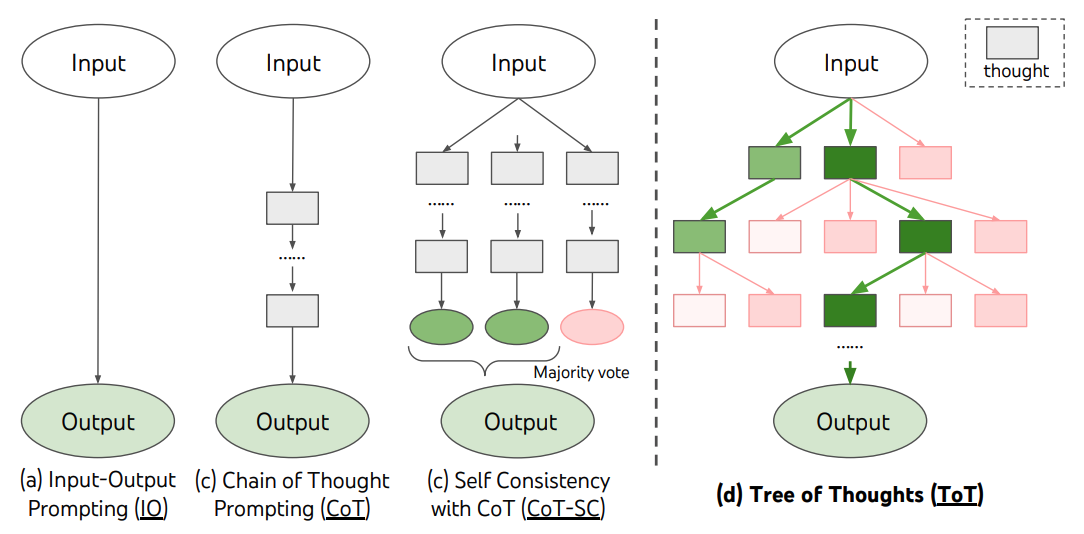
The fundamental idea of self-consistency is to explore multiple, diverse reasoning paths for the same problem and then select the most consistent answer. Instead of taking the single "best" path, we generate several plausible paths and trust the answer that the majority of them converge on.
This visual from a post by Niklas Heidloff perfectly illustrates the shift from a single Chain of Thought to the multi-path approach of Self-Consistency.
2. The Core Idea: The Expert Panel Analogy
The most intuitive way to understand self-consistency is through an analogy. Imagine you pose a complex problem to a single expert. They might solve it, but they could also make a calculation error or a logical misstep. Now, imagine you assemble a panel of diverse experts, have them all solve the problem independently, and then see which answer gets the most votes. Your confidence in an answer that multiple experts arrived at through different lines of reasoning would be much higher. Self-consistency applies this very logic to LLMs.
The following article explains this analogy and the high-level process very clearly.
Mastering Self-Consistency Prompting
The article 'Mastering Self-Consistency Prompting' provides an excellent intuitive explanation of the concept.
Please read the section 'Layer 2: Embracing Diversity – Self-Consistency Prompting 🏛️'. Focus on 'The Big Idea' and the 'How It Works (The Expert Panel Analogy)' subsection. This will solidify the core concept.
3. The Theory Behind the Technique: Marginalization
While the expert panel analogy is a great intuition, there's a more formal, probabilistic principle at play. Since you have a background in mathematics and computer science, you'll appreciate the deeper reason why this works.
The core idea is marginalization. When we ask a model for an answer, what we ideally want is the answer with the highest probability, summed over all possible reasoning paths that could lead to it.
Mathematically, for a given question , we want to find the answer that maximizes . This can be expressed by marginalizing out the reasoning path :
Computing this sum over all possible reasoning paths is computationally intractable. Self-consistency offers a clever, practical approximation:
- We sample several reasoning paths from the model's distribution .
- For each path, we determine the final answer .
- We then find the most frequent answer among all . This is essentially a majority vote, which acts as a Monte Carlo estimate of the marginalization process.
To hear this explained by one of the technique's creators, let's watch a clip from a talk by Denny Zhou of Google Deepmind, a co-author of the original self-consistency paper.
Stanford CS25: V5 I Large Language Model Reasoning, Denny Zhou of Google Deepmind
In this segment, Denny Zhou connects the dots between the high-level idea of self-consistency and the formal concept of marginalization in probability.
Watch from 41:34 to 45:50. Pay close attention to how he explains the desire to sum over all reasoning paths and how self-consistency (sampling multiple responses and taking the most frequent answer) is a practical way to implement this.
The key takeaway is that correct reasoning paths, even if they differ in their steps, are more likely to converge on the same correct answer. Incorrect paths tend to be more varied and lead to a wider scatter of wrong answers.
4. Empirical Proof: The Impact on Performance
The theory is sound, but the real-world performance gains are what cemented self-consistency as a standard technique. The original paper demonstrated dramatic improvements across a range of reasoning benchmarks.
Let's look at the key evidence from that seminal paper.
Self-Consistency Improves Chain of Thought Reasoning in Language Models
The paper 'Self-Consistency Improves Chain of Thought Reasoning in Language Models' introduced this method. We'll look at the sections that highlight its core mechanism and results.
You don't need to read the entire paper. Please focus on these specific parts: Read the Abstract and Introduction (Section 1) to grasp the high-level summary and motivation. Examine Figure 1 on page 2. This is the paper's own visual explanation of the process. Skim Table 2 on page 5. This is the main results table for arithmetic reasoning. Note the absolute accuracy improvements (the numbers in parentheses) for models like PaLM and GPT-3 on the GSM8K benchmark. Finally, look at Figure 2 on page 6. This graph shows how accuracy generally increases as you sample more reasoning paths.
As you saw in Table 2, self-consistency boosted the accuracy on the GSM8K (grade-school math) dataset by a massive +17.9% for PaLM-540B and GPT-3 (code-davinci-002). This is a remarkable improvement for a decoding strategy that requires no changes to the model itself.
5. Practical Implementation Guide
Now, let's get concrete. Implementing self-consistency involves a few clear steps:
- Prepare a CoT Prompt: Start with a good few-shot Chain-of-Thought prompt for your problem.
- Generate Diverse Paths: Call the LLM API multiple times (e.g., 5-10 times) with the same prompt. The critical parameter here is
temperature. You must set it to a non-zero value (e.g., 0.7) to encourage the model to sample different tokens and thus generate diverse reasoning paths. Iftemperatureis 0 (greedy decoding), you would get the same path every time. - Parse the Final Answers: For each generated response, extract the final answer. This often requires some light data cleaning, typically using regular expressions to find a specific pattern like "The final answer is XX."
- Aggregate and Vote: Collect all the extracted answers and find the one that occurs most frequently.
The article we looked at earlier provides a great Python snippet illustrating this process.
Mastering Self-Consistency Prompting
Let's return to the 'Mastering Self-Consistency Prompting' article for a practical code example.
Read the section 'Action Card 2: Implementing Self-Consistency' and study the Python code. Notice how the simulated_responses array contains several different (but logical) ways to solve the problem, and see how Python's re and collections.Counter are used to implement the parsing and voting steps.
Test your understanding!
You are trying to solve the following problem: "A grocery store has 8 aisles. Each aisle has 12 shelves. 2 aisles are for snacks. How many shelves are NOT for snacks?"
You run a CoT prompt three times with temperature=0.7 and get the following responses:
- "There are 8 aisles total. 2 are for snacks, so 8 - 2 = 6 aisles are not for snacks. Each aisle has 12 shelves, so 6 * 12 = 72 shelves are not for snacks. The final answer is 72."
- "Total shelves are 8 aisles * 12 shelves/aisle = 96 shelves. Snack shelves are 2 aisles * 12 shelves/aisle = 24 shelves. Non-snack shelves are 96 - 24 = 72 shelves. The final answer is 72."
- "There are 8 aisles. 2 are for snacks. That means 8 - 2 = 5 aisles are not for snacks. 5 aisles * 12 shelves = 60 shelves. The final answer is 60."
Based on the self-consistency method, what is the final answer you should trust and why?
Show answer
The final answer should be 72.
Here's the reasoning:
- The final answers extracted from the three paths are:
[72, 72, 60]. - Applying a majority vote, the answer
72appears twice, while60appears once. - Therefore,
72is the most consistent answer.
This example also illustrates a key point: the third reasoning path contains a simple arithmetic error (8 - 2 = 5), which self-consistency helps to filter out as an outlier.
6. Caveats and Considerations
While powerful, self-consistency isn't a silver bullet. Here are the key trade-offs to keep in mind:
- Increased Cost: This is the most significant drawback. Generating
Nreasoning paths means your token costs and latency will be roughlyNtimes higher than a single CoT query. As Figure 2 in the paper showed, there are diminishing returns, so finding a sweet spot (often 5-10 paths) is key. - Best for Convergent Problems: The method shines on tasks with a single, verifiable answer (e.g., math problems, multiple-choice QA, symbolic reasoning). It's much harder to apply to open-ended, creative tasks where there is no single "correct" answer to vote on.
- Confidence Score: An interesting side benefit is that the degree of consistency can serve as a confidence score. If all 10 of your generated paths yield the same answer, you can be highly confident. If they produce 5 different answers, it indicates the model is uncertain, which is valuable information in itself.
Conclusion
Today we've added a crucial technique to our prompt engineering arsenal. By moving beyond a single reasoning chain, we can significantly boost the reliability and accuracy of LLMs on complex reasoning tasks.
Key Takeaways:
- Self-Consistency is a decoding strategy that enhances Chain-of-Thought prompting by sampling multiple diverse reasoning paths and taking a majority vote on the final answer.
- It works because correct reasoning paths, though diverse, tend to converge on the same correct answer, while incorrect paths produce a scatter of different wrong answers.
- Implementation involves looping API calls with a non-zero
temperatureto ensure diversity, followed by parsing and aggregating the results. - The main trade-off is increased computational cost and latency, making it a powerful but expensive tool.
Preview of the Next Lesson:
So far, we have focused on general reasoning enhancement with CoT and Self-Consistency. These are broad techniques that improve a model's logical capabilities. In our next lesson, "Engineer effective prompts for specific task optimization," we will shift our focus. We will learn how to move from general strategies to crafting highly tailored, specialized prompts designed to maximize performance on one particular task, a skill essential for building production-grade LLM applications.