
Introduction
Hello! Welcome back. In our last lesson, we delved into the complex and dual-natured deities Chía and Chibchacum, seeing how they represented the Muisca understanding of order, chaos, and the very ground beneath their feet. We saw how their beliefs were deeply intertwined with their environment and social order.
Today, we transition from the realm of the gods to the most iconic ceremony where humans and deities met: El Dorado. Your learning outcome for this lesson is to recount the ceremony of El Dorado and its mythological meaning. This story, perhaps more than any other, has captured the world's imagination, but it's often told from a European perspective of treasure and conquest. We will strip away the layers of myth to uncover the authentic Muisca ritual at its heart. As a native Colombian with a passion for storytelling, you are uniquely positioned to appreciate the nuance and cultural significance behind the famous legend.
The Real "El Dorado": The Ceremony of the Golden One
The legend that obsessed European conquerors was a misunderstanding. They were searching for El Dorado, "The Golden Place," a city of gold. But the original story was about El Hombre Dorado, "The Golden Man." It was not a place, but a person and a sacred ritual.
This ceremony was the final, spectacular act in the investiture of a new Zipa (the leader of the southern Muisca confederation). The Spanish chronicler Juan Rodriguez Freyle described it in 1636, and his account, combined with archaeological findings, gives us a vivid picture.
To start, let's get a concise overview of the ritual itself.
El Dorado: The truth behind the myth
The BBC article 'El Dorado: The truth behind the myth' provides an excellent summary of the ceremony, pieced together from historical texts and archaeological research.
Please read from the beginning of the section that starts 'The real story behind the myth...' to the end of the section that describes the allegiance ceremony on the raft. Focus on the sequence of events and the roles of the different participants.
As you've just read, the ceremony was a deeply symbolic public event. Let's break down the key steps you could visualize for an illustration:
- The Preparation: The chosen leader, usually the nephew of the former Zipa, would undergo a long period of initiation.
- The Anointing: For the final ceremony, the new leader was taken to a sacred lake, such as Lake Guatavita. He was stripped naked, and his body was covered in sticky resin, then dusted entirely with gold powder until he shone like a living statue.
- The Raft: He boarded a raft with four high priests, who were adorned with feathers and gold crowns. The raft was laden with offerings—gold objects and precious emeralds.
- The Offering: The raft was paddled to the exact center of the lake. The shores were crowded with the Muisca people, playing music and burning fires. When a flag was raised by a priest, silence fell. The new leader would then wash the gold dust from his body into the water and cast the treasures into the lake as an offering to the gods.
- The Acclamation: This act sealed his new status. As he emerged from the water, the crowds on the shore would roar their allegiance, accepting him as their new ruler.
This artwork powerfully captures the mood and setting of the ceremony on the sacred lake.

The Mythological Meaning: Gold as a Spiritual Offering
Why throw away a fortune in gold and emeralds? This is the question the Spanish conquistadors could not comprehend, and their failure to understand the answer is what created the myth of the lost city. For the Muisca, the meaning of the ceremony was entirely spiritual, not material.
Let's watch a short, beautiful video that describes the famous Muisca Raft artifact and explains the dual significance of gold. The narration is in Spanish.
La balsa Mwiska, pieza emblemática del patrimonio artístico precolombino de Colombia
This video from 'Historias de Adelina' focuses on the Muisca Raft, a masterpiece of goldwork that is essentially a miniature diorama of the El Dorado ceremony.
Please watch the first 1 minute and 17 seconds. Pay close attention to the line: 'El oro tenía para los muiscas un doble sentido: era sagrado pero también representaba el poder.' (Gold had a double meaning for the Muiscas: it was sacred, but it also represented power.)
The key insight is that gold's value was not economic. The Muisca economy was based on trade (barter) of goods like salt, textiles, and food. Gold had two primary functions:
- Spiritual Power: Gold was seen as a sacred material connected to the sun god Sué and the creative energy of the cosmos. Offering gold was a way to feed and appease the gods, maintaining the balance and harmony of the universe. It was a transaction with the divine to ensure stability for the community.
- Symbol of Power: Because of its sacred nature, gold was used to signify the leader's divine right to rule. By covering himself in gold and then offering it to the lake, the new Zipa demonstrated that his power came from the gods and that he, in turn, was subservient to them.
The most incredible physical evidence we have of this ceremony is the Muisca Raft itself, discovered by farmers in a cave near Bogotá in 1969.
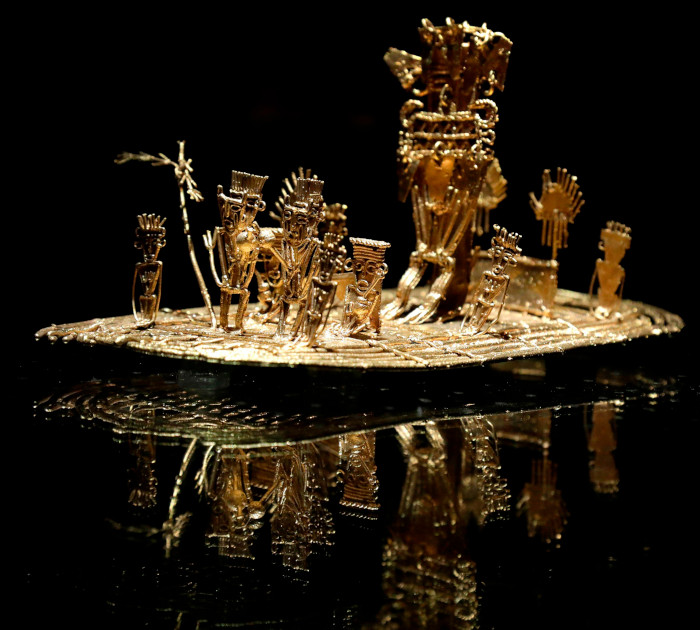
This artifact confirms that the ceremony was not just a story, but a central practice in Muisca society. It wasn't about getting rid of wealth; it was about transforming a physical material into spiritual energy to validate leadership and sustain the cosmos.
Test your understanding!
Imagine you are a UX designer tasked with creating an "interface" for the Muisca people to interact with their gods. How does the El Dorado ceremony function as a successful "user interface" for achieving the "user goal" of inaugurating a legitimate ruler and ensuring cosmic balance? What are its key features?
Show answer
Thinking of it as a UX problem is a great analogy. Here's how it breaks down:
- User Goal: Successfully install a new leader who is recognized by both the people and the gods, and in doing so, reinforce the stability of the world.
- Key Features of the "Interface":
- Clear Feedback: The crowd's roar of approval after the offering provides immediate, positive feedback that the new leader is accepted.
- High-Stakes Input: The offering of gold and emeralds is a significant "cost" or "input," signifying the importance of the transaction. The use of the leader's own body covered in gold makes the input deeply personal and symbolic.
- Shared Experience: The ceremony is public, involving the entire community on the shores. This creates a shared reality and collective buy-in, much like a well-designed multi-user system.
- Symbolic Language: The interface uses powerful symbols everyone understands: gold (divine energy), the lake (a sacred portal or axis mundi), and the ruler (mediator between worlds).
- Ritual Flow: The ceremony has a clear, step-by-step process (preparation, anointing, offering, acclamation), guiding all participants through the experience smoothly.
From this perspective, the ceremony is an exceptionally well-designed system for reinforcing social and religious cohesion.
The Clash of Worlds: How the Ritual Became a Legend
So, how did this sacred ritual become a wild goose chase for a lost city? It was a fundamental clash of worldviews, a misinterpretation born of greed.
The following video explains this transformation in an engaging and insightful way. It clearly lays out the two opposing value systems that were at play.
The channel 'Overly Sarcastic Productions' made a fantastic video that breaks down how the Spanish conquistadors' mindset led them to hear the story of 'The Golden Man' and imagine 'The City of Gold'.
Please watch from 0:55 to 4:18. The video humorously but accurately presents the conquistador's thought process and the two different ways of interpreting the Muisca's use of gold.
The video brilliantly summarizes the disconnect. Faced with a culture that threw gold into a lake, a 16th-century conquistador had two choices:
- The Anthropological Conclusion: "These people do not assign the same value to gold as we do. For them, it is a spiritual and decorative object, not a currency."
- The Greedy Conclusion: "These people must have SO MUCH gold that they can afford to waste it! The real motherlode must be hidden somewhere else!"
Driven by an insatiable desire for gold as money and power, the conquistadors inevitably chose the second conclusion. The man became a place, the ritual became a city, and the hunt for El Dorado began, leading to countless disastrous expeditions, the devastation of indigenous peoples, and the birth of one of history's most enduring myths. The tragic and sometimes comical attempts to drain Lake Guatavita are a testament to the powerful grip this myth had on the European imagination.
Conclusion
Today we have journeyed to the heart of the El Dorado legend and found the truth to be far more fascinating than the myth. We have seen how a profound spiritual and political ceremony was tragically misinterpreted, sparking a centuries-long obsession.
Key Takeaways:
- The Ceremony: The true El Dorado was a Muisca ritual for the investiture of a new leader (Zipa), involving covering him in gold dust and making offerings in a sacred lake.
- The Meaning: For the Muisca, gold's value was spiritual, not economic. The ceremony was an offering to the gods to ensure cosmic balance and a demonstration of the leader's divine mandate.
- The Myth: The legend of a lost city of gold was born from the conquistadors' inability to understand the Muisca worldview, projecting their own obsession with gold-as-currency onto the Muisca's spiritual practices.
- Visual Storytelling: The contrast between the sacred, solemn Muisca ceremony and the frantic, greedy European search offers a powerful narrative and visual dichotomy for you to explore in your illustrations.
Preview of the Next Lesson:
We have now concluded our deep dive into the world of the Muisca. For our next module, we will travel north, to a different and dramatic landscape: the Sierra Nevada de Santa Marta. There we will meet the Tairona people and their living descendants, the Kogi, who view their mountain home as the 'Heart of the World.' We will explore their unique cosmology and their role as its self-proclaimed guardians.
Can't find a good explanation? Sign up and we'll make it for you
Sign up