Hello! Welcome back to our module on "Fundraising for Your Venture Fund."
In our last lesson, we developed a systematic process for identifying and building a target list of your ideal Limited Partners (LPs), focusing on High-Net-Worth Individuals and Family Offices. You now have a strategy for finding the right people to approach.
This lesson addresses the next critical step: preparing the materials you'll use to engage them. Our learning outcome is to prepare the core components of a fund pitch deck and a data room for LP due diligence. These two assets serve distinct but complementary purposes:
- The Fund Pitch Deck: This is your marketing and storytelling tool. It’s designed to capture an LP’s interest and persuade them to learn more about your fund.
- The LP Data Room: This is your verification and diligence tool. It’s a secure, organized repository of documents that provides the evidence to back up the claims in your deck and allows LPs to conduct a thorough review.
Given your extensive experience preparing pitch decks for startups, you'll find the structure familiar. However, the audience (LPs) and the "product" (your fund) require a different focus. Let's dive in.
1. The Fund Pitch Deck: Crafting Your Narrative
Your fund pitch deck is the primary document you'll use to introduce your fund to potential LPs. Its goal is to tell a compelling story about your team, your strategy, and the opportunity you're targeting. Think of it as a startup pitch deck, but instead of selling a product to customers, you're selling an investment strategy to partners.
The article "How to Create an Investor Pitch Deck for Your VC Fund" by GoingVC provides a fantastic, slide-by-slide breakdown of what to include.
How to Create an Investor Pitch Deck for Your VC Fund
Let's study the key components of a strong LP pitch deck. This article will be our guide.
Please read the section titled 'Important Elements of an LP Deck'. As you read, focus on how each element would apply to your specific situation as a solo GP launching an AI-focused fund.
Based on the article, here are the core components you need to build, tailored for your specific context:
- Fund Overview: Your mission and vision. This is where you concisely state your goal: to launch a solo-led incubator and fund that leverages AI to support the next generation of AI-native startups.
- The Team: For a solo GP, this slide is arguably the most important. You are the primary asset. You must showcase your 10 years of startup consultancy experience, your expertise in business model validation and product-market fit, and your unique perspective. This builds personal credibility.
- Investment Thesis: This is your fund's core strategy. It must clearly define your focus (e.g., pre-seed AI-native startups in a specific vertical), your unique angle (the incubator/accelerator model), and why this market presents a compelling opportunity right now.
- Track Record: As a first-time fund manager, you won't have a formal fund track record. Instead, this section should highlight your "angel track record" if you have one, successful outcomes of startups you've advised, or case studies from your consulting work that demonstrate your ability to identify and support high-potential companies.
- Deal Sourcing Strategy: How will you find the best AI startups? Your answer must be more than "my network." Detail your connections to universities, research labs, and founder communities. Explain how you'll use AI tools to identify emerging teams and trends, creating a proprietary advantage.
- Portfolio Construction: Explain your plan. How many companies will you invest in per year? How much capital will you deploy in the initial check? How much will you reserve for follow-on investments? This shows LPs you have a disciplined plan for managing their capital.
- Fund Structure and Terms: This section summarizes the fund's economics you defined in a previous module: fund size, management fees, carried interest, and fund lifecycle.
- Financial Projections: What returns are you targeting for your LPs? Present your target Internal Rate of Return (IRR) and Multiple on Invested Capital (MOIC). These should be ambitious but grounded in the realities of pre-seed venture returns.
To help you visualize these components, here are two examples of what professional fund pitch decks look like.

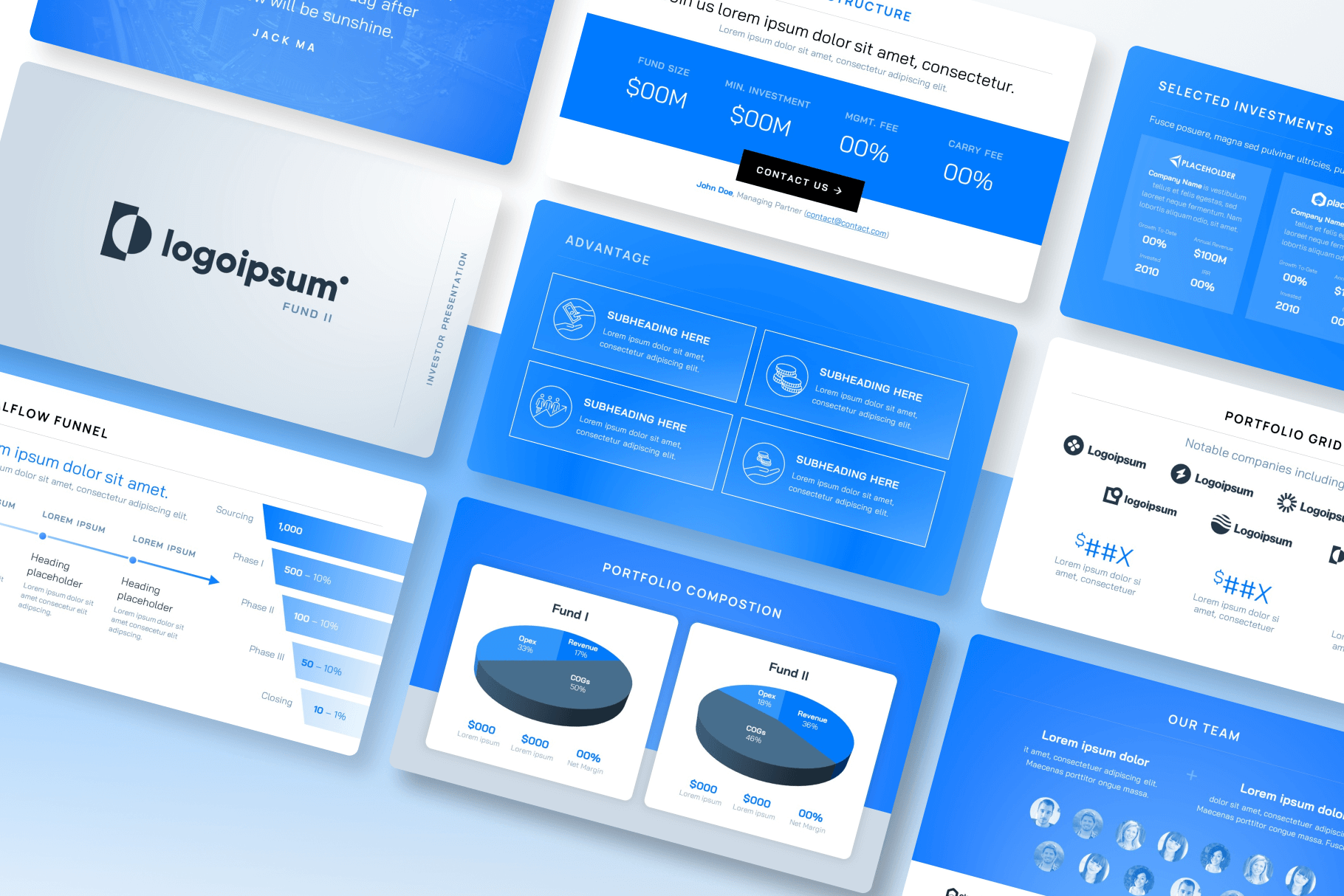
Test your understanding!
For your fund, what are the three most critical points you would include on your "Team" slide to build credibility as a solo GP?
Show answer
While answers may vary, here are three strong examples:
- "10 Years Pre-Seed Startup Consulting:" Frame this as deep, hands-on experience in the exact stage you'll be investing in. Highlight your expertise in validating business models and assessing product-market fit.
- "Proven Access & Network:" Mention specific successes, such as startups you advised that went on to raise significant funding or achieve successful exits. This serves as a proxy for a track record.
- "AI-Driven Investment Thesis:" Connect your computer science background and interest in AI directly to the fund's strategy, positioning yourself as a technically credible investor in this domain, not just a generalist.
2. The LP Data Room: Preparing for Due Diligence
Once your pitch deck sparks an LP's interest, their next step is due diligence. The data room is where this happens. It's a virtual space where you provide all the necessary legal, financial, and operational documents that substantiate the claims made in your deck. The purpose is not to "sell," but to enable verification and build trust through transparency.
To understand the mindset behind this process, let's first review the purpose of due diligence from an investor's perspective.
[VC Unlocked] The Basics of Due Diligence
The video '[VC Unlocked] The Basics of Due Diligence' from 500 Global offers an excellent overview of what investors are looking for. While it discusses diligence on startups, the principles are identical for LPs diligencing a fund.
Watch from the beginning to 07:13. Pay close attention to the purpose of due diligence (verification, not discovery) and the different types (commercial, legal, technical). Also, note the discussion on who performs diligence and where it happens (the data room).
As the video explains, due diligence is about verifying expectations and managing risk. A well-organized data room makes this process smooth and signals your professionalism.
What Goes into a Fund Data Room?
The list of required documents can seem daunting, but it can be broken down into logical categories. As an aspiring fund manager, your role isn't to draft every legal document from scratch, but to know what's required so you can work effectively with your lawyers and administrators.
A checklist for producing a great fundraising data room
This checklist from PEARonline provides a comprehensive list of what a sophisticated LP expects to see in a data room. It's a great reference for ensuring you cover all your bases.
Review the checklist under the heading 'What to Include in Your Fundraising Data Room'. Don't worry about understanding every single item in depth. Instead, focus on the categories: Fund, Organisation, Team, Market, Investment Strategy, Track Record, and Legals. This gives you a mental map of the required information.
Drawing from that comprehensive list, here are the essential categories and documents for a first-time fund manager's data room:
1. Fund Marketing & Thesis
- Pitch Deck: The latest version of your main presentation.
- Private Placement Memorandum (PPM): The formal legal document describing the fund offering. Your lawyers will draft this, but it will be based on your pitch deck and strategy.
- Due Diligence Questionnaire (DDQ): A standardized Q&A document that answers common LP questions. Many LPs will provide their own template for you to fill out.
2. Legal & Structure
- Fund Structure Chart: A diagram showing the legal relationship between the Management Company (your operating company) and the Fund (the investment vehicle).
- Draft LPA (Limited Partnership Agreement): The main legal agreement between the GP (you) and the LPs. Your lawyers will lead this.
- Management Company Budget: A projection of the management company's operational expenses, showing how you will use the management fees.
3. Team & References
- Team CVs/Bios: Your detailed professional biography.
- Reference List: A list of professional references (e.g., founders you've advised, former colleagues) who can speak to your character and expertise.
4. Track Record & Case Studies
- Detailed Track Record: A spreadsheet detailing any personal angel investments, including company name, investment date, amount, and current status/return.
- Investment Case Studies: 2-3 detailed memos on past advisory clients or investments, explaining why you engaged, what value you added, and the outcome.
To see how these categories are structured in practice, let's look at an analogous situation you're already familiar with: a startup's data room. The structure and logic are nearly identical.
How to build an Investor Data Room
The video 'How to build an Investor Data Room' from Slidebean walks through the structure of a startup data room. The parallels to a fund data room are striking and will help you organize your own materials.
Watch from 00:16 to 07:41. As you watch, draw parallels: 'Financials' for a startup are like your 'Track Record' and 'Fund Projections'. 'Legal Stuff' for a startup is like your fund's 'Legal & Structure' documents. 'IP' for a startup is analogous to your proprietary 'Deal Sourcing Strategy' and 'Investment Thesis'.
A well-structured data room—whether for a startup or a fund—shows you are organized, transparent, and ready for serious business. Using a simple, clearly labeled folder structure in a service like Google Drive or Dropbox is perfectly sufficient.
Conclusion
You now have a clear blueprint for the two most critical assets in your fundraising toolkit. The pitch deck tells your story to capture interest, while the data room provides the organized proof to build trust and pass due diligence. Preparing these materials thoroughly is a non-negotiable step toward establishing your credibility and successfully raising your first fund.
Key Takeaways:
- Pitch Deck is for Persuasion: It must tell a compelling story about your team, thesis, and unique advantage as a solo, AI-focused GP. Leverage your consulting background.
- Data Room is for Verification: It is an organized, transparent repository of documents that substantiates your claims. It is not a marketing tool.
- Structure is Key: A logical structure for both the deck and the data room signals professionalism and makes the LP's job easier.
- Prepare Proactively: Don't wait for an LP to ask for these documents. Having them ready demonstrates that you are a serious, organized manager.
Preview of the next lesson:
Once an LP has reviewed your materials and given you a verbal "yes," the work isn't over. The next step is to formalize their commitment. In our next lesson, we will "Outline the legal and administrative steps of a fund closing process," taking you from a handshake agreement to having capital in the bank.