Hello! Welcome to the first lesson of our fifth module, "Fundraising for Your Venture Fund."
In our previous lessons, we delved into the specifics of deal-making, culminating in a framework for deciding how much equity to take from your portfolio companies. You now have a clear idea of the terms of your investment. Today, we take a crucial step back to address a more fundamental question: What companies will you invest in, and why?
This lesson is dedicated to formulating a fund strategy and a compelling investment thesis. This isn't just an academic exercise; your investment thesis is the single most important document you will create as a fund manager. It is the north star that guides every decision you make—from sourcing deals to supporting founders—and it is the core narrative you will use to convince Limited Partners (LPs) to invest in your fund. For your goal of launching an AI-focused accelerator, a sharp, differentiated thesis will be your primary tool for attracting capital and the best AI startups.
1. What is an Investment Thesis and Why is it Critical?
An investment thesis is a clear, concise argument explaining your strategy for generating exceptional returns. It defines your fund's reason for existing. It answers the questions every LP will ask: "Where will you find unique opportunities that others miss?" and "Why are you the right person to capitalize on them?"
Let's begin by establishing a clear definition and understanding of the components of a thesis.
How to Write an Investment Thesis
The article 'How to Write an Investment Thesis' from Carta provides a great starting point by defining what an investment thesis is in the context of venture capital and listing its key components.
Please read the sections 'What is an investment thesis?' and 'Why you need a solid investment thesis'. Focus on the list of elements a thesis includes and the role it plays in differentiating your fund and aligning with LP interests.
As the article outlines, a thesis is not just a vague mission statement. It's a strategic plan that encompasses your fund size, stage, industry focus, and how you'll support companies. To further explore the strategic importance of this, let's watch a segment from a workshop at Harvard Business School.
HBS VC Pathways Session 2 - "Building an Investment Thesis"
This HBS workshop session, 'Building an Investment Thesis', explains the strategic purpose of a thesis beyond just picking stocks. It highlights its role as a signaling device and a tool for focus.
Please watch from 04:23 to 07:11. Listen for the three primary reasons for having a thesis: developing a perspective, signaling your focus to stakeholders (LPs, founders), and narrowing your focus to prioritize resources.
In summary, your thesis serves three critical functions:
- Internal Compass: It forces you to develop a specific point of view and provides a filter for the thousands of opportunities you'll see, helping you focus your time and capital effectively.
- External Signal: It communicates your strategy to the market, attracting the right founders, co-investors, and, most importantly, LPs who are looking for exposure to your specific area of focus.
- Competitive Differentiation: It articulates why your fund can succeed where others might not.
2. The Anatomy of a Compelling Fund Thesis
Now that we understand the "why," let's move to the "how." Crafting a thesis can feel daunting, but there is a proven structure you can follow. Many successful first-time fund managers use a simple, powerful formula to articulate their strategy.
The article 'VC Fund Thesis' by VC Lab provides an exceptionally practical, fill-in-the-blanks formula for building your thesis. This is an excellent tool for ensuring you cover all the essential elements LPs need to see.
Please read the introduction and the section 'What Makes a Strong Fund Thesis?'. Pay close attention to the core formula presented and the breakdown of its five essential components: Identity, Geography, Market/Sectors, and Secret Sauce.
The core formula is:
“[Fund Name] is launching a [$x MM] [Stage] venture fund in [Country/City] to back [Geography] [Sector/Market Companies] [with Secret Sauce]”
Let's break this down:
- Identity (Fund Name, Size, Stage): This sets the basic parameters. For a first-time fund manager, a smaller fund size (e.g., under $10M) and a clear stage focus (e.g., pre-seed) are more credible.
- Geography (Base Location, Investment Geography): Where are you based, and where will you invest? This signals your network's strength and focus.
- Market/Sectors: Be specific. "Technology" is too broad. "B2B SaaS for regulated industries" is better. In your case, this will be centered on AI.
- Secret Sauce: This is your unique, quantifiable advantage. It's the answer to "Why you?"
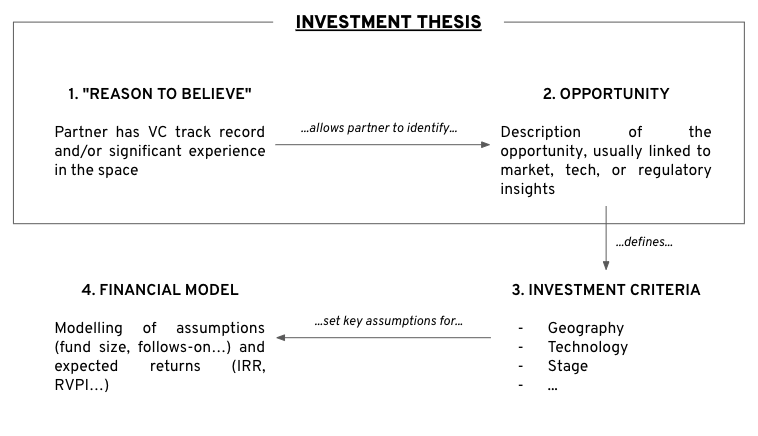
This structure can be visualized as a logical flow, where your personal experience helps you identify an opportunity, which in turn defines your investment criteria and financial model.
3. Crafting Your "Secret Sauce"
The "Secret Sauce" is the most critical element. It's where you connect your personal background and expertise to a market opportunity. Given your 10 years in startup consultancy, your secret sauce is not a hypothetical skill set; it's a proven track record.
The VC Lab article you just read outlines seven key metrics to quantify your credibility. For you, the most relevant will be:
- Companies Helped: The number of startups you've advised.
- Capital Raised: The total funding your clients secured.
- Network Size: Your quantifiable connections in the startup ecosystem.
Your expertise is in business model validation and product-market fit for early-stage companies. This is a powerful asset. Your thesis should explicitly state this.
Now, let's address your AI focus. You have a Computer Science degree, which is a great foundation, but you've noted you're not an AI research expert. This is a common situation for fund managers. You don't need to be the expert, but you need access to expertise.
How to Write Your Investment Thesis for Your Fund
In his video 'How to Write Your Investment Thesis for Your Fund,' Bridger Pennington offers practical advice for new managers. He discusses how to leverage existing experience and what to do when your thesis area is outside your deep operational expertise.
Watch the segment from 05:59 to 11:17. Focus on two key ideas: 1) 'Lean into your team's experience', and 2) 'Partner with someone who has it'. This directly addresses how to build a credible thesis around your consulting background while incorporating your AI focus.
The key takeaway is to build your thesis around what you know (early-stage startup strategy) and partner for what you don't (deep AI technical diligence). Your "Secret Sauce" can therefore be a combination of your personal track record and the expert network you build.
4. An Example: Building Your AI-Focused Thesis
A great thesis is specific enough to be credible but broad enough to allow for a full portfolio of investments. A broad theme like "AI" must be broken down into concrete, investable sub-sectors.
Look at how a major player approaches this.
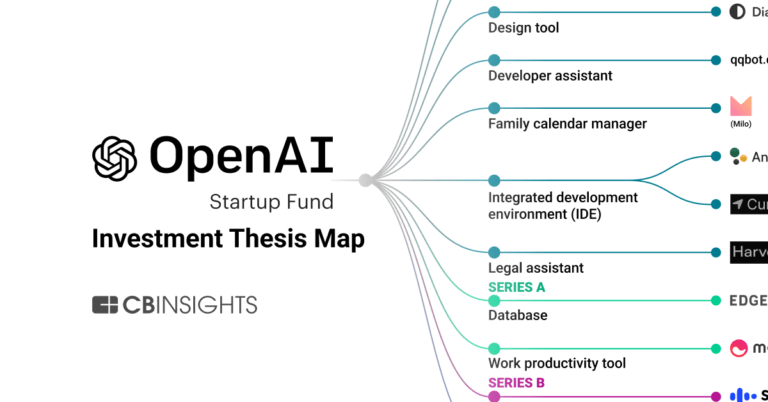
This map shows you how to move from a high-level concept ("AI") to actionable investment areas. You could define your thesis around "AI-native tools that automate core business functions" or "AI applications for vertical-specific problems."
Let's use the VC Lab formula to draft a hypothetical thesis for your accelerator fund:
"AI Launchpad Ventures is launching a $5MM pre-seed fund in [Your City] to back North American AI-native startups, leveraging the GP's experience guiding 50+ startups from idea to product-market fit and a strategic network of AI researchers from leading universities and corporations."
This thesis is strong because it:
- Is specific (fund size, stage, geography, sector).
- Is credible by highlighting your direct experience ("guiding 50+ startups").
- Addresses the expertise gap by referencing a strategic network.
- Is compelling by targeting a high-growth, relevant market (AI).
Test your understanding!
Using the VC Lab formula, draft a one-sentence investment thesis for your planned incubator/accelerator. Don't worry about getting it perfect; the goal is to practice assembling the core components. Try to quantify your "secret sauce" based on your consulting experience.
Show answer
There's no single right answer, but a strong draft might look something like this:
- "Momentum AI Ventures is launching a $3MM pre-seed fund in San Francisco to back US-based B2B SaaS companies using generative AI, leveraging the GP's track record of helping 40+ startups achieve product-market fit and a network of 10+ senior AI engineers for technical diligence."
This example specifies the fund size, stage, location, market (B2B SaaS with GenAI), and a quantifiable secret sauce that combines your consulting background with a clear plan for technical validation.
5. Keeping Your Thesis Focused but Flexible
A common question is how narrow a thesis should be. For a first-time fund, a narrower focus is almost always better. It demonstrates expertise and makes it easier for LPs to understand your unique value.
HBS VC Pathways Session 2 - "Building an Investment Thesis"
Let's return to the HBS workshop to hear a discussion on the optimal scope of a thesis and how it connects to fundraising.
Watch from 16:19 to 19:51. Pay attention to the argument for starting with a narrow thesis. The speaker makes a critical point: LPs want to know your competitive advantage, and a narrow thesis helps you prove you are 'the best at this.'
While your thesis must be focused, it's a strategic guide, not a straitjacket. The best investors know when to make an exception for an extraordinary founder who might fall just outside the lines of their stated thesis. This is often called the "mythical fourth bucket"—investing in people. Your primary filter remains your thesis, but you retain the flexibility to act on truly exceptional, outlier opportunities.
Conclusion
Today, you've laid the strategic foundation for your entire fund. A well-formulated investment thesis is your most powerful tool for raising capital and building a world-class portfolio.
Key Takeaways:
- An investment thesis is your fund's strategic blueprint, explaining how you will source unique deals and generate returns.
- A compelling thesis can be constructed using a simple formula: Identity + Geography + Market + Secret Sauce.
- Your "secret sauce" must be a quantifiable and credible demonstration of your unique advantage. Leverage your 10 years of consulting experience and build a network to cover any gaps.
- For a first-time fund, a narrow, focused thesis is more effective for convincing LPs of your expertise and competitive edge.
- An AI thesis should be broken down into specific, investable sub-sectors, moving from a broad theme to actionable opportunities.
Preview of the next lesson:
With a draft of your investment thesis in hand, the next step is to translate it into a compelling story for investors. In our next lesson, we will focus on how to articulate your fund's value proposition for potential Limited Partners (LPs). We'll take the core components of your thesis and shape them into a narrative designed to attract capital.