Hello! Welcome back to our course.
In the last lesson, you did an excellent job writing a full 3-part email nurture sequence for "Forecastly," our fictional AI forecasting tool. You successfully moved a prospect—a Sales Manager—from initial interest to being ready for a demo request using the Value -> Proof -> Action framework.
However, in B2B, the person you first engage is often just the beginning of the conversation. They become your internal champion, but they need to convince others. This brings us to today's goal: to write email variations for different buyer roles within the same nurture sequence (e.g., champion vs. decision-maker).
We'll take the "Proof" email you wrote for the Sales Manager and adapt it for two other critical stakeholders: their boss, the VP of Sales (the economic decision-maker), and the Head of IT (the technical gatekeeper).
1. Understanding the B2B Buying Committee
Before we can write for different roles, we need to understand who they are and what they care about. In B2B, you're not selling to an individual; you're selling to a "buying committee" or "buying center."
To build a solid foundation, let's start with a resource from Zapier that defines the key roles you'll encounter.
B2B email marketing guide: Strategies + examples
This article provides a great overview of the different roles people play in a B2B purchase decision, giving us a shared vocabulary for the task ahead.
Please read the section titled '1. Profile your target customers'. Focus on the six main roles it defines: Initiators, Users, Buyers, Deciders, Gatekeepers, and Influencers.
Those six roles provide a comprehensive map. For practical copywriting, we can often simplify this into four key personas. The next resource frames this perfectly and explains what each role is listening for.
Navigating Decision Makers with Targeted Emails
Now that we have the formal roles, let's look at a practical framework for targeting them. This article from SalesHive explains how to think about their different motivations.
Read the section 'Map the Buying Committee Before You Write'. Pay close attention to how it categorizes buyers (economic, technical, user, and champion) and what each role's 'filter' is. This is the core concept for today's writing task.
To bring this all together, here is a chart that visually summarizes how to tailor your message, value proposition, and content for each persona.
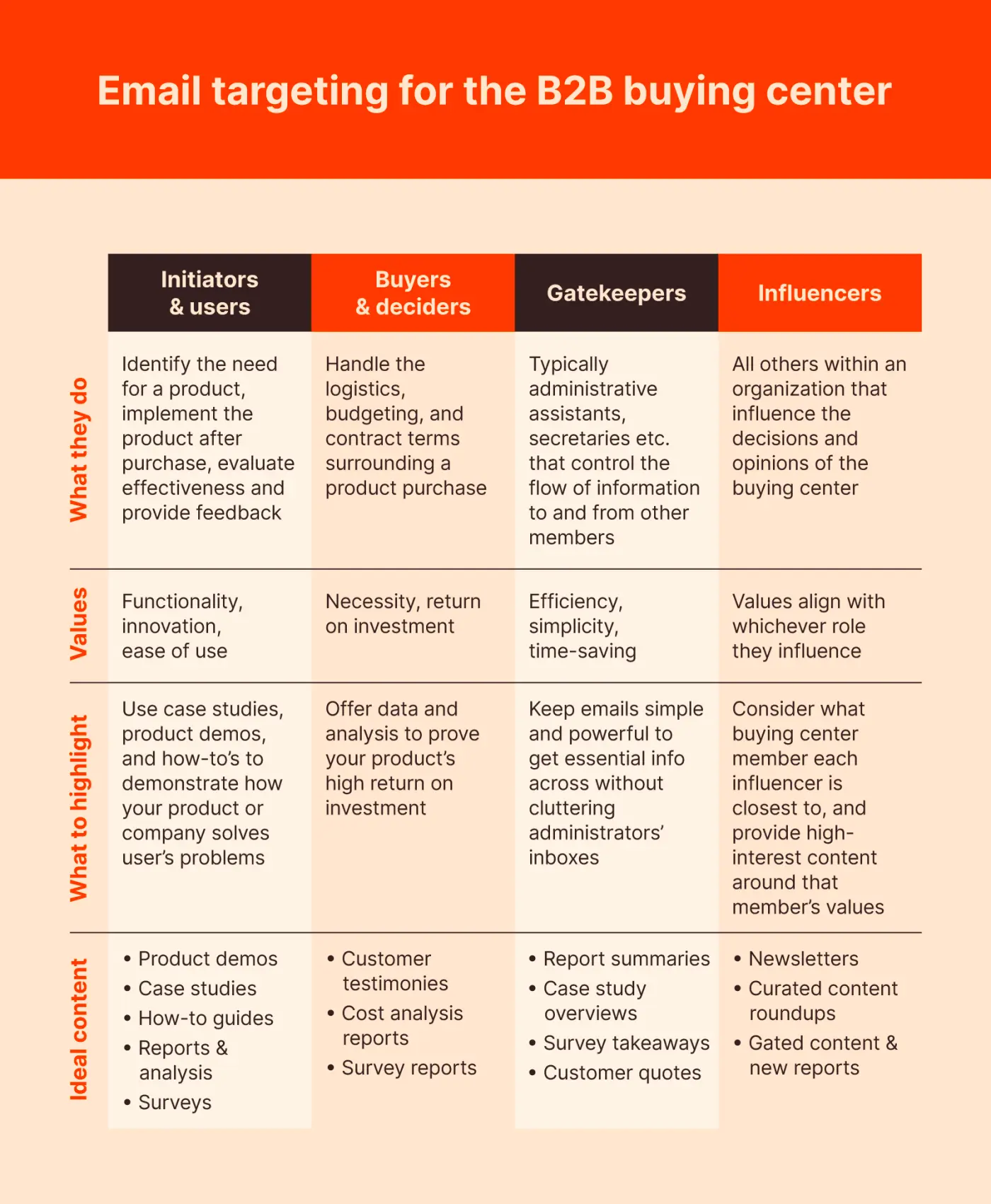
From this, we get a clear principle:
- Economic Buyers (like a VP or CFO) care about ROI, strategic goals, and risk.
- Technical Buyers (like a Head of IT) care about security, integration, and stability.
- Users/Champions (like our Sales Manager) care about workflow improvements and ease of use.
2. The Writing Task: Adapting Your "Proof" Email
Let's ground this in our "Forecastly" scenario. Imagine our Sales Manager (the Champion) received Email #2 and was impressed by the case study. They forward it to their boss, the VP of Sales, and the Head of IT for their input.
Here is the original email you wrote, designed for the Sales Manager (User/Champion):
Subject: 25% more accurate forecasts?
Body:
Hi [First Name],Hope that spreadsheet was useful for getting a baseline.
A common challenge we hear from sales managers is that even a 10% forecasting error can lead to misplaced budgets and missed targets.
It reminded me of the work we did with Acme Corp. They were struggling to get a reliable picture of their quarter. By using our platform to analyze their pipeline data, they were able to improve their forecast accuracy by 25% in three months.
This didn't just give them peace of mind; it gave them the confidence to reallocate over $50k in budget from underperforming ad campaigns to their top-performing sales team.
It’s a powerful example of what’s possible.
Best,
[Your Name]
Our task is to rewrite the body copy of this email for the two other personas, using the same core proof point (Acme Corp's 25% improvement) but framing it to match their specific "filter."
Version 1: The Economic Buyer (VP of Sales)
The VP of Sales thinks in terms of revenue targets, budget allocation, and strategic advantage. "Peace of mind" is nice, but "hitting our annual growth target" is essential.
Your Turn: Write for the VP of Sales (10 minutes)
Rewrite the body of the email for the VP of Sales. Focus on connecting the 25% accuracy improvement to high-level business outcomes like revenue predictability and confident capital allocation.
Draft your new email body here:
My Version
Once you're done, compare your version to mine below. Notice how the language shifts from operational pain to strategic gain.
Body:
Hi [VP's First Name],
Sales forecasting isn't just an operational report; it's the foundation for our most critical budget and revenue decisions. A small error at the team level can create significant risk at the company level.
For example, we recently helped Acme Corp improve their forecast accuracy by 25% in a single quarter.
For their leadership, this translated directly into de-risking their revenue commitments and gave them the data to confidently reallocate a $50k marketing budget to a sales channel with higher ROI.
This is the level of predictability we aim to provide for our partners.
Best,
[Your Name]
This version speaks the language of a leader: risk, revenue commitments, and ROI.
Version 2: The Technical Buyer (Head of IT)
The Head of IT's primary concern isn't sales targets; it's whether a new tool will create security vulnerabilities, cause integration headaches, or require a massive implementation effort. They are the guardians of the tech stack.
Your Turn: Write for the Head of IT (10 minutes)
Now, rewrite the same email body for the Head of IT. This time, frame the 25% accuracy improvement as a result of a secure, well-integrated system. Reassure them on the technical front.
Draft your new email body here:
My Version
Let's compare. See how this version immediately addresses the likely questions a technical leader would have.
Body:
Hi [IT Head's First Name],
I know that introducing any new platform into the sales stack raises immediate questions about data security and integration.
When we worked with Acme Corp, their IT team's main priority was ensuring our platform could securely process their CRM data without disrupting existing workflows. Our platform integrates directly with Salesforce's API and adheres to SOC 2 compliance standards, which was key for them.
The result was a seamless implementation that enabled their sales team to improve forecast accuracy by 25% in three months, all while maintaining the integrity and security of their core sales data.
Our goal is to deliver powerful business results without creating a burden for the technical teams that support them.
Best,
[Your Name]
This version preemptively answers the "Is this safe and will it work with our stuff?" questions, building trust with the technical gatekeeper.
Conclusion
Excellent work. You've just performed one of the most critical skills in B2B copywriting: adapting a single message for a complex buying committee. You didn't need to find new facts; you simply reframed the same proof point to speak directly to each stakeholder's unique priorities.
Key Takeaways:
- One Message, Different Lenses: A single value proposition can be translated to speak to different roles. Frame the outcome in terms of ROI for leaders, security/integration for tech, and usability for users.
- Acknowledge Their World: The most effective copy shows the recipient you understand their specific concerns (e.g., revenue targets vs. data security).
- The Goal is Consensus: Your job as a copywriter is to equip your champion with the arguments they need to build consensus across the buying committee. These email variations do exactly that.
Preview of the Next Lesson:
We've focused on getting our message to the right people through email. But where do we send them when they click? The next step in our journey is to structure a B2B landing page using a logical persuasion flow: problem, solution, proof, and action. We'll learn how to build the destination that converts the interest we've generated into a solid lead.