
Welcome. This first module gives you a vocabulary for reading myths carefully before we move into particular traditions. The four labels in this lesson—myth, legend, folktale, and fairy tale—are useful tools, but they are not four locked rooms. A single narrative can carry features of more than one category, especially after centuries of retelling.
By the end of this lesson, you should be able to classify a short narrative by identifying its strongest signals: what kind of world it describes, what relationship it claims to history or belief, and what work it does for its community. This is also a practical skill for writing: choosing a genre changes the atmosphere, stakes, and voice of a story.
Genre labels are guides, not verdicts
A common mistake is to classify a story from one surface feature: “It has a god, so it is a myth,” or “It has magic, so it is a fairy tale.” But gods appear in legends; magic can appear in almost any traditional narrative; and a story about an ordinary person may be vitally connected to sacred practice.
Instead, think of these categories as a spectrum of narrative relationships:
- Is the story connected to a community’s sacred order, origins, rituals, or explanation of the world?
- Is it attached to a remembered human past, a place, or an ancestor?
- Does it centre on ordinary social pressures, fears, cleverness, desire, or survival?
- Does it place an everyday protagonist in an enchanted or magical world?
The terms themselves come largely from European and Western scholarly traditions. A community may have its own names and distinctions for its stories, or may not divide stories in these exact ways at all. When studying South Asian, East Asian, West Asian, Egyptian, Indigenous, or African traditions later in the course, use these labels provisionally: they should clarify a story’s context, not replace the tradition’s own understanding.
Myth - Folklore, Legends, Fables
Read this Britannica overview to gain a scholarly framework for the categories while noticing its central warning: genres overlap, and classification is never perfectly rigid.
Begin with the opening discussion before the “Fables” subsection. Read the spectrum framework, focusing on why a traditional narrative may reasonably receive more than one label. Then read the subsections “Fables,” “Fairy tales,” “Folktales,” and “Legends.” In “Fables,” notice the contrast between an explicit moral and a sacred narrative. In “Fairy tales,” focus on the contrast between “Once upon a time” vagueness and the named genealogies or places often found in myths. In “Folktales,” read the discussion of overlap and history; it is especially important for avoiding the assumption that “folk” means simple or culturally inferior. Finish with “Legends,” where the article explains the link to historical memory and cautions against applying the term unevenly across religions.
Four working definitions
For this course, use the following definitions as a reliable first-pass method. They are not rules that override a story’s cultural context.
| Genre | Strongest identifying feature | Typical setting and figures | What it often does |
|---|---|---|---|
| Myth | Connected to sacred meaning, collective belief, origins, divine order, ritual, or the structure of reality | A primordial past, sacred time, or a world beyond ordinary time; gods, ancestors, culture heroes, cosmic beings, or forces | Explains, justifies, imagines, or questions how the world and human obligations work |
| Legend | Linked to a community’s historical memory, named place, ancestor, ruler, saint, or heroic person | A more recognizable human past; specific landscapes, towns, dynasties, graves, battles, or local sites | Shapes identity, memory, belonging, and ideas of exemplary action |
| Folktale | A traditional, usually self-contained tale concerned with ordinary human situations and recurring desires or fears | Flexible or vague time and place; villagers, siblings, tricksters, animals, spouses, poor workers, rivals | Entertains, explores social tensions, and may offer practical or ethical insight |
| Fairy tale | A wonder-filled type of folktale in which an ordinary protagonist encounters magic, enchantment, or an otherworldly realm | “Once upon a time” settings; transformations, impossible tasks, enchanted beings, magical objects | Explores danger, desire, injustice, courage, loss, and reversal through magical logic |
Two qualifications matter.
First, a myth is not simply a “false story.” In this lesson, treat myth as a story that has held—or still holds—serious sacred, cosmological, or social meaning. The next lesson will examine this point in depth.
Second, folktale can be used broadly or narrowly. Broadly, some scholars use it as an umbrella for traditional tales, potentially including myths, legends, and fairy tales. More narrowly, and more usefully for basic classification, it refers to non-sacred stories of everyday life. When in doubt, state the sense in which you are using the word.
Library Research Guide for Folklore and Mythology
Harvard Library’s guide provides a compact reference set of definitions and introduces two terms—“variant” and “metadata”—that will become important as you begin documenting sources.
In the “Oral Traditions” material, read from the genre definitions. Pay closest attention to the entries for myth, legend, tale, folktale, fairytale, and fable. Then consult the glossary table below it, especially the entries “FAIRYTALE,” “FOLKTALE,” “LEGEND,” “MYTH,” “MOTIF,” and “VARIANT.” Notice that this guide defines both myth and legend as narratives that are or have been believed, while Britannica stresses different boundaries between sacred myth and historically rooted legend. The difference is not a problem to solve; it shows why you should explain the evidence for a classification rather than merely attach a label.
A useful boundary: fable is not the same as myth
The infographic below is a helpful visual memory aid. Its most useful message is that these traditional forms can entertain, teach, travel through time, and reflect cultural values. Its categories are deliberately simplified, however. In particular, remember that “folktale” is sometimes an umbrella term rather than a category separate from every other kind of tale.
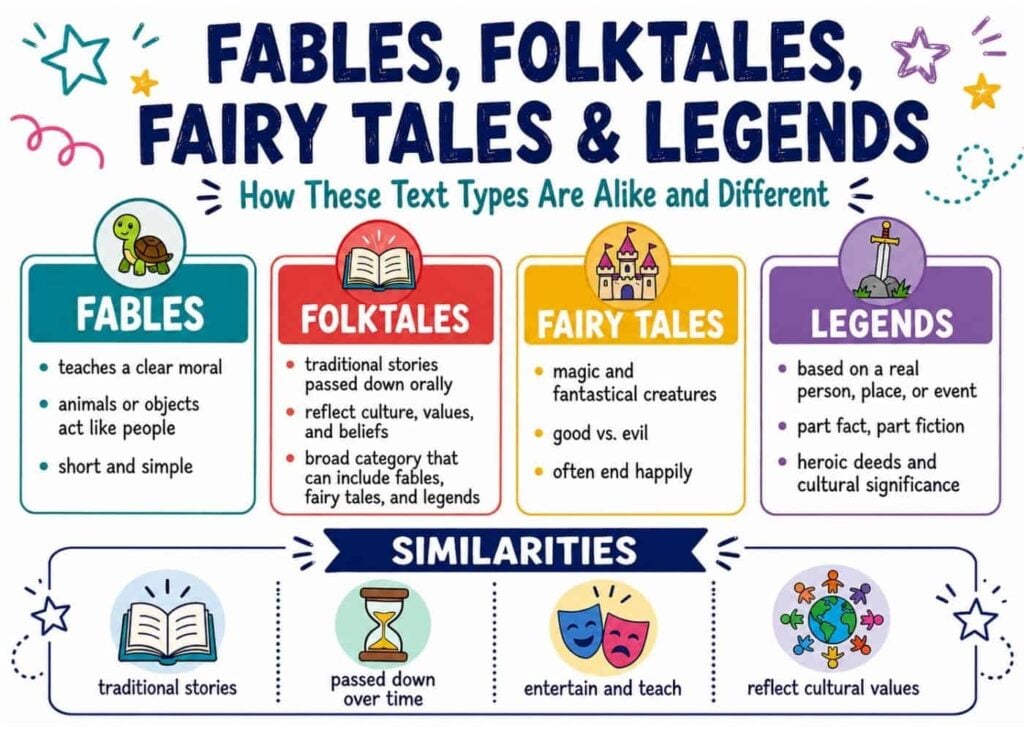
A fable is often short, features personified animals or objects, and delivers a direct lesson about conduct. For example:
A crow mocks a tortoise for moving slowly. When a forest fire comes, the crow flies into smoke and becomes trapped, while the tortoise survives beneath the pond. Moral: Do not mistake speed for wisdom.
This is best classified as a fable, not as one of the four genres at the centre of this lesson. Animals alone do not make a story a fable; the decisive clue is the stated moral and its compact, instructive design.
A myth may involve animal beings, a fairy tale may contain talking animals, and a folktale may teach an ethical lesson. The difference is that a fable normally makes its instruction unusually explicit.
Classifying narratives: look for evidence, not decorations
When you meet a short summary, classify it in five moves.
-
Ask what the story claims to concern.
Is it about the world’s order, a sacred beginning, a local hero, or a human problem such as hunger, jealousy, marriage, or clever survival? -
Notice its relation to time and place.
“Before the first dawn” suggests a different narrative scale from “near this village, during the reign of Queen…” Neither formula decides the genre alone, but each is evidence. -
Identify the social status of the narrative.
Was it connected to belief, ritual, community memory, place, or ancestry? Or is it framed chiefly as a story told for pleasure, suspense, and imaginative exploration? -
Treat magic as supporting evidence only.
A magical sword might belong to a legend; a divine being might appear in a fairy tale; a miracle might appear in a sacred legend. The narrative’s cultural role matters more than its inventory of wonders. -
Give the strongest label, then preserve uncertainty.
Say, for example: “This is most plausibly a legend because it is rooted in a named landscape and a remembered human founder, though its supernatural details overlap with myth.”
That final phrase—most plausibly—is not evasive. It is intellectually accurate.
Model classifications
The following examples are invented for practice. They do not represent any living tradition.
| Short narrative | Best first classification | Why |
|---|---|---|
| “Before day and night were divided, the River Mother opened her clay vessel. Its waters became the world’s rivers. Each year, the valley community recites this account before opening its irrigation channels.” | Myth | The narrative explains a feature of the world and is tied to a collective ritual. Its sacred, cosmological function matters more than the magical clay vessel. |
| “People of the hill town say that Arin, the first defender of their pass, delayed an invading army alone for three days. His sword is said to lie beneath a stone above the old road, where visitors still leave flowers.” | Legend | It is anchored in a local landscape, historical memory, and a human heroic figure. Whether Arin existed exactly as described is not the primary classification question. |
| “A poor potter feeds a hungry stranger, who is secretly a magistrate in disguise. When the potter later refuses to flatter him, the magistrate rewards her honesty and punishes the greedy neighbour who tries to imitate her.” | Folktale | The focus is everyday social life: poverty, hospitality, power, envy, and ethical cleverness. The setting could move easily from one region or era to another without changing the basic plot. |
| “Once upon a time, a young gardener is forbidden to enter the moonlit orchard. She enters, finds the sleeping prince turned into a pear tree, and must bargain with a speaking fox for three seeds of return.” | Fairy tale | The vague time, magical transformation, enchanted place, talking animal, and quest-like task all place it within fairy-tale territory. |
| “A fox tells a crane that generosity is pointless; the crane shares food with the fox anyway, and the fox later needs the crane’s help. Moral: Kindness returns.” | Fable | The direct moral and animal characters make it a fable. It may circulate as folklore, but “fable” is the most precise label. |
Notice the difference between the second and fourth examples. Both include unusual elements: a sacred sword beneath a stone; a man transformed into a tree. Yet the first is bound to local memory and a named place, while the second works in an untethered enchanted realm. That difference in relationship to history and place is more important than whether a story is realistic.
When one story legitimately has several labels
Traditional narratives are not static texts. They are told, translated, recorded, reworked, and adapted; a community may understand the same figure differently across centuries. A deity in one context can become a heroic ancestor in another; a local legend can acquire fairy-tale motifs; a sacred origin account can later circulate as entertainment after its ritual setting has been lost or suppressed.
The Irish storytelling example in the following video vividly demonstrates this problem. Use it not as a universal system for all cultures, but as a case study in why rigid boxes fail.
Differences Between Myths, Legends, Folktales, & Fairytales
Watch “Differences Between Myths, Legends, Folktales, & Fairytales” from Irish Myths for a concise illustration of genre overlap in a specific Irish context.
Watch the opening problem, where the presenter challenges the assumption that the four categories have clean boundaries. Then skip to the Causeway case, which uses the Giant’s Causeway and Finn McCool to show how a story can be read as etiological, legendary, folkloric, and fairy-tale-like at once. Focus on the evidence that changes the classification: a natural landmark, a named hero, superhuman scale, and a shifting storytelling context.
The key lesson from such cases is not “all categories are meaningless.” It is more precise: classification depends on context as well as plot.
Consider a story in which a bear marries a human being. That single premise does not tell you enough.
- If the story explains a clan’s sacred origin or ritual obligation, it may function as a myth.
- If it is attached to a named ancestor or a particular mountain, it may function as a legend.
- If it is an anonymous story about marriage, danger, and domestic survival, it may be a folktale.
- If it unfolds through enchantment, impossible tasks, and a magical release, it may be a fairy tale.
The same motif—here, marriage across human and nonhuman boundaries—can live in several genres. Later in the course, you will learn to name motifs and trace variants without assuming that shared motifs mean shared meanings.
A concise classification record
For your myth-reading notebook, create a small entry whenever you encounter a new traditional narrative. This record will prevent you from treating a label as self-evident.
| Field | What to record |
|---|---|
| Provisional genre | Myth, legend, folktale, fairy tale, fable, or “mixed/uncertain” |
| Evidence | Two or three details: sacred function, place, historical claim, ordinary-life conflict, magic, moral, formulaic setting |
| Narrative world | Primordial, historical, local, everyday, enchanted, or mixed |
| Relation to belief or memory | Sacred, historically remembered, entertainment-oriented, unknown, or contested |
| Uncertainty | A sentence explaining what additional context could revise the label |
For example:
Provisional genre: Legend
Evidence: Named pass, human defender, local monument, collective memory
Narrative world: Local historical past with marvelous elements
Uncertainty: It could overlap with myth if the defender is understood as an ancestral sacred being rather than a historical hero.
This approach will be particularly useful for your own mythic writing. If you write an origin story for a personal cosmos, you can deliberately make it mythic through its concern with first principles, sacred images, and the world’s underlying order. If you write a magical tale of an unnamed young traveller, you may be working closer to fairy tale. Neither is lesser; they simply make different promises to the reader.
Key takeaways
- Myths are best recognized by their relationship to sacred meaning, collective belief, origins, cosmic order, or ritual—not by the mere presence of gods.
- Legends connect a community to remembered human history, places, ancestors, and heroic identity, even when marvelous details accumulate.
- Folktales commonly explore ordinary human situations, fears, desires, and social tensions in flexible settings.
- Fairy tales are wonder-filled tales of enchantment and transformation, typically involving ordinary protagonists in magical conditions.
- Fables are a useful neighbouring category: their explicit moral instruction distinguishes them from the four genres above.
- A story can straddle categories. A strong classification names the evidence and acknowledges uncertainty.
Next, we will focus on the word myth itself and examine why scholars reject the everyday equation of “myth” with “falsehood.”
Can't find a good explanation? Sign up and we'll make it for you
Sign up