
Hello! Welcome to the final lesson in our module on the low-level design process.
In our last session, we sharpened our design skills by learning to apply SOLID principles and spot design smells. You now have the tools to evaluate a design and understand what makes it robust and maintainable.
Today, we shift our focus from what to how. This lesson is dedicated to a crucial skill for your interview preparation: developing a strategy for communicating a low-level design solution in an interview setting. A brilliant design is only as good as your ability to articulate it clearly and persuasively under pressure. We will synthesize everything you've learned into a structured, repeatable framework that you can use to confidently navigate any LLD interview.
1. The LLD Interview: More Than Just Code
Before diving into a framework, it's essential to understand what interviewers are actually evaluating. They aren't just looking for a correct answer. A 45-minute interview is not enough time to build a production-ready system. Instead, they are assessing your thought process.
How to Prepare for a Low-Level Design Interview
The article 'How to Prepare for a Low-Level Design Interview' from hellointerview.com clearly outlines the interviewer's perspective. It helps set the right mindset for the interview.
Read the first two sections, 'What is LLD?' and the list of four things interviewers are evaluating. Pay close attention to the last point: 'How clearly you communicate your reasoning and trade-offs'.
As the article highlights, success in an LLD interview hinges on demonstrating:
- How you break down ambiguous problems.
- How your components interact cleanly.
- How your design can evolve.
- How clearly you communicate your reasoning.
The goal is not to silently write perfect code, but to have a structured conversation that showcases your engineering judgment.
2. A Framework for Communication
To manage the pressure and complexity of an LLD interview, you need a reliable framework. Having a step-by-step process ensures you cover all the necessary bases and manage your time effectively, preventing you from getting lost or spending too much time on one area.
This visual guide shows a common, effective workflow for tackling an LLD problem. We will use these steps to structure our approach.
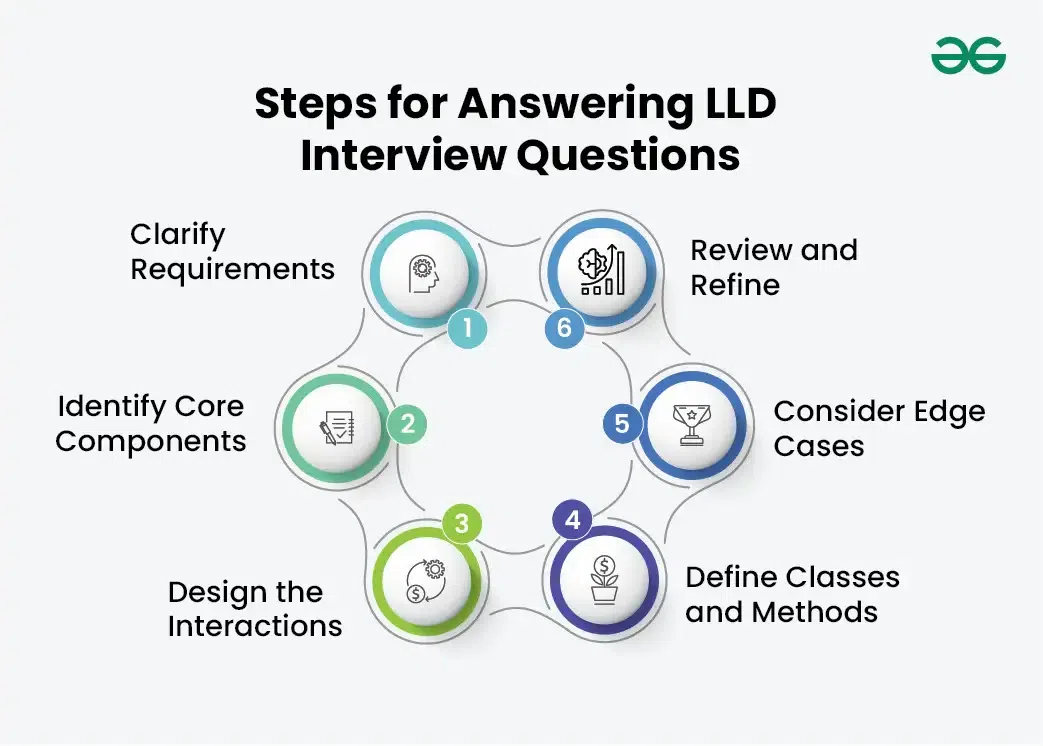
Let's watch a video that walks through this process in a realistic interview context.
Introduction to LLD | How to Approach LLD Problems in an Interview 🔥
The video 'Introduction to LLD' by codeWithAryan provides a fantastic walkthrough of how to approach an LLD problem from start to finish. It models the kind of structured thinking and communication that interviewers look for.
Watch the section 'how should we approach it' from 15:07 to 21:02. This part outlines the entire structured approach, which we will break down in detail.
Now, let's dissect this process into five actionable phases, incorporating best practices from our resources.
Phase 1: Clarify Requirements & Scope (5–7 minutes)
Every LLD interview begins with a vague prompt, like "Design a parking lot system." Your first job is to turn this into a concrete set of requirements. Do not start designing until you know what you are building.
How to do it:
Ask clarifying questions to define the boundaries of the problem. A great tool for this is a questioning framework.
Low-Level Design (LLD) :Interview Framework
The 'Low-Level Design (LLD) :Interview Framework' article on dev.to provides excellent, structured methods for each phase. We'll look at its framework for asking smart questions.
Read section 13, 'Smart Clarifying Questions,' and focus on the 'SCALE Framework'. This gives you a memorable structure for the types of questions to ask.
The SCALE framework is a great mental checklist:
- Scope: What are the core features? What user types are there? (e.g., "Are we handling just cars, or also bikes and trucks?")
- Constraints: What is the expected scale? Any technology preferences? (e.g., "How many concurrent bookings should we handle?")
- Assumptions: What can we assume? (e.g., "Can I assume users are already authenticated?")
- Limitations: What is explicitly out of scope? (e.g., "Should I handle payment processing, or can I assume a third-party service exists?")
- Edge Cases: How should we handle specific scenarios? (e.g., "What happens if a user tries to book an already taken seat?")
As you get answers, write them down in the shared document. This creates a contract between you and the interviewer and helps you stay on track.
Phase 2: Identify Core Entities & Relationships (5 minutes)
With clear requirements, you can now identify the main building blocks of your system.
How to do it:
Scan the requirements you just wrote down and extract the key nouns and verbs.
- Nouns become your candidate entities (classes). Examples:
User,Movie,Booking,ParkingLot,Ticket. - Verbs become your candidate behaviors (methods). Examples:
bookSeat,makePayment,issueTicket.
The goal here is to identify the main responsibilities and how they relate. For example, a ParkingLot HAS-A collection of ParkingSpots. A User CREATES a Booking.
What about UML?
While formal, detailed UML diagrams are rarely required, a simple box-and-arrow sketch on the whiteboard is incredibly effective for communicating structure. Don't worry about perfect notation; focus on clarity.
[ ParkingLot ] -----manages-----> [ 1..* ParkingSpot ]
     |
 issues
     |
     v
[ Ticket ]
Phase 3: Design the Classes and Interactions (15 minutes)
This is the core of the design phase, where you apply your knowledge of OOP, SOLID, and design patterns.
How to do it:
- Define Class Members: Go through each entity you identified and list its key attributes (fields) and methods. For a
Bookingclass, this might bebookingId,user,show,seats, and methods likeconfirmBooking()orcancel(). - Apply Principles and Patterns: As you design, think aloud about your choices.
- "I'm creating a
PaymentStrategyinterface here to follow the Open/Closed Principle. This way, we can add new payment methods like Crypto without modifying theBookingService." - "The
ParkingLotclass will be a Singleton because we only need one instance of it managing the entire lot." - "To avoid tight coupling, my
BookingServicewill depend on aNotificationServiceinterface, not a concreteEmailService. This follows the Dependency Inversion Principle."
- "I'm creating a
Justifying your design with principles and patterns is a powerful way to demonstrate your expertise.
Test your understanding!
During an interview to design a food delivery app, the interviewer asks, "How would you handle calculating the delivery fee, which might depend on distance, time of day, or special promotions?"
How would you answer this, explicitly mentioning a design pattern and a SOLID principle to justify your approach?
Show answer
A strong answer would be:
"That's a great question, as the pricing logic is likely to change. I would handle this using the Strategy Pattern.
I would define a PricingStrategy interface with a single method, like calculateFee(Order order). Then, I could create concrete implementations like DistanceBasedPricing, DynamicPricing (for peak hours), and PromotionalPricing.
My OrderService would be configured with a specific PricingStrategy object. This approach follows the Open/Closed Principle (OCP). It allows us to introduce new ways of calculating fees in the future (e.g., a WeatherBasedPricing strategy) without ever modifying the existing OrderService code. The system is open for extension but closed for modification."
Phase 4: Implement Core Logic (15 minutes)
You won't have time to write all the code. The key is to be strategic.
How to do it:
- Ask the interviewer: "I've outlined the classes and methods. Which part of the logic would be most interesting for you to see implemented?" They will often guide you to the most complex or critical part of the system (e.g., the seat-locking mechanism in a booking system).
- Focus on the core workflow: Implement the primary methods that show how your entities collaborate to fulfill a requirement.
- Use pseudocode or simplified Java: You can state, "I'll omit getters, setters, and constructors for brevity, but they would be included in a production implementation." This shows you know they're necessary while saving precious time.
Phase 5: Verify the Design & Discuss Extensions (5 minutes)
Finally, close the loop by validating your design and showing you've thought about the future.
How to do it:
- Walk through a scenario: Verbally trace a primary use case through your code. "Okay, let's trace a successful booking. A user calls
BookingController.createBooking(). This callsBookingService.processBooking(), which first checks seat availability. Then, it uses theStripePaymentStrategyto process payment. If successful, it saves the booking and uses theNotificationServiceto send a confirmation email." This proves your design works. - Discuss edge cases: Briefly mention how your design would handle errors, like payment failure or concurrent requests.
- Talk about extensibility: Proactively mention how your design could evolve. "Because we used the Strategy pattern for payments, adding a new payment provider would just involve creating one new class."
3. Key Tips for Acing the Interview
The framework gives you structure, but execution matters. Here are some final, critical tips to keep in mind.
10 LLD Interview Tips you should follow!!
The video '10 LLD Interview Tips you should follow!!' by Keerti Purswani offers a collection of high-impact, practical advice that complements the structural framework we've discussed.
Watch the following clips for some essential tips: 4:28 - 5:41: The importance of writing things down. 5:41 - 7:07: Being smart about which design patterns to implement. 8:06 - 9:47: How to handle disagreements with the interviewer. 10:27 - 11:07: The value of discussing trade-offs.
Summary of Essential Tips:
- Communicate Constantly: Think out loud. If you're silent, the interviewer can't evaluate you. Explain the why behind your decisions.
- Manage Your Time: Keep an eye on the clock. If you're 15 minutes in and still gathering requirements, you need to move on. The 45-minute breakdown (5-5-15-15-5) is a good guideline.
- Don't Over-engineer: Start with the simplest solution that works for the stated requirements. You can discuss more complex patterns when asked about extensions.
- Discuss Trade-offs: Show your depth as an engineer by discussing alternatives. "I could have used an Abstract Factory here, but since we only have a few object types, a simple Factory Method is sufficient and less complex."
- Be Coachable: If the interviewer offers a suggestion or pushes back on a decision, listen carefully. Discuss the trade-offs of their approach versus yours. It's a dialogue, not a confrontation.
Conclusion
Congratulations on completing the foundational modules of this LLD course! You now have a complete toolkit: you know the OOP fundamentals, you've mastered design principles and patterns, and today you've learned a strategic framework to communicate your designs effectively in an interview.
Key Takeaways:
- LLD interviews test your thought process, not just your coding.
- Use a structured framework: Clarify -> Identify -> Design -> Implement -> Verify.
- Justify your decisions with SOLID principles and design patterns. This is where you connect all your knowledge.
- Communication is paramount. Think aloud, discuss trade-offs, and guide the interviewer through your design.
- Time management is crucial. Be strategic about what you discuss, draw, and code.
In our next module, we move from theory to practice. You'll apply this communication strategy to full-fledged LLD Case Studies, starting with problems like designing a parking lot, a library management system, and an elevator control system. It's time to put your strategy to the test