Hello! Welcome back to our journey into game theory for your business.
In our last lesson, we focused on the crucial decision of when to pivot. We developed a framework for evaluating market signals to decide whether to persevere with your current strategy or make a significant change. This was an inward-looking analysis, focused on your own business strategy in response to customer feedback.
Today, we're going to zoom out and look at the broader competitive landscape. The profitability and viability of any strategy—whether it's your initial one or a pivot—depend heavily on the structure of the market you're operating in. Your very act of entering the market with your CNC woodworking business is an event that changes this structure.
Our learning outcome for this lesson is to analyze how market structure changes as competitors enter, exit, or consolidate. Understanding these dynamics will help you anticipate how the "game" itself might evolve, moving beyond just playing your turn to understanding how the board is changing.
1. The Competitive Landscape: What is Market Structure?
"Market structure" is simply a way to describe and classify the competitive environment of an industry. The main factors that define a market's structure are the number of firms in it and how they compete. Thinking about this helps you understand the "rules of the game" you're about to enter.
Economists generally classify markets into four main types, which exist on a spectrum from most competitive to least competitive.

To get a quick and clear overview of these four types, let's watch a segment from a Crash Course Economics video.
Game Theory and Oligopoly: Crash Course Economics #26
This video provides a concise explanation of the four basic market structures. As you watch, try to identify which structure best describes the market for premium custom furniture in your area.
Watch the section from 00:24 to 01:59. Pay close attention to the characteristics of each market type: perfect competition, monopolistic competition, oligopoly, and monopoly.
Let's quickly map these concepts to your woodworking business:
- Monopoly: If you were the only provider of custom CNC cabinets in your entire region, you'd be a monopolist. You would have significant control over pricing. This is rare in the real world.
- Perfect Competition: Think of a commodity like raw pine lumber. There are thousands of sellers, the product is identical, and no single seller can influence the price. This is not the market for your premium, differentiated products.
- Oligopoly: This is a market dominated by a few large players. This might describe the market for the high-end CNC machines you're considering buying, where a few brands (like Felder, Biesse, or SCM) hold most of the market share. If your local custom furniture market were dominated by 3 or 4 huge, well-known companies, it would be an oligopoly.
- Monopolistic Competition: This is the most likely structure for your market. As the resource Competition and Market Structures from Econlib notes, this structure involves "many firms, each selling slightly differentiated products that are not perfect substitutes for one another." Restaurants are a classic example, and custom furniture shops fit this description perfectly. Each has a unique style, location, reputation, or specialty. You can set your own prices to a degree, but if you charge too much, customers have many other options.
Test your understanding!
Based on your initial research of the local market for premium doors and cabinets, which market structure do you think you are entering? Briefly justify your answer by considering the number of competitors and how they differentiate themselves.
Show answer
You are most likely entering a monopolistically competitive market. There are probably several other custom woodworkers, cabinet shops, and small furniture companies in your area. Each one competes not just on price, but on factors like design style, material specialty (e.g., reclaimed wood), craftsmanship, customer service, and relationships with builders or architects. Your plan to use CNC technology for premium quality is a form of product differentiation within this structure.
2. Changing the Game: The Impact of Market Entry
Your decision to start a business is not just a personal one; it's a strategic move that alters the market structure. When you enter, a market with N firms now has N+1. This might seem small, but it can trigger significant reactions and change the dynamics of competition.
The Incumbent's Dilemma
From the perspective of an existing business (the "incumbent"), your entry is a threat. They must decide how to respond. This classic strategic interaction can be visualized with a game tree.
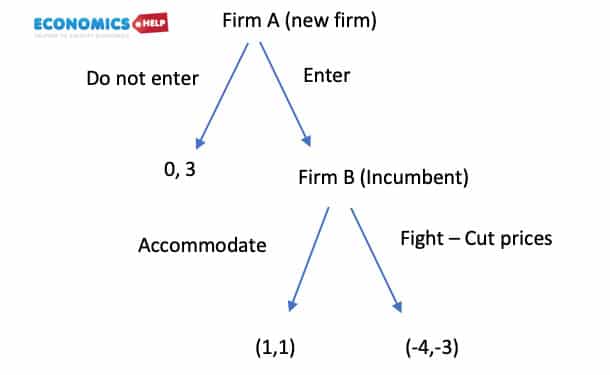
Using this tree as a guide:
- You Enter: You make the first move, launching your woodworking business.
- Incumbent Reacts: An established local cabinet maker now has a choice:
- Accommodate: They can accept the new reality, keep their prices stable, and compete with you on quality and service. The market is now shared, and their profits might decrease (in the diagram, from 3 to 1).
- Fight: They can try to drive you out of the business. This might involve aggressive price cuts (predatory pricing), launching a massive marketing campaign, or trying to lock up key suppliers. This is often costly for the incumbent as well (their profit drops from 3 to -3 in the diagram), but they might do it to prevent future competition.
Entry and the Shift in Market Structure
The very threat of entry can change behavior, but actual entry forces a structural change. How this plays out is beautifully illustrated by a simple model of spatial competition.
Why do competitors open their stores next to one another? - Jac de Haan
This wonderful TED-Ed video explains Hotelling's Model, which answers the question, 'Why do competitors open their stores next to one another?'. It visually demonstrates how a market changes when a new competitor enters.
Please watch the entire video (it's short). Notice the stark difference in the market when there is one ice cream vendor (a monopoly) versus when a second one enters (a duopoly, which is a type of oligopoly).
The video shows that the arrival of a single new competitor fundamentally changes the game. The monopolist's peaceful existence is over. Now, every decision (like where to place your cart) is interdependent. The market structure shifted from a monopoly to a duopoly, and the competitive dynamic shifted from simple service to strategic positioning.
Your entry into the local woodworking market does the same thing. An established firm that previously only had to worry about its old rivals now has to consider your actions when setting prices or bidding on projects.
3. Consolidation and Exit: The Market Shrinks
Markets don't just grow; they also shrink and consolidate, which also changes the structure. This happens through two primary mechanisms: competitor exit and consolidation.
Competitor Exit
A firm might exit the market for many reasons: bankruptcy, a strategic pivot to a different market (as we discussed last lesson), or being driven out by competition.
- Impact: When a competitor leaves, the market becomes more concentrated. If you are in a monopolistically competitive market with 10 local shops, and two go out of business, the market moves slightly towards an oligopoly.
- Your Opportunity: The customers of the exiting firm are now available. For the remaining firms (including yours), an exit means a larger potential market share and potentially more pricing power. The game becomes less crowded.
Consolidation (Mergers & Acquisitions)
Consolidation happens when two or more firms merge, or when one firm acquires another.
- Example: Imagine two of the larger, established cabinet manufacturers in your state decide to merge into one entity.
- Impact: Like an exit, this leads to higher market concentration. A market that was a loose oligopoly of five firms might become a tight oligopoly of four. These larger, consolidated firms can be more formidable competitors due to greater resources and economies of scale. They may also be more inclined to engage in price leadership, where one firm sets a price and the others follow, reducing price competition for all of them.
Analyzing these dynamics is crucial for long-term strategy. You're not just entering the market as it is today; you're entering a dynamic system that will continue to evolve.
Conclusion
Today, we've pulled the lens back to see the entire competitive playing field. Understanding market structure is fundamental to thinking strategically, as it dictates the nature of competition you will face.
Key Takeaways:
- Market structure classifies a market based on the number of competitors, ranging from a single-firm monopoly to the highly fragmented perfect competition. Your premium woodworking business will likely operate in monopolistic competition.
- Your market entry is a structural event. It forces incumbents to react, and you must anticipate their moves (like accommodating or fighting).
- Competitor exit and consolidation also change the game. These events lead to a more concentrated market, which can increase the power of the remaining firms and change how they compete.
- By analyzing these forces, you can better anticipate the future competitive landscape, not just react to the current set of players.
Preview of the Next Lesson:
We've touched upon the idea of an incumbent choosing to "fight" a new entrant. But what does that fight look like? In our next lesson, we will dive into this topic: "Recognize aggressive competitive behaviors like predatory pricing." This will equip you to identify and defend against hostile tactics from established competitors.