Hello! Welcome back to your course on game theory for entrepreneurs.
In our last lesson, we focused on formulating a defensible niche strategy. We used the Blue Ocean framework to see how you could create a unique market space for your woodworking business, one where large incumbents would find it irrational to compete with you directly. This strategy of sidestepping a head-on fight is a great starting point.
However, a business decision is never made in a vacuum. Choosing to invest in a new machine, changing your prices, or sourcing a new type of wood isn't just a move against a competitor; it's like pulling on a single string in a complex web. It tugs on your suppliers, your customers, and even companies you may not have considered.
Today, we'll zoom out to see this entire web. We will learn a framework for analyzing how any single business decision simultaneously affects all the key players in your business ecosystem. This holistic view is the capstone of our module on navigating competitive dynamics.
By the end of this lesson, you will be able to analyze a business decision by considering its simultaneous impact on customers, suppliers, and competitors.
1. From Splitting the Pie to Growing the Pie
So far, many of our examples have focused on the tension between you and a competitor, like a chess match. This often feels like a "zero-sum" game, where you're both fighting to split a fixed pie.
A more powerful way to think about strategy is to focus first on creating value. Profit is the result of creating value, not the other way around. But who do you create value for? And how does that translate into success for your business? A simple model can help us visualize this.
To get started, let's watch a video from Harvard Business Review that introduces the "value stick." This tool breaks down how a business transaction creates value and how that value is shared among your business, your customers, and your suppliers.
What Is Strategy? It’s a Lot Simpler Than You Think
This video, 'What Is Strategy? It’s a Lot Simpler Than You Think,' introduces a simple but powerful model to visualize how value is created and divided among your business, your customers, and your suppliers.
Please watch two segments: From 1:09 to 3:39, which explains the 'value stick' concept, defining Willingness to Pay (WTP), Willingness to Sell (WTS), and how value is split. From 6:22 to 9:28, which details the Best Buy turnaround. As you watch, notice how their strategic moves weren't just about competing with Amazon; they simultaneously changed the value proposition for customers, suppliers (like Microsoft and Sony), and their own employees.
The video illustrates a crucial point: strategy is the plan to increase the total value created, which is the difference between your customer's Willingness to Pay (WTP) and your supplier's Willingness to Sell (WTS).
Let's apply this to your business:
- Customer's WTP: The absolute maximum a client would pay for your custom cabinets. Your unique CNC designs and premium materials aim to raise this.
- Supplier's WTS: The minimum your wood supplier would accept for their lumber, or your hardware provider for their hinges.
- Your Price & Costs: These fall between WTP and WTS. The gap between WTP and your Price is the value your customer gets. The gap between your Price and your Costs is your profit. The gap between your Costs and the supplier's WTS is their profit.
The Best Buy example shows this in action. By creating "stores-within-a-store," they didn't just fight Amazon on price. They:
- Increased customer WTP by providing expert staff and a better shopping experience.
- Decreased their key suppliers' WTS by offering them a much cheaper way to get a premium retail presence than building their own stores.
- Increased their own profit by capturing a slice of this newly created value.
This is the essence of today's lesson: a single strategic move can, and should, be analyzed for its impact on everyone involved.
2. The Value Net: Your Business Ecosystem Map
The value stick gives us the financial dimension. Now, we need a map of the players themselves. For this, we'll use a powerful game theory framework called the Value Net, developed by strategists Adam Brandenburger and Barry Nalebuff.
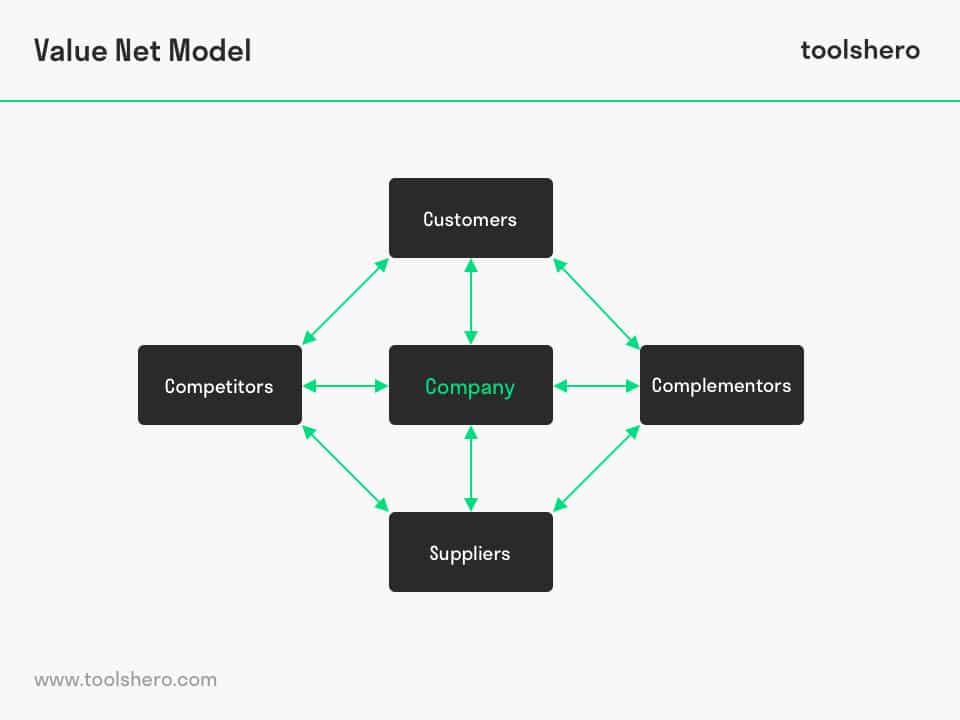
This model introduces a new, critical player that is often overlooked: the Complementor.
Let's define these four players in the context of your premium woodworking business:
- Customers: The people who buy your products (e.g., homeowners, interior designers, building contractors).
- Suppliers: The businesses that provide you with resources (e.g., lumber providers, CNC software companies, hardware manufacturers).
- Competitors: Other businesses a customer could go to instead of you (e.g., traditional cabinet makers, other CNC shops, IKEA).
- Complementors: Businesses that sell products or services that make yours more attractive to customers. For your business, this could include:
- High-end appliance manufacturers (e.g., Wolf, Sub-Zero).
- Premium countertop installers (quartz, marble).
- Interior designers who specify your work in their projects.
- Even IKEA, if you pursue the niche of making premium doors for their standard cabinet systems.
The following article explains this framework and why it encourages a mindset of "co-opetition"—a mix of competition and cooperation.
This article introduces the Value Net framework, explains the role of each player, and makes the crucial point that strategy is not just about competing but also about cooperating to 'grow the pie' for everyone.
Please read the sections 'What is the Value Net Framework?' and 'Why is the Value Net Framework Important?'. Focus on understanding the role of each of the four players and the core idea of 'growing the pie' rather than just fighting to 'split the pie'.
Test your understanding!
You're considering focusing on high-end custom doors for standard IKEA kitchen cabinets. In this scenario, who is IKEA in your Value Net? Are they a competitor, a supplier, or a complementor?
Show answer
This is a great example of the complexity of business relationships! In this case, IKEA is primarily a complementor. Their cabinet systems create the demand and the platform for your high-value doors. A customer buying an IKEA kitchen becomes a potential customer for you.
You could argue they are also an indirect competitor because they sell their own doors. However, your niche strategy is to offer a level of quality and design that IKEA doesn't, so you are not competing head-to-head. This shows how one player can wear multiple hats in the Value Net, and your strategy determines which relationship is most important.
3. Making a Decision: The PARTS Framework
The Value Net gives you the "who," but you need a process for analyzing the "what"—your strategic decisions. The creators of the Value Net also developed a practical checklist called PARTS, which is rooted in game theory. It helps you systematically think through the ripple effects of any action.
Let's use PARTS to analyze a key decision for your startup: "Should I invest in a very expensive, specialized 5-axis CNC machine that can do intricate carvings, or a more flexible, standard 3-axis one?"
- Players: Who are all the players this decision affects? (Customers, Suppliers, Competitors, Complementors). Will this decision bring new players into the game (e.g., a specialized software provider for the 5-axis machine)?
- Added Value: How does this change the value you bring? The 5-axis machine dramatically increases your added value for high-end designers (customers) and differentiates you from competitors, raising your customers' WTP.
- Rules: Are there industry norms or "rules" this challenges? For example, perhaps the standard is simple, flat-panel doors. Offering complex curved surfaces could change what high-end customers expect.
- Tactics: How will others perceive this action? This is about shaping beliefs. Investing in the expensive machine is a powerful tactic. It sends a credible signal to competitors that you are committed to the ultra-premium niche, and it signals to customers that you have unique capabilities. It is not "cheap talk"; it's a costly, and therefore credible, move.
- Scope: Could this decision link your business to other markets? The 5-axis machine might allow you to expand your scope beyond kitchens into architectural millwork, custom furniture, or even artistic fabrication, opening up entirely new games to play.
Now, take a few minutes to read the description of this powerful checklist.
The PARTS framework provides a structured way to apply the Value Net to a real-world decision.
Please read the section that begins 'That being said, the original creators of this framework recommend using the PARTS methodology...'. Go through the definitions of Players, Added Value, Rules, Tactics, and Scope, thinking about the CNC machine example.
Using this framework forces you to move beyond a simple cost-benefit analysis and consider the full strategic impact of your decisions across the entire business landscape. This type of analysis is a core application of game theory, used to model everything from pricing strategies to supply chain negotiations.
Conclusion
Today, we've broadened our strategic lens from a narrow focus on competitors to a panoramic view of the entire business ecosystem. By understanding the interconnectedness of all players, you can make smarter, more robust decisions.
Key Takeaways:
- Strategy isn't just about beating rivals; it's about creating value. The Value Stick helps visualize how this value is distributed among your company, customers, and suppliers.
- The Value Net provides a map of your business ecosystem, highlighting the four key players: Customers, Suppliers, Competitors, and the often-overlooked Complementors.
- The PARTS framework (Players, Added Value, Rules, Tactics, Scope) is a practical checklist for analyzing the full, simultaneous impact of any strategic decision on all players in the Value Net.
Preview of the Next Lesson:
We now have a powerful map for analyzing our decisions. But the real world is messy. We don't always know what customers truly want, or how a competitor will react. In our next lesson, we will begin the final module of the course, Decision Making Under Uncertainty. We'll start by learning how to identify the critical uncertainties that most impact your strategic choices, ensuring your strategy is not just clever, but also resilient.