
Hello! Welcome to the final lesson in our module on the Thomistic development of Aristotle's arguments.
In our last two lessons, we delved deep into Aquinas's specific metaphysical vision. We saw how he identified the First Cause with ipsum esse subsistens (subsistent being itself), and from this, deduced that this being must be purely actual (actus purus) and therefore absolutely simple (non-composite).
Today, we will build directly on this understanding to address a crucial point of comparison: how does this being act as a cause? Our goal is to contrast Aquinas's view of God as both an efficient and final cause with Aristotle's more restricted view of the Unmoved Mover as primarily a final cause. This distinction marks a pivotal shift from a purely philosophical first principle to the active, creative God of classical theism.
1. A Refresher: Aristotle's Four Causes
To understand the contrast, we must first be clear on the causal language both thinkers inherited from Aristotle. As a quick refresher, Aristotle identified four types of explanation, or "causes," for any given thing or process.
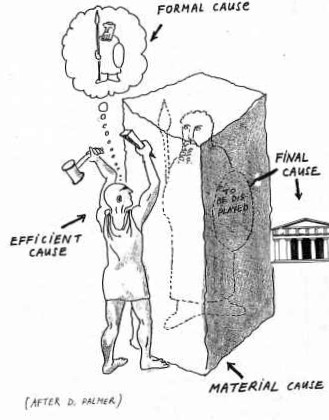
The crucial distinction for our lesson is between the efficient cause (the agent that produces an effect, like the sculptor carving) and the final cause (the end, goal, or purpose for which an agent acts).
2. Aristotle's Unmoved Mover: The Supreme Final Cause
As we've discussed, Aristotle's Unmoved Mover is the ultimate explanation for the eternal, circular motion of the celestial spheres. But how does it cause this motion?
Aristotle argues that the Unmoved Mover causes motion not by pushing or pulling (not as an efficient cause), but by being an object of love and desire. In Metaphysics XII, he explains that the "object of desire and the object of thought" move things without being moved themselves. The Unmoved Mover, in its perfect and eternal activity of self-contemplation (noesis noeseos), is the ultimate good and most intelligible reality. The celestial spheres, in their own way, seek to imitate this perfection, and the closest they can come is through eternal, uniform, circular motion.
- Mode of Causality: Purely final. It moves the world in the same way a beloved person inspires action in a lover, simply by being an object of adoration, without actively doing anything to the lover.
- Object of Causality: Primarily the motion of the heavens. It explains change within an already existing, eternal cosmos. It does not explain the existence of the cosmos.
For Aristotle, the Unmoved Mover is a passive, self-contained principle whose influence is a consequence of its supreme desirability.
3. Aquinas's Expansion: God as Primary Efficient Cause
Aquinas adopts Aristotle's causal framework but transforms it to align with the theological doctrine of creation. This requires a much more robust role for God as an efficient cause. For Aquinas, God is not just the cause of motion, but the cause of being itself.
This expansion happens in two key ways:
- Creation ex nihilo: God is the efficient cause that brings the universe into existence from nothing. This is a concept entirely foreign to Aristotle's worldview of an eternal cosmos.
- Conservation in Being (conservatio in esse): God's efficient causality is not a one-time event. He continuously sustains everything in existence at every moment. Without this constant "ontological influx," all of creation would instantly cease to be.
To explain how God can be the efficient cause of everything without negating the real causality of created things, Aquinas introduces a crucial distinction.
Thomas Aquinas and His Many Causes
This short article, 'Thomas Aquinas and His Many Causes,' explains this key Thomistic distinction between primary and secondary causes.
Please read the sections explaining 'primary and secondary causes' and 'principal and instrumental causality'. Focus on the core idea: God is the sole primary cause, whose action enables all secondary causes (creatures) to act. The effect is due to both, with the creature acting as an instrument of the primary cause.
As the article explains, Aquinas's system presents a hierarchy of causality:
- Primary Cause: God is the ultimate source of all being and all action.
- Secondary Causes: Creatures (people, animals, natural forces) are real causes that produce real effects. However, their ability to act is entirely dependent on and derived from God's continuous action as the Primary Cause.
In this model, God and the creature are not competing causes. Rather, God's primary efficient causality is what makes the creature's secondary causality possible. God is the cause of both the existence of the rock and the rock's falling.
4. Aquinas's Synthesis: God as Both Efficient and Final Cause
While expanding the role of efficient causality, Aquinas fully retains the idea of God as the ultimate final cause. All of creation is ordered toward God as its final end. This is the central argument of his "Fifth Way" for the existence of God.
The Argument Atheists Always Get Wrong
This video, while critiquing common misinterpretations of Aquinas, provides a good explanation of his Fifth Way as an argument rooted in final causality.
Please watch from 19:15 to 22:26. The video explains that the Fifth Way is not a simple 'design' argument. Instead, it's about what grounds the 'causal reliability' or tendency of things to act toward specific ends (their 'final cause'). Aquinas argues this regularity is grounded in an intellect that directs all things to their goal—God.
For Aquinas, every being, from an acorn growing into an oak to a human seeking happiness, is striving to actualize its potential. This universal striving is ultimately a participation in the desire for the ultimate good, which is God himself.
Therefore, Aquinas's God acts in two fundamental ways:
- As the Primary Efficient Cause, He creates and sustains the being of all things.
- As the Ultimate Final Cause, He is the goal and perfection that all things seek.
5. Why the Difference? Philosophy vs. Theology
The contrast between Aristotle's and Aquinas's views is not merely a technical disagreement. It reflects the fundamental difference in their projects.
- Aristotle is engaged in philosophy and cosmology. He seeks the most logical explanation for the eternal motion he observes in the universe. A passive, final cause is sufficient for this task.
- Aquinas is engaged in theology. He is integrating the insights of Aristotelian philosophy with the revealed truths of Christianity, particularly the doctrine of a free and loving Creator God. A God who creates and sustains the universe must be an active, efficient cause.
This next resource is a scholarly paper that masterfully summarizes the different metaphysical frameworks and theological intentions of Aristotle and Aquinas, explaining why their conceptions of the First Cause's causality differ.
On Proofs for the Existence of God: Aristotle, Avicenna, and Thomas ...
The paper 'On Proofs for the Existence of God' provides a rigorous academic comparison of Aristotle and Aquinas, highlighting why Aquinas returns to and modifies the Aristotelian proof.
Please read Section 4, 'Thomas Aquinas’s Cosmological Proof...', and Section 5, 'Conclusions'. Don't worry about grasping every detail about Avicenna. Focus on how the text contrasts Aristotle and Aquinas. Pay special attention to the conclusion, which states that Aquinas defines God's nature 'primarily in terms of causality... identifying God as the First Mover, the primary efficient, final, and existential cause.' This directly encapsulates our lesson's key point.
As the paper clarifies, Aquinas's project required him to identify the First Cause not only with motion, but with existence itself. This "causal relationship in the creationist sense" is the core of the Thomistic expansion.
Conclusion: From First Principle to Creator God
Today we have seen how Aquinas takes Aristotle's metaphysical toolkit and re-engineers it to build a much more powerful and encompassing vision of the First Cause.
Here are the key takeaways:
- Aristotle's Unmoved Mover is a restricted cause. It acts only as a final cause, explaining the motion of an eternal universe by being an object of desire.
- Aquinas's God is an all-encompassing cause. He acts as both:
- The Primary Efficient Cause, explaining the very existence of all things through creation and conservation.
- The Ultimate Final Cause, serving as the purpose and goal towards which all of creation is ordered.
- This expansion is driven by theological commitments. The Christian doctrine of a Creator God requires a first principle that is an active, efficient cause of being, not merely a passive attractor for motion.
This fundamental shift from a supreme Final Cause to a Primary Efficient and Final Cause is perhaps the most significant step in the journey from Aristotle's Unmoved Mover to the God of classical theism.
In our next module, we will shift our focus from building up the argument to examining its critiques. We will begin by looking at how early modern philosophers, such as Leibniz, approached the demand for an ultimate explanation with different principles, setting the stage for the powerful objections that would follow.
Can't find a good explanation? Sign up and we'll make it for you
Sign up