
Welcome to your second lesson. In our previous session, we established the fundamental distinction between common law and statutory law, clarifying the different sources of legal authority in England. We now turn from where the law comes from to what it is made of. To analyse any criminal offence, including the historic offence of sedition, we must first understand its constituent parts.
Today, we will define and explore the two essential building blocks of a criminal offence: the actus reus (the guilty act) and the mens rea (the guilty mind). The core principle, expressed in the Latin maxim actus non facit reum nisi mens sit rea, is that an act does not make a person guilty unless their mind is also guilty. By the end of this lesson, you will be able to define both elements, understand their key variations like intention and recklessness, and explain how they must coincide to establish criminal liability.
The Two Core Components of a Crime
Every criminal offence, unless specifically stated otherwise, is composed of an external, physical element and an internal, mental element. Let's begin with a formal definition of these two concepts from the Incorporated Council of Law Reporting (ICLR).
Mens rea and actus reus - ICLR
This short article provides a concise and authoritative definition of both actus reus and mens rea.
Please read the entire article. Pay close attention to how it defines the two core terms and introduces the concepts of absolute and strict liability as exceptions to the rule.
As you've just read, the actus reus refers to the prohibited act, while the mens rea refers to the required state of mind. We will now examine each of these in greater detail.
Actus Reus: The External Element
The actus reus encompasses all the elements of an offence that are not concerned with the defendant's state of mind. This includes the defendant's conduct, the existence of any relevant circumstances, and, for many crimes, the consequences of that conduct.
A comprehensive guide for understanding these principles can be found in a legal revision text. It breaks down the components of actus reus systematically.
[PDF] General principles of criminal law - Revise SQE
This chapter provides a detailed breakdown of the actus reus.
Start by reading the initial introduction on page 3, which defines actus reus, mens rea, and the distinction between 'result crimes' and 'conduct crimes'. Then, read the section titled "ACTUS REUS" from pages 3 to 7. This covers three key principles: The act must be voluntary. Liability can sometimes arise from an omission (a failure to act). Focus on the different categories of 'duty to act' described in Table 1.1. For an omission to lead to liability, the defendant must have failed to discharge their duty by not taking reasonable steps.
As the text explains, a core requirement is that the act be voluntary. Furthermore, while the law does not generally punish people for failing to act, it makes exceptions where a person is under a specific legal duty to do so.
Causation in "Result Crimes"
For 'result crimes' (e.g., murder, where the result is a death), the prosecution must also prove that the defendant's conduct caused the prohibited result. The law approaches this by establishing two forms of causation: factual and legal. Given your background in statistics and econometrics, you are familiar with the complexities of establishing causal links. In law, this is addressed through a two-stage test.
[PDF] General principles of criminal law - Revise SQE
This reading covers the legal principles of causation.
Please read the section titled "Causation" from pages 7 to 11. Focus on: Factual causation: The 'but for' test, which functions as a test for a necessary condition. Legal causation: The principle that the defendant's act must be a 'substantial and operating' cause of the result. Novus actus interveniens: A 'new and intervening act' that can break the chain of causation. Note the different rules for acts of the victim, a third party, or medical treatment.
The 'but for' test for factual causation is a logical filter. However, legal causation introduces a normative element, asking whether it is fair to attribute the result to the defendant. The rules around intervening acts are designed to determine if the defendant's conduct has been superseded by a subsequent event to such a degree that they should no longer be considered the legal cause.
Mens Rea: The Internal Element
Mens rea refers to the mental state required for an offence. The law has developed a hierarchy of fault, with different terms signifying different levels of culpability. The most common forms are intention, recklessness, and negligence.
Levels of Culpability
Let's return to the revision guide to define these key terms.
[PDF] General principles of criminal law - Revise SQE
This reading defines the different forms of mens rea.
Read the section titled "MENS REA" from pages 12 to 17. As you read, focus on the precise legal tests for each concept: Intention: Pay close attention to the distinction between direct intent (aim or purpose) and oblique intent. For oblique intent, the two-part Woollin test (Figure 1.3) is crucial: was the consequence a virtual certainty, and did the defendant realise this? Subjective Recklessness: The test is whether the defendant was aware of a risk and proceeded to take that risk unjustifiably. Negligence: This is an objective test concerned with whether the defendant's conduct fell below the standard of a reasonable person.
The distinction between direct and oblique (or indirect) intent is one of the most conceptually important areas of criminal law. This flowchart provides a clear visual representation of the decision-making process a jury would follow.
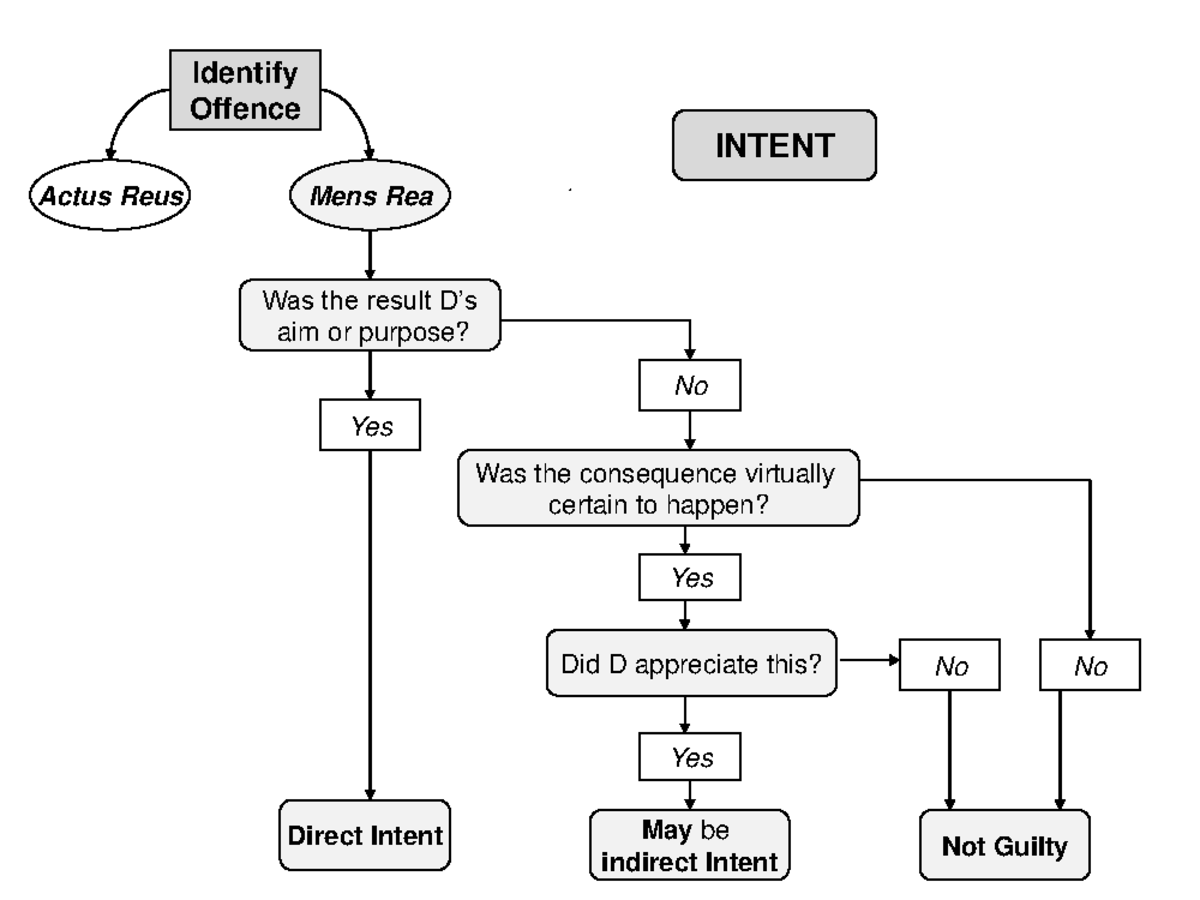
As you can see, the flowchart perfectly maps the questions outlined in the text for establishing intent. Oblique intent acts as a safety net to capture defendants who may not have desired a particular outcome but acted with a virtual certainty that it would occur.
For a deeper insight into how mens rea is handled in practice, this short video explains a critical point: since we cannot read minds, a court must infer the defendant's mental state from the available evidence.
This video discusses the practical challenge of proving a defendant's mental state in court.
Watch the segment from How do we prove mens rea?. The presenter explains that intent is not proven directly but is inferred from evidence, referencing Section 8 of the Criminal Justice Act 1967.
The Principle of Coincidence
For liability to be established, the actus reus and mens rea must coincide, meaning they must occur at the same time. If you plan to commit a crime but accidentally complete the actus reus at a time when you lack the mens rea, you are not guilty.
However, the courts have interpreted this principle flexibly to ensure that defendants do not escape liability on a technicality.
[PDF] General principles of criminal law - Revise SQE
This section explains how the courts ensure the elements of a crime are treated as contemporaneous.
Read the section on page 17 titled "COINCIDENCE OF ACTUS REUS AND MENS REA". Note the concepts of a 'continuing act' and a 'series of acts', which courts use to link the guilty act with the guilty mind even if they don't occur at the exact same moment. Also, take note of the doctrine of 'transferred malice'.
Conclusion
In this lesson, we have dissected the anatomy of a criminal offence. You should now be comfortable with the following key concepts:
- Actus Reus: The external element of a crime, encompassing a voluntary act, or in some cases, an omission where a duty to act exists. For result crimes, it also requires proof of causation.
- Mens Rea: The internal or mental element. The main forms, in descending order of culpability, are intention (direct and oblique), recklessness, and negligence.
- Coincidence: For a crime to be committed, the actus reus and mens rea must happen at the same time. Courts can interpret this rule flexibly through doctrines like the 'continuing act'.
These principles are the essential toolkit for legal analysis. They apply to almost every offence, whether it originates in common law or statute.
In the next lesson, we will conclude our foundational module by examining the process through which Parliament abolishes common law offences. We will also look at the historical offence of criminal libel, which serves as an important precursor to the law of sedition and other modern speech-related crimes.
Can't find a good explanation? Sign up and we'll make it for you
Sign up