
Hello again. In the previous lesson, you mapped Steelo’s ecosystem by separating value flow from cash flow. You identified that a fan, artist, brand, merchant, payment provider, and Steelo can each play different roles in the same exchange. Most importantly, cash collected by Steelo is not automatically Steelo revenue. Some of it may be owed to artists, participating members, suppliers, or payment providers.
This lesson gives each legitimate Steelo income source a clear commercial label: subscription, transaction, sponsorship, advertising, or service revenue. That classification will let you build a credible pitch and, later, forecast each stream with the right drivers rather than treating all money coming into the platform as one number.
By the end, you should be able to look at a proposed Steelo charge and state: who pays, what they are buying, what triggers the payment, and which revenue category it belongs to.
Revenue classification begins with the thing being sold
A revenue stream is not just “a way money enters the bank.” It is the repeatable commercial mechanism through which a business earns income. The same platform can operate several mechanisms at once.
For Steelo, the key is to classify revenue by the primary promise made to the payer, not by the screen on which the payment occurs.
Consider these examples:
- A fan pays monthly to remain in an artist community.
- A merchant pays Steelo a percentage of merchandise sales completed through a community offer.
- A brand pays for an artist approved campaign delivered to a defined community.
- A brand buys promotional placements that appear in a community feed.
- An artist pays Steelo to build and manage a branded community campaign.
All five payments might sit within Steelo’s product. But they are not economically identical. They have different sales processes, cost structures, risks, and forecasting methods.
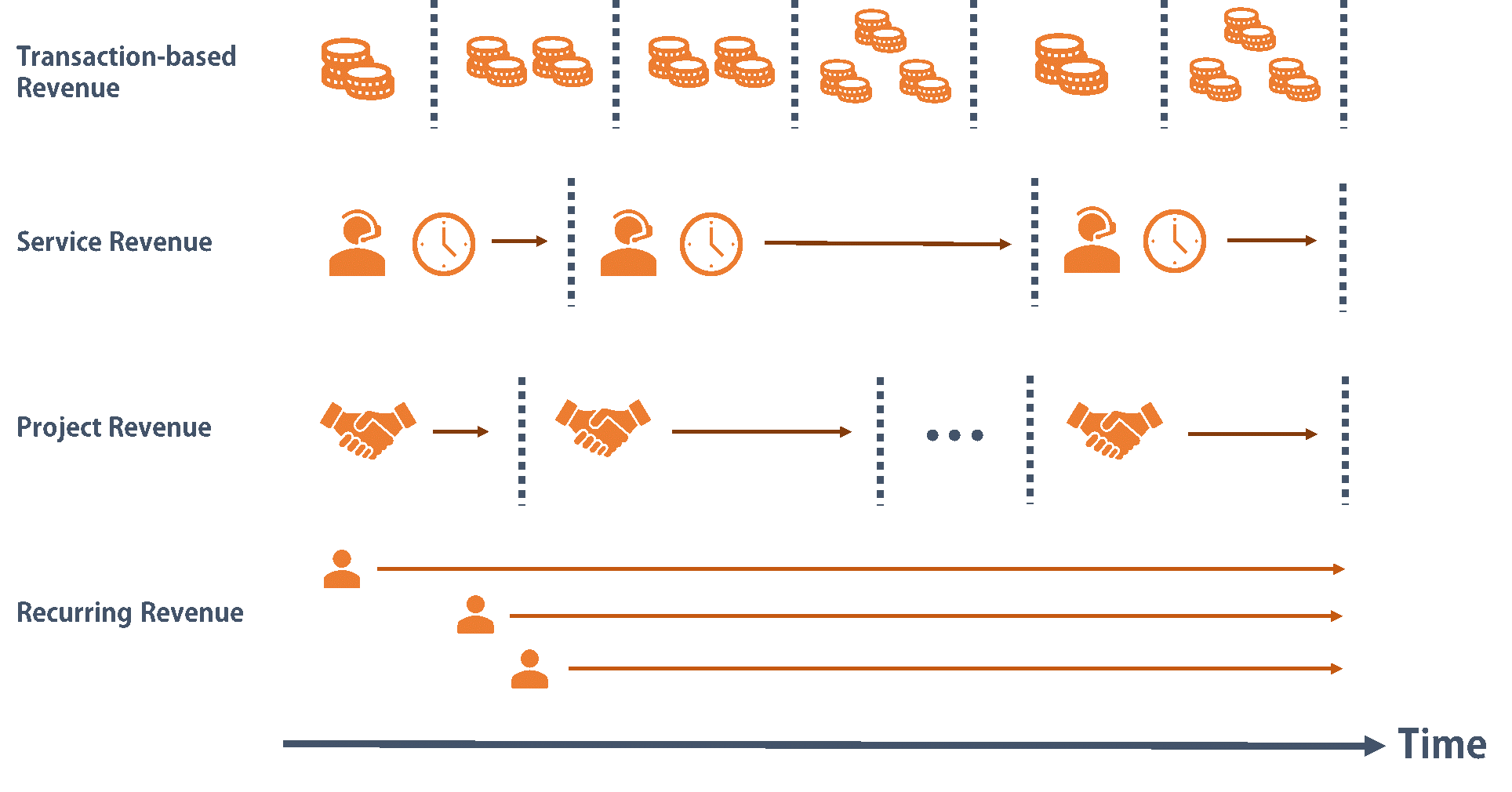
Corporate Finance Institute distinguishes transaction, service, project, and recurring revenue, and explains why recurring revenue tends to be more predictable than transaction or project income.
Revenue Streams - Overview, Examples, Different Types of Revenue
Read the relevant sections of Corporate Finance Institute’s guide to establish the distinction between transaction, service, and recurring revenue. Focus especially on why each type behaves differently when forecasting.
In “Examples of Revenue Streams,” read from the explanation of common revenue models. Then continue into “Importance of Revenue Streams,” focusing on the discussion of predictability and the need for different forecasting models for recurring and project based income.
The following image gives a useful high level distinction. Transaction, service, and project revenue happen in separate commercial events. Recurring revenue continues over time as long as customers remain active.
For this course, use a practical classification rule:
Classify a payment according to the primary thing Steelo promises to deliver to the payer and the event that causes the payment to be earned.
This prevents vague labels such as “partnership revenue” or “platform income,” which are not useful when someone needs to assess commercial viability.
A note on classification versus billing frequency
A monthly payment is not automatically subscription revenue.
For example, if an artist pays Steelo each month for a dedicated community manager, the commercial promise is ongoing operational work. It is primarily service revenue, even though the invoice recurs monthly.
Likewise, a brand might sign a three month deal to display promotional content. If Steelo is mainly selling promotional placement, that is advertising revenue, even if the brand pays in monthly instalments.
A helpful hierarchy is:
- Identify what Steelo is selling.
- Identify who pays.
- Identify what event earns the fee.
- Then record whether the billing is one time, recurring, usage based, or project based.
The five revenue categories for Steelo
1. Subscription revenue: payment for continuing access
Subscription revenue is a recurring payment for ongoing access to a product, service, feature set, or membership. The customer keeps access while they continue paying.
For Steelo, there are two distinct subscription possibilities:
| Payer | What they receive | Likely category |
|---|---|---|
| Fan | Continued access to an artist community, exclusive content, member benefits, and messaging | Fan membership subscription |
| Artist | Continued access to Steelo’s software, analytics, payment tools, or operating features | Artist software subscription |
The first is central to Steelo’s current proposition. The second may be relevant if Steelo positions itself partly as operating infrastructure for artists and community operators.
Subscription revenue is usually driven by:
This is why the current fan membership model can feel linear. If price remains fixed, revenue rises mainly when the platform acquires and retains more paying members. Retention matters because a subscriber who leaves stops contributing future revenue.
However, “linear” does not mean “weak.” Subscription revenue can be valuable because it is relatively predictable. The strategic question is whether Steelo can offer enough differentiated value to win and keep subscriptions when artists already have multiple direct fan channels.
Watch the subscription and marketplace segments of AltexSoft’s overview. They show the central difference between charging for access and charging because a transaction occurs.
How to choose a revenue model for a software product
In “How to choose a revenue model for a software product,” AltexSoft contrasts recurring access fees with marketplace commissions and explains why advertising requires very different scale.
Watch subscription basics for the access based logic and predictability of recurring payments. Then watch marketplace commissions to see how platforms charge when they enable a transaction. Finish with advertising limits, noting why audience scale alone does not automatically create an attractive ad business.
2. Transaction revenue: payment triggered by marketplace activity
Transaction revenue is earned when a defined purchase, booking, sale, payout, or other platform enabled exchange occurs. Steelo may charge a percentage of transaction value, a fixed fee per transaction, or both.
Examples include:
- Steelo keeps a fee when a member purchases merchandise through a community offer.
- Steelo charges a booking fee on each paid event ticket.
- Steelo charges a commercial partner a fee for each verified referral, sale, or qualified lead.
- Steelo retains a portion of a paid opportunity budget after distributing agreed payments to artists and participating members.
The core formula is:
Suppose merchandise orders are completed in a month, with an average order value of , and Steelo’s take rate is .
In that case:
- Gross merchandise value, or GMV, is .
- Steelo’s transaction revenue is , before considering payment processing and other direct costs.
The distinction is essential in an investor or owner pitch. Saying “Steelo generated through merchandise” can be misleading if Steelo only keeps . The larger amount describes activity flowing through the ecosystem. The retained amount is closer to Steelo’s commercial income, subject to the final contractual and accounting structure.
Stripe’s marketplace guidance provides a concise view of three common platform income mechanisms: taking a portion of transactions, selling financial products, and collecting subscriptions.
Read Stripe’s “Monetization” section to connect the revenue categories to a practical marketplace structure. Its focus is on what a marketplace may charge connected accounts for and the costs it remains responsible for paying.
In the “Monetization” section, read from the complete monetization discussion. Pay attention to the difference between keeping part of the transaction and charging a subscription, and note that payment and payout fees can reduce the amount Steelo ultimately keeps.
Transaction revenue is particularly relevant to your community commerce proposal because it creates a revenue driver beyond membership count. But it still depends on actual activity. A large community does not create transaction revenue unless members or commercial partners complete qualifying exchanges.
3. Sponsorship revenue: payment for an approved association and activation
Sponsorship revenue is paid by a commercial partner in exchange for an agreed association with an artist, community, event, campaign, or property, often combined with specific activation rights and deliverables.
For Steelo, a sponsor might pay for:
- An artist approved campaign within a relevant community
- Exclusive association with an event, release, or community series
- A product sampling or offer campaign with defined participation
- Access to a curated group of community ambassadors
- Reporting on campaign delivery and agreed outcomes
The payer is usually a brand, merchant, promoter, venue, or other commercial partner. What they buy is not simply an impression or a click. They are buying a structured relationship with an artist community and a managed activation.
A strong Steelo sponsorship offer might read:
A commercial partner funds an artist approved activation. Steelo matches the partner with a suitable community, manages the campaign workflow, verifies agreed participation, and provides reporting. The artist retains approval over the partnership and receives agreed compensation.
That is fundamentally different from “brands can advertise to fans.”
Sponsorship often has a project character. It may be sold as a one time campaign, a seasonal partnership, or an annual package. It is typically forecast using a pipeline of prospective deals, expected contract values, probability of close, and delivery timing. It is therefore less predictable than an established subscription base.
Most importantly, use precise language around “artist sponsored opportunities.”
| Situation | Is it Steelo revenue? | Likely classification |
|---|---|---|
| A brand pays Steelo for an artist approved campaign | Yes, to the extent Steelo is contractually entitled to a fee | Sponsorship revenue |
| An artist pays Steelo to administer a fan reward pool | Yes, if Steelo charges for administration | Service revenue |
| An artist contributes money that Steelo passes to fans as rewards | No, not merely because Steelo holds the money | Pass through funds or payout obligation |
| A brand provides a reward budget for participating members | Steelo’s retained fee may be revenue | Sponsorship revenue, with member rewards treated separately |
This distinction protects the pitch from a common weakness: calling all money related to “opportunities” revenue. A reward budget is not necessarily revenue to Steelo. It may be money Steelo must distribute.
4. Advertising revenue: payment for promotional inventory
Advertising revenue is earned when an advertiser pays for the delivery of promotional exposure to an audience. The deliverable is usually standardized inventory: an ad placement, sponsored post, impression, click, view, or promotional message.
Possible Steelo advertising inventory could include:
- Sponsored placements in an opt in community feed
- Featured merchant offers
- Promoted event listings
- Sponsored content units that are clearly labelled
- Paid placements in a community discovery area
The commercial logic can be expressed simply:
The unit might be a campaign package, thousand impressions, click, promoted placement, or time period. The specific pricing mechanism is less important than the promise: Steelo sells promotional exposure.
The practical distinction between sponsorship and advertising is shown below.
| Question | Advertising | Sponsorship |
|---|---|---|
| What is mainly sold? | Promotional placement or audience exposure | Association, rights, activation, and campaign participation |
| Is the offer standardized? | Often yes | Often tailored to the artist, campaign, or event |
| Typical measurement | Impressions, clicks, views, reach | Deliverables, participation, sales, leads, event outcomes, brand rights |
| Relationship | Usually media buying | Usually deeper commercial partnership |
| Suitable early role for Steelo | Limited and carefully curated | Potentially stronger if Steelo can coordinate trusted campaigns |
This does not mean that advertising is impossible for Steelo. It means it should not be the first assumption behind the proposed commercial model. Advertising usually needs meaningful, repeatable inventory and a sufficiently large or valuable audience. Intrusive advertising also risks undermining the paid sense of exclusivity that makes artist communities attractive.
If Steelo introduces advertising, artist approval, member consent, relevance, and disclosure should be part of the product rules. Selling audience access without trust can weaken the very community value Steelo is trying to monetize.
5. Service revenue: payment for Steelo’s work
Service revenue is earned when Steelo performs work for a customer. The customer pays for expertise, execution, administration, support, implementation, or a defined deliverable.
For Steelo, service revenue could include:
- Campaign strategy and commercial partner matching
- Community setup and onboarding for artists
- Managed community operations
- Sponsorship campaign management
- Payment administration and reconciliation support
- Event coordination
- Custom reporting and performance analysis
- Creative production or merchant activation support
The key question is:
If Steelo stopped doing the work, would the customer still be receiving the thing they paid for?
If the answer is no, the payment is likely service revenue.
For example, an artist may pay for Steelo to launch a community, configure member tiers, set up an event offer, and train the artist’s team. That is service revenue because Steelo is being paid to execute a defined piece of work.
Service revenue may be charged:
- By the hour
- Per project
- Through a fixed implementation fee
- As a monthly retainer
- As a managed percentage of campaign spend
The final option needs care. A fee equal to of campaign spend might look like transaction revenue because it is percentage based. But if the fee pays for campaign planning, artist coordination, reporting, and operational delivery, service revenue is the clearer commercial classification. The percentage is simply the pricing method.
A classification method for Steelo proposals
When someone proposes a new monetization idea, run it through this five question test.
| Question | Why it matters |
|---|---|
| Who is paying Steelo? | Identifies the customer: fan, artist, merchant, brand, or another partner |
| What does that payer receive? | Identifies the core commercial promise |
| What event causes Steelo to earn the fee? | Distinguishes access, a completed transaction, campaign rights, ad delivery, or work performed |
| Is the offer standardized or tailored? | Helps distinguish advertising from sponsorship and services |
| Does Steelo retain the money, or distribute it to someone else? | Prevents pass through funds and participant payouts from being mistaken for revenue |
Apply the test to several Steelo examples:
| Proposed Steelo offer | Payer | Primary promise | Trigger | Classification |
|---|---|---|---|---|
| Monthly artist community membership | Fan | Continued exclusive access | Each membership period | Subscription |
| Artist operating plan for analytics and community tools | Artist | Continued access to Steelo software | Each plan period | Subscription |
| Fee on merchandise orders completed through Steelo | Merchant, artist, or fan depending on policy | Platform enabled sale | Each completed order | Transaction |
| Fee on ticket sales for a community event | Artist, venue, or fan depending on policy | Platform enabled booking and payment | Each completed ticket sale | Transaction |
| Artist approved footwear campaign delivered to members | Brand | Curated association and managed activation | Contracted campaign delivery | Sponsorship |
| Featured merchant slot in a discovery feed | Merchant or brand | Promotional exposure | Placement or campaign delivery | Advertising |
| Campaign design, partner matching, and reporting | Artist or brand | Steelo’s specialist work | Work completed or billing period | Service |
| Artist funded fan reward pool administered by Steelo | Artist | Administration, if separately charged | Work completed | Service fee only; reward pool itself is not revenue |
The point is not to force each commercial idea into a perfect box. Real contracts can contain several elements. A brand campaign, for example, might include sponsorship rights, promotional placements, and managed services.
When that happens, do not write one vague revenue line called “brand revenue.” Break it apart:
| Contract element | Example charge | Classification |
|---|---|---|
| Artist community association and campaign rights | Sponsorship | |
| Three featured placements in a discovery feed | Advertising | |
| Campaign reporting and participant payout administration | Service | |
| Reward budget paid to participating members | Payout obligation, not Steelo revenue |
This gives the owner a far more credible view of where Steelo’s income comes from and what it costs to deliver.
Designing a diversified model without creating confusion
Multiple revenue streams can reduce dependence on one source, but diversification is not automatically an advantage. Each new stream adds sales work, operations, systems, reporting needs, legal considerations, and delivery risk.
A sensible near term Steelo model might have three layers:
-
Fan subscriptions
A predictable base for exclusive access and community membership. -
Transaction fees
Fees connected to real commerce such as merchandise, tickets, paid experiences, or verified referrals. -
Selective sponsorship and managed services
Higher value but less predictable commercial partner campaigns, supported by operational fees where Steelo performs meaningful work.
Advertising can remain a later option rather than a core assumption. It should be introduced only when Steelo has valuable inventory, clear audience consent, brand safety standards, and evidence that promotion will not damage the member experience.
This gives you a stronger owner focused position:
Steelo should not depend solely on fan subscriptions. Membership establishes a trusted community base. Transaction fees monetize commerce completed within that base. Sponsorship and managed services monetize Steelo’s ability to coordinate artist approved commercial opportunities. Each revenue source has a distinct payer, trigger, margin profile, and operating requirement.
That statement is more defensible than simply claiming that Steelo will “take a percentage” from every community activity.
Key takeaways
Steelo can classify its income using the primary promise made to the payer:
- Subscription revenue comes from recurring payments for continuing access, such as fan membership or artist software plans.
- Transaction revenue is triggered by an actual marketplace exchange, such as a merchandise sale, ticket purchase, or verified paid referral.
- Sponsorship revenue comes from a commercial partner paying for artist approved association, campaign rights, and activation.
- Advertising revenue comes from selling promotional exposure or placement to an audience.
- Service revenue comes from Steelo doing work, such as campaign management, community setup, reporting, or payment administration.
Keep two disciplines in view. First, recurring billing does not always mean subscription revenue: a recurring managed service is still primarily service revenue. Second, funds that Steelo collects to pay artists, members, or suppliers are not automatically Steelo revenue.
Next, you will translate these revenue categories into measurable drivers. Instead of forecasting vague lines such as “sponsorship income” or “community commerce,” you will identify the specific volumes, prices, take rates, and conversion assumptions that produce each amount.
Can't find a good explanation? Sign up and we'll make it for you
Sign up