Hello! Welcome to the final module of your course, "Decision Making Under Uncertainty."
In our last lesson, we put together a powerful toolkit for analyzing business decisions. By using the Value Net and the PARTS framework, you learned to see your business as part of a complex ecosystem and to analyze how a single choice—like buying a new machine—sends ripples out to your customers, suppliers, competitors, and complementors.
That analysis is essential, but it relies on an assumption: that we have a reasonably clear picture of the world. In reality, the future is fundamentally unpredictable. How will the economy perform next year? What new technology will emerge? How will your main competitor really react when you launch? Simply hoping for the best isn't a strategy.
Today, we begin to tackle this challenge head-on. We'll learn how to cut through the noise of countless "what-ifs" and zero in on the handful of uncertainties that truly matter to the success of your woodworking business.
By the end of this lesson, you will be able to identify the critical uncertainties that most impact your strategic choices.
1. Why You Can't Predict the Future (and What to Do Instead)
As an engineer, you're used to modeling systems and predicting outcomes based on known variables. Business strategy, however, operates in a world of profound uncertainty where trying to predict a single, correct future is not only impossible but dangerous. A strategy built for one specific outcome can shatter if the world zigs when you expected it to zag.
The goal isn't to become a better fortune-teller. It's to build a strategy that is robust enough to succeed across a range of possible futures. This process is called scenario planning.
Let's start with a short video that explains why acknowledging uncertainty is the first step toward smarter strategic planning.
Strategy 101 - Scenario Planning
This video, 'Strategy 101 - Scenario Planning' by Christian Stadler, makes a clear case for why businesses should plan for multiple futures instead of betting on a single prediction.
Please watch from the beginning until 1:47. Pay close attention to the core argument: it's more sensible to assume multiple futures exist and plan accordingly.
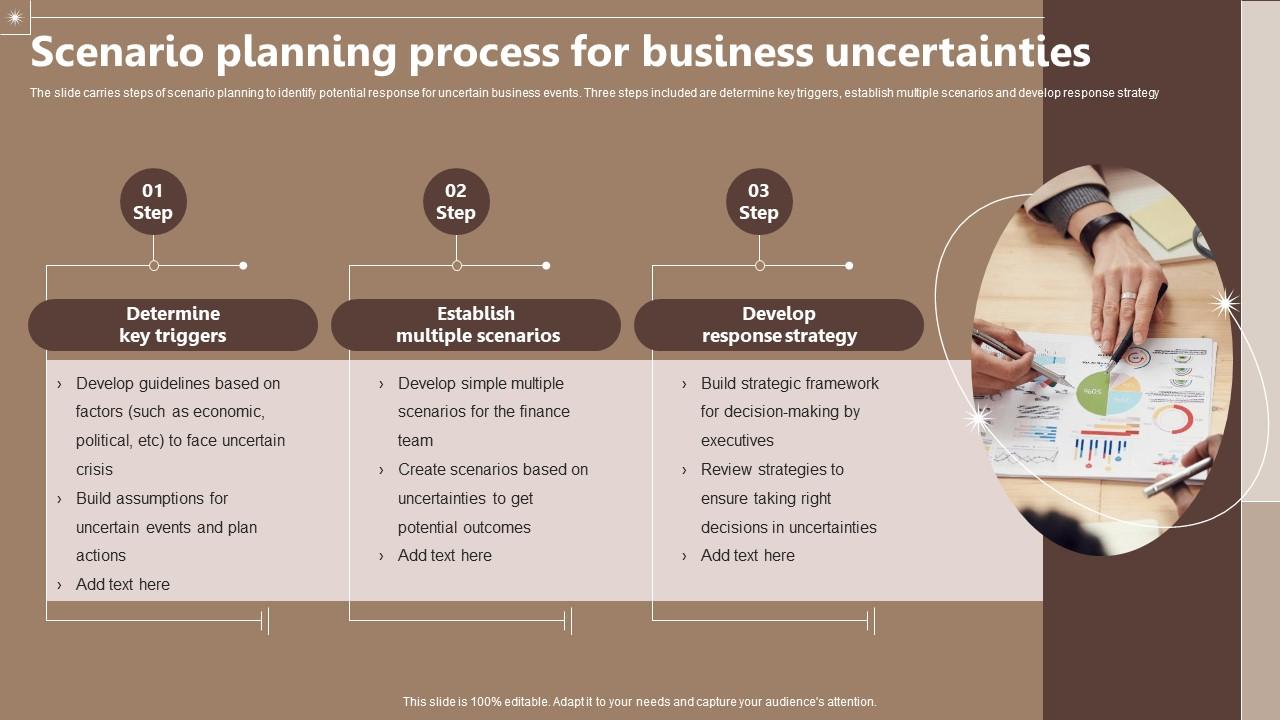
This idea of preparing for alternative futures is the foundation of decision-making under uncertainty. But with infinite possible futures, where do we even begin? We need a way to separate the critical from the trivial.
2. A Framework for Finding What Matters
Not all uncertainties are created equal. The possibility of a meteor strike is an uncertainty, but it's probably not worth spending your time on. The chance of a key competitor launching a price war, however, is. We need a system to filter and prioritize.
A powerful way to do this is to map uncertainties on two axes: their potential impact on your business and their predictability.
Let's return to the "Scenario Planning" video to see how this works.
Strategy 101 - Scenario Planning
This segment explains how to categorize external factors to find the 'critical uncertainties' that should be the focus of your planning.
Watch the section from 3:52 to 5:10. The key takeaway is the 2x2 matrix that helps you isolate what's both difficult to predict and has a high impact on your business.
As the video explains, your focus should be squarely on the quadrant of high impact, difficult to predict events. These are your critical uncertainties.
This concept is sometimes visualized in an "Uncertainty Matrix."
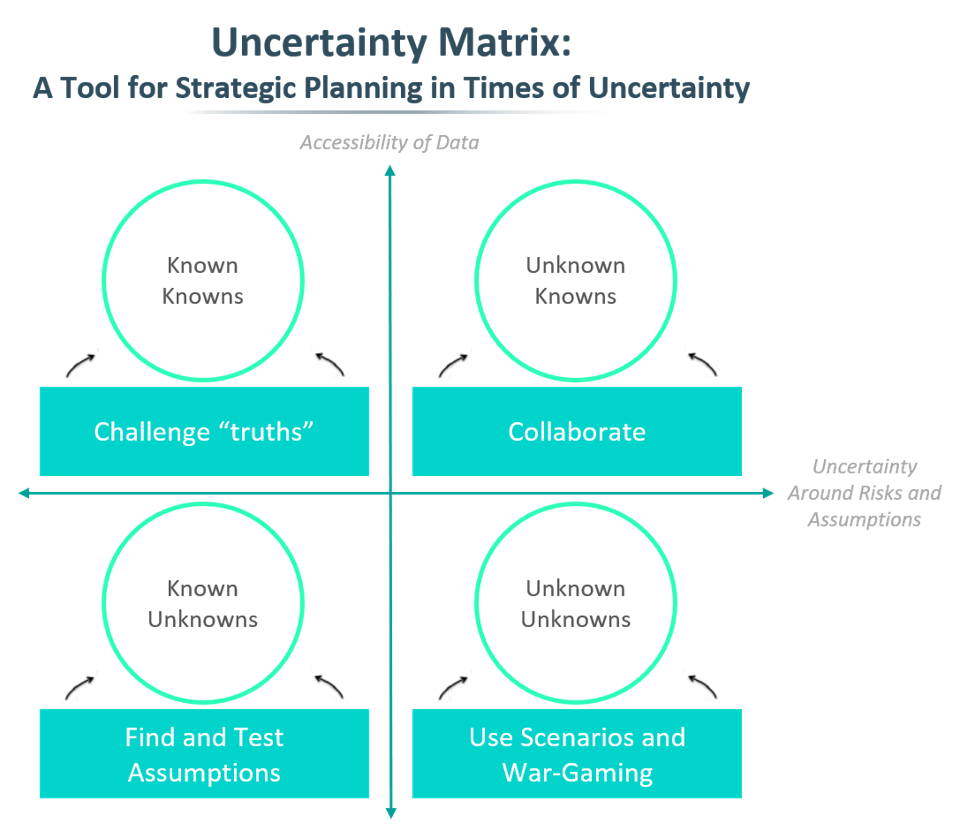
For your woodworking business, examples of potential "Known Unknowns" might be:
- The future demand for luxury home goods in your local economy.
- The strategic response of established cabinet makers to your market entry.
- The long-term price volatility of premium hardwoods like walnut or white oak.
3. Practical Tools for Identifying Your Critical Uncertainties
Now that we have a framework, let's explore two powerful methods to brainstorm and then pinpoint the critical uncertainties for your own business.
Method A: The "What Would Have to Be True?" Test
One of the most effective ways to uncover critical uncertainties is to work backward from a potential strategy. Instead of asking "What will happen?", you ask, "For this strategy to be a brilliant success, what would have to be true?"
Strategy expert Roger Martin explains this elegant and powerful approach.
How to develop a strategy that wins in competitive markets | Roger Martin
In this clip from the Growth Manifesto Podcast, Roger Martin explains how to identify the most critical assumptions (or 'barriers') underlying any strategic choice.
Please watch two short segments: From the start to 1:20, to understand the basic 'What would have to be true?' question. From 33:52 to 35:48, for a deeper dive into the process. Focus on how you move from a list of assumptions to identifying the one you are most worried about.
Let's apply this to a core decision you're facing: Focusing on premium custom doors for IKEA cabinets.
What would have to be true for this to be a huge success?
- About the customer: A large number of IKEA kitchen buyers are dissatisfied with IKEA's door options and are willing to pay a significant premium for high-quality, custom-designed alternatives.
- About the competition: Other local woodworkers won't or can't copy this model easily. Online-only competitors can't provide the local measurement and installation service that you can.
- About your capabilities: You can consistently produce doors that fit IKEA's system perfectly, with a higher perceived quality that justifies the price.
Now, as Roger Martin asks, which of these assumptions are you most worried about? It's likely #1 and #2. These are your critical uncertainties: market demand at your price point and the reaction of competitors.
Method B: The Environmental Scan
Another, more traditional method is to conduct a broad scan of your external and internal environments, much like a SWOT (Strengths, Weaknesses, Opportunities, Threats) analysis. This helps ensure you don't miss any major trends.
The following guide, written specifically for wood products businesses, outlines this process. It also includes a fantastic, relevant example.
A Planning Guide for Small and Medium Sized ...
This section of 'A Planning Guide for Small and Medium Sized...' wood products companies provides a structured way to assess your business environment and identify strategic issues, which are essentially critical uncertainties.
Please read two parts of this guide: Step 3. Assessing the External and Internal Environments and Step 4. Identifying Strategic Issues (pages 17-18). Focus on the types of trends to look for (environmental, technological, economic, etc.). In the Appendix, look at the 'Critical issues' section for the sample company, 'Frank's Frames' (page B of the appendix, which is page 45 of the PDF). Notice how they identified concrete issues like global competition and rising labor costs.
The example of "Frank's Frames" is particularly useful. They identified issues like "inexpensive composite materials...are taking an increasing share" and "Global competition is bringing new competitors... with products that are low in cost and high in quality." These are exactly the kind of critical uncertainties you should be thinking about for your own business.
Test your understanding!
Consider a major strategic decision you face right now, such as "Should I invest in a large 5-axis CNC machine or a smaller, more standard 3-axis machine?"
Using the "What Would Have to Be True?" method, identify at least two critical uncertainties related to this decision. Briefly explain why they are critical (i.e., high impact and hard to predict).
Show answer
Here's a possible answer. Yours might be different, but it should follow the same logic.
Strategic Choice: Invest in the expensive, highly capable 5-axis CNC machine.
What Would Have to Be True?
- Assumption 1: There is a sustained local market of clients (e.g., architects, high-end homeowners) who will pay a significant premium for the complex, artistic designs that only a 5-axis machine can produce.
- Assumption 2: My competitors will not also invest in a similar machine in the near future, which would erode my unique advantage.
- Assumption 3: I can master the complex software and operation of the 5-axis machine to deliver on its promise of quality and uniqueness without excessive errors or delays.
Critical Uncertainties:
- The size and willingness-to-pay of the niche market (from Assumption 1): This is critical because the machine is a huge, irreversible investment. If the demand isn't there, the business could fail. It's high impact and very hard to predict without testing the market.
- Competitor reaction and technological pace (from Assumption 2): This is also critical. If a larger, more established competitor buys the same machine a year later, my primary competitive advantage could be neutralized before I've even paid off my investment. This is high impact and difficult to predict as it depends on their private strategic plans.
Conclusion
You've now taken the crucial first step in navigating an uncertain world. Instead of being paralyzed by endless possibilities or making a blind bet on one version of the future, you have a set of tools to identify the few uncertainties that will truly define your success or failure.
Key Takeaways:
- Don't try to predict a single future; prepare for several plausible ones.
- Focus your energy on uncertainties that are both high-impact and hard to predict. These are your "Known Unknowns."
- Use the "What Would Have to Be True?" test to work backward from a strategic choice and reveal its most fragile underlying assumptions.
- Conduct a broad environmental scan (political, economic, competitive, etc.) to ensure you haven't overlooked major external shifts, using examples like "Frank's Frames" to guide you.
Preview of the Next Lesson:
Identifying your critical uncertainties is only half the battle. In our next lesson, we will learn how to use them to build a scenario matrix. This powerful tool will allow us to pick our two most critical uncertainties (like market demand and competitor response) and use them as axes to create four distinct, plausible future worlds. We will then learn how to craft a strategy that is robust enough to work well across all of them.