
Hello! Welcome to the first lesson in our fifth module, "Advanced Mixing Techniques."
In the previous modules, we've built a solid foundation. You've mastered the hardware, learned to beatmatch by ear, and can craft basic transitions using faders and EQs. Now, we're going to add a crucial artistic layer to your skills: mixing in key.
This lesson will introduce you to the concept of harmonic mixing and the primary tool DJs use to achieve it: the Camelot Wheel. By the end of our session, you'll be able to explain what harmonic mixing is, why it's important, and how to use the Camelot Wheel to find musically compatible tracks for your DnB sets.
Let's get started.
1. What is Harmonic Mixing?
At its core, harmonic mixing is the art of mixing tracks that are in the same or compatible musical keys. When you're blending two tracks, you're not just aligning their beats; you're also combining their musical elements—basslines, melodies, and vocals. If the keys of these tracks clash, the mix can sound dissonant or "off," no matter how perfectly beatmatched it is. Conversely, when the keys are compatible, the transition sounds smooth, professional, and musically pleasing.
Given your background in music production, you likely have an intuitive feel for when notes work together. Harmonic mixing provides a system to apply that intuition in a DJ context.
To get a foundational understanding of musical keys and why they matter in a mix, please watch the beginning of the following video. It uses a simple piano analogy to explain the theory.
MIXING IN KEY: How to use HARMONIC MIXING to PERFECT your DJ Mixes
This clip from the Crossfader channel provides an excellent, concise introduction to the theory behind mixing in key.
Watch the section 'Introduction to Harmonic Mixing and Key Theory' from the beginning until 01:56. Focus on how a musical key is defined and why tracks in related keys (like a major key and its relative minor) share notes and therefore sound good together.
As the video explains, every piece of music is built around a central key. Mixing tracks that share the same or related notes ensures that their melodic components blend seamlessly, creating a cohesive musical journey for the listener.
2. The Camelot Wheel: A DJ's Guide to Music Theory
Understanding music theory can be complex. Fortunately, a system was developed to make harmonic mixing accessible without needing to be a music theory expert: the Camelot Wheel.
Think of it as a simplified user interface for the traditional "Circle of Fifths." It translates the 24 major and minor musical keys into a simple, color-coded, clock-like diagram. Your DJ software, Rekordbox, can analyze your tracks and assign each one a key code from this system.
Let's look at the wheel itself.
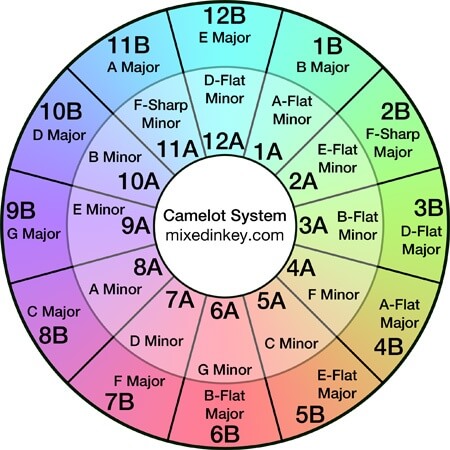
To understand its structure, let's read a short explanation.
The DJ's Guide to the Camelot Wheel and Harmonic Mixing
This article from DJ.Studio clearly breaks down the structure of the Camelot Wheel.
Please read the sections 'What Is the Camelot Wheel?' and 'Structure of the Camelot Wheel'. Focus on understanding the alphanumeric coding (e.g., 8A, 8B) and the layout of major vs. minor keys.
As the article describes, the system is straightforward:
- Numbers (1-12): Represent the different keys, arranged like a clock.
- Letters (A/B): Distinguish between minor and major keys.
- A = Minor Key (inner ring)
- B = Major Key (outer ring)
So, a track labeled 8A is in the key of A Minor, while a track labeled 8B is in its relative major, C Major.
A quick but important note: The convention established by Mixed In Key (the creators of the system) is A for Minor and B for Major. You may occasionally find articles or software that reverse this, but the A/B standard is what you'll see in Rekordbox and is the most widely accepted.
3. How to Use the Camelot Wheel
Now for the practical part: how do you use these codes to choose your next track? The system is based on a few simple rules for moving around the wheel. A mix will almost always sound harmonic if you move to an adjacent key.
The following video provides a very clear, step-by-step guide to the basic mixing rules.
How to Use The Camelot Wheel for Harmonic Mixing While DJing
This video from Complete DJ Method walks through the most common and reliable ways to move around the Camelot Wheel.
Watch from 02:08 to 06:03. This covers the four most fundamental techniques: mixing in the same key, moving one number up or down, changing between A and B, and a summary.
Let's summarize those key moves. Imagine your current track is 8A (A Minor). You have four high-percentage options for your next track:
- Stay in the Same Key (8A): This is the most seamless option. Mixing into another track in 8A guarantees a perfect harmonic blend.
- Move to the Relative Major/Minor (8B): You can move from the inner ring to the outer ring (or vice-versa) within the same number. Mixing from 8A (A Minor) to 8B (C Major) often creates a nice lift in energy.
- Move One Step Clockwise (9A): Moving one number up (e.g., from 8A to 9A) is a fifth up in music theory terms. This transition typically raises the energy of the set.
- Move One Step Counter-Clockwise (7A): Moving one number down (e.g., from 8A to 7A) can subtly lower the energy or create a "deeper" feeling, depending on the tracks.
This image provides a great visual summary of these compatible moves:

Mastering these four basic moves is the foundation of harmonic mixing and will serve you well in building smooth, professional-sounding sets.
4. Harmonic Mixing in Practice
While the Camelot Wheel is a powerful guide, it's not an unbreakable rule. Your ears are always the final judge. It's also important to understand when harmonic clashes are most likely to occur.
MIXING IN KEY: How to use HARMONIC MIXING to PERFECT your DJ Mixes
Let's return to the Crossfader video to hear some practical advice on when and how to apply these rules, especially in a live setting.
Watch the section 'When and How to Apply Harmonic Mixing' from 04:19 to 06:14. Pay attention to the discussion about mixing percussive sections versus melodic sections.
This is especially relevant for DJing DnB. Many DnB tracks have long intros and outros that are primarily drums and percussion. During these sections, the musical key is less defined, giving you more freedom to mix in a track that might not be a perfect harmonic match. The critical moment is when the main melodic elements, like the bassline or lead synth, of both tracks overlap. That's when a key clash will be most noticeable.
So, use the Camelot Wheel as your primary tool for planning and selecting tracks, but don't be afraid to break the rules if it feels right. If a track has the perfect energy for the moment, you can often find a way to mix it in, perhaps by using a percussive loop or performing a quicker transition to avoid a melodic clash.
Conclusion
Great work today! We've covered a concept that will significantly elevate the quality and creativity of your mixes.
Key Takeaways:
- Harmonic Mixing is the practice of mixing tracks in compatible musical keys to create smooth, professional-sounding transitions.
- The Camelot Wheel is a visual tool that simplifies music theory for DJs, using an alphanumeric system (e.g., 8A, 8B) to represent keys.
- The three most reliable ways to find a compatible track are to:
- Choose a track in the same key (e.g., 8A → 8A).
- Move between the relative major/minor (e.g., 8A → 8B).
- Move one step sideways on the same ring (e.g., 8A → 7A or 9A).
- Harmonic compatibility is most crucial when melodic elements overlap. Always trust your ears as the final authority.
Preview of the Next Lesson:
In our next session, we'll put this theory into practice. You will learn how to use Rekordbox to organize a playlist by key and then perform a mix between two harmonically compatible tracks, applying the rules we've discussed today.
Can't find a good explanation? Sign up and we'll make it for you
Sign up