
Hello! Welcome to Module 6: Applying Choice Architecture Ethically.
In our previous module, we explored specific psychological drivers of choice, such as social proof, scarcity, and commitment. We saw how these principles can be used to influence user behavior in targeted ways. Now, we're going to zoom out. Instead of looking at individual tools, we're going to examine the entire workshop—the environment where decisions are made.
This lesson kicks off our new module by introducing a foundational concept for any designer. Our goal is to define choice architecture and its role in guiding user decisions within a digital environment. You'll learn what it means to be a "choice architect" and how the design of any digital product inherently shapes the choices users make, whether we intend it to or not.
1. What Is Choice Architecture?
The term "choice architecture" was popularized by Richard Thaler and Cass Sunstein in their influential book, Nudge. It refers to the practice of consciously designing the context in which people make decisions. As a product designer, you are already a choice architect. Every screen you design, every flow you map out, and every option you present creates an environment that influences what users will do.
Let's start with a clear, expert definition.
Choice Architecture: How to Improve Decision-Making
Professor Eric Johnson of Columbia Business School, a leading researcher in this field, provides a concise introduction to choice architecture.
Please watch the first 1 minute and 23 seconds of the video. Professor Johnson defines choice architecture and explains how the way a choice is presented, or framed, can be used to guide people toward better outcomes.
As Professor Johnson explains, anyone who designs the presentation of a choice is a choice architect. The key insight is that there is no neutral design. The way you order options, what you highlight, and what you leave out will always influence the outcome.
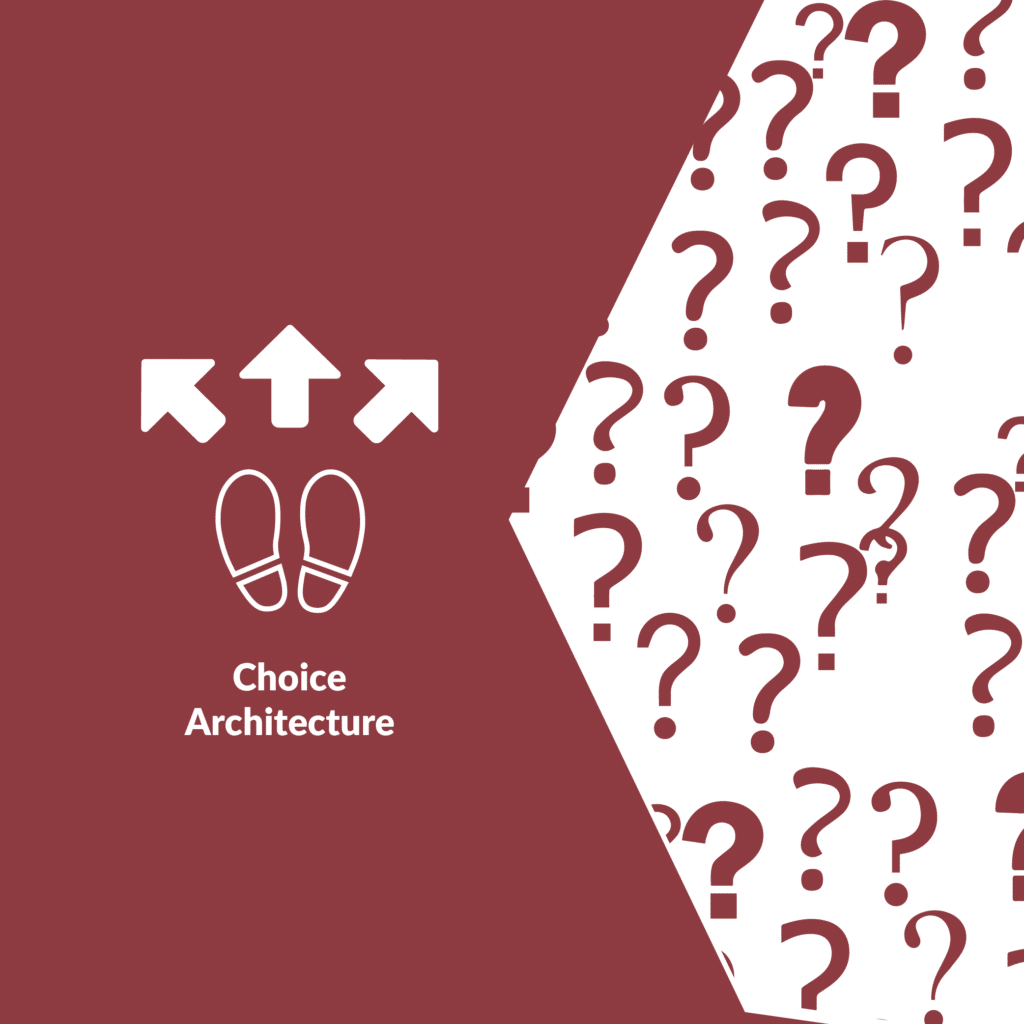
This image provides a simple but powerful visual metaphor for the concept:
To solidify this definition, let's look at a practical explanation written for professionals.
How Choice Architecture Influences Decisions
The article 'How Choice Architecture Influences Decisions' from FlowState offers a straightforward definition and connects the concept to its origins.
Read the sections 'What Is Choice Architecture?' and 'The Psychology Behind Choice Architecture.' This will reinforce the definition and explain why it works by connecting it to the mental shortcuts we all use.
The core takeaway is that choice architecture works because it accounts for how people actually think—relying on emotions, habits, and mental shortcuts (our System 1 thinking) rather than pure logic, especially when faced with complexity or decision fatigue.
2. The Role of Choice Architecture in Digital Environments
So, what is the specific role of choice architecture in the digital products you design? Its primary function is to serve as the underlying infrastructure that governs how users navigate through the "possibility space" of your product. It's not just about adding a button; it's about designing the entire path that makes clicking that button feel easy, logical, and safe.
This next reading frames this role in a way that should resonate with your background in systems thinking.
Choice Architecture and Framing Effects
The article 'Choice Architecture and Framing Effects' by Milijana Komad presents a sophisticated view of this topic, describing choice architecture as the 'infrastructure' or 'geometry' of decision-making.
Read the introduction and the section titled 'Choice Architecture as Decision Infrastructure.' Focus on the idea that choice architecture defines the 'topology of decision-making'—determining which paths are smooth and which have friction.
As the article argues, your design determines what is practically possible for a user, not just theoretically possible. You do this by managing what is "easy," "clear," and "safe."
From Infrastructure to Interface
This "decision infrastructure" translates directly into the UX and product design choices you make every day. The goal is almost always to reduce friction for desired actions and, in some cases, add friction for undesirable ones.
Let's connect this high-level concept to practical UX design strategies.
How Choice Architecture Influences Decisions
Returning to the FlowState article, let's look at the section that explicitly discusses the application in our field.
Read the short subsection 'UX and Product Design.' It clearly states the goal: to reduce friction and make the desired path the easiest one.
Choice Architecture in the Wild
Given your preference for real-world examples, let's examine how some of the most successful digital products apply these principles. The design choices in these examples are deliberate acts of choice architecture.
How Choice Architecture Influences Decisions
This section of the FlowState article provides excellent visual examples from familiar brands.
Review the 'Real-World Examples of Choice Architecture' section. Look at the examples from Netflix, Amazon, Apple, and Canva. For each one, consider how the design guides the user's decision-making process by making certain choices more salient or simpler than others.
These examples—from Netflix's personalized recommendations to Apple's simplified product lineup—demonstrate how choice architecture is used to manage complexity, reduce choice overload, and steer users toward actions that benefit both them and the business.
3. The Psychology of Presentation
Finally, how you present information is a critical component of choice architecture. This goes beyond just the number of options. Visual hierarchy, color, and information density all play a role in managing a user's cognitive load and influencing their perception.
Your experience in UI design has already given you an intuitive feel for this, but let's connect it directly to the psychology of decision-making.
Psychology Behind UI/UX Design | Harrish Murugesan | TEDxUTA
This TEDx talk, 'Psychology Behind UI/UX Design,' provides a great visual and conceptual overview of how design elements influence user perception and choice.
Watch the segment from 01:57 to 04:34. The speaker discusses how visual presentation, information density (cognitive overload), and color affect our perception and the ease with which we process information (processing fluency).
The concept of processing fluency is key here: the easier information is to process, the more positively we feel about it. Good choice architecture creates high processing fluency for desired paths, making them feel like the right and obvious choice.
Conclusion
In this lesson, we established a foundational understanding of choice architecture. It’s not just one tool among many; it is the thoughtful, intentional design of the entire decision-making context.
Key Takeaways:
- Definition: Choice architecture is the design of the environment where people make decisions. As a product designer, you are unavoidably a choice architect.
- The Role in Digital Products: Its role is to act as the "decision infrastructure" that guides users by shaping what is visible, easy, and feels normal. It defines the paths of least resistance within a digital environment.
- Why It Works: It leverages predictable human psychology, particularly our reliance on mental shortcuts (System 1) and our preference for choices that are easy to process (high processing fluency).
- It's Unavoidable: Every design choice—from layout and color to the number and order of options—influences user behavior. The only choice is whether to be deliberate and ethical about it.
Next Up
Now that we have defined choice architecture and understood its fundamental role, our next lesson will get more tactical. We will address the learning outcome: Structure an interface or information hierarchy to minimize cognitive load and simplify decision-making for the user. We'll move from the "what" to the "how," exploring specific techniques for organizing information and designing interfaces that make choosing simple and clear.
Can't find a good explanation? Sign up and we'll make it for you
Sign up