
Evaluating Financial Information and Avoiding Investment Biases
Hello again. You now know that buying a share is not merely tapping “Buy” on an app: it creates a real trade, a settlement obligation, and ultimately an ownership position in a company. That makes the quality of the information behind a decision extremely important.
News, TV discussions, social-media posts, and recommendations can be useful starting points. They are not, by themselves, evidence that a stock or mutual fund is suitable for you. This lesson gives you a practical method to separate useful information from persuasion, manipulation, and your own emotional shortcuts. It completes Module 1 by helping you decide what not to act on before later modules teach you how to analyse companies, funds, prices, and charts.
Treat every market message as a claim, not a command
A message such as “ABC Ltd. will double,” “Buy before results,” or “this is the best mutual fund” contains a claim. Your task is to identify:
- What exactly is being claimed?
- Who is making the claim?
- What evidence supports it?
- What might the speaker gain if you act on it?
- Does it fit your own objective and time horizon?
A useful mental shift is this:
A market message may deserve investigation. It does not deserve immediate execution.
Following markets through headlines can build awareness of events. The risk begins when repeated exposure creates a feeling of familiarity: “I have heard this company everywhere, so I understand it.” Familiarity is not analysis.
Separate fact, interpretation, and recommendation
Much confusion disappears when you split a message into three layers.
| Layer | Example | What to do |
|---|---|---|
| Fact | “The company reported quarterly revenue growth.” | Find the original exchange filing or company release. |
| Interpretation | “The results were strong.” | Ask: strong compared with what: expectations, prior quarters, competitors, or valuation? |
| Recommendation | “Buy now; target Rs. 900.” | Examine the analyst, assumptions, horizon, risks, disclosures, and suitability. |
A headline may accurately report a fact but still encourage a poor decision if its interpretation is incomplete. For example, a company can announce higher profit because of a one-time gain rather than improvement in its underlying business. You will learn to detect such distinctions from financial statements later in the course.
A practical evidence hierarchy
When a claim concerns a listed Indian company, begin as close to the source as possible:
- Exchange disclosures and company filings on NSE or BSE: results, board decisions, shareholding disclosures, acquisitions, dividend announcements, and other material information.
- The company’s investor-relations material: annual reports, presentations, and earnings-call materials. These are primary sources, though they naturally present management’s perspective.
- Established financial journalism and research reports: useful for context, comparisons, and sceptical questions. Check whether the article links to the underlying disclosure.
- Social media, messaging groups, short videos, forwarded posts, and anonymous screenshots: useful mainly as leads to verify elsewhere, not as a basis for a trade.
Primary evidence is still not an automatic buy signal. An acquisition announcement, for instance, may be genuine but could be expensive, risky, or already reflected in the share price.
Judge the messenger before you weigh the message
A recommendation has more value when you can identify its author, method, date, horizon, risks, and conflicts. Vague confidence is not a substitute for these details.
In India, a person or entity providing research reports or investment recommendations for a fee may be a Research Analyst, or RA, under SEBI’s framework. A legitimate research process should be structured, should discuss risk, and should include required disclosures. A registered RA can still be wrong: registration is a credibility and accountability check, not a guarantee that a call will make money.
Research Analysts - Securities Market Investment
Read SEBI Investor’s overview of research analysts to understand what registration, research discipline, and disclosures can tell you about a recommendation source.
In the “Understanding Research Analysts” article, begin with the subsection “Who is a Research Analyst?” Read the definition and role. Then continue to the “Types of Research Analysts” subsection, focusing on how sell-side, buy-side, and independent analysts differ. Finally, locate “SEBI Regulations for Research Analysts” and read the conflict and integrity requirements. Notice that a recommendation should be accompanied by reasons and risks, rather than just a ticker symbol and a target price.
Research Analyst, broker, adviser, influencer: not interchangeable
The label attached to a person matters.
- A broker provides trading access. Some brokerage firms also publish research through research analysts, but the ability to place a trade does not itself make every message research.
- A research analyst publishes research or recommendations, generally based on a view of a company, sector, or security. This is not necessarily personalised advice for your income, goals, or existing portfolio.
- An investment adviser provides advice tailored to a client’s circumstances. If someone claims to offer personalised advice, verify that they are authorised for that role.
- A financial journalist may report and interpret events, but reporting is different from a formal recommendation.
- A social-media creator, channel administrator, or acquaintance may have useful observations, but popularity, follower counts, screenshots, and claimed past wins are not evidence of competence or regulation.
For paid services, verify the claimed SEBI registration directly through SEBI’s official records rather than trusting a registration number displayed in a post or profile. Also verify that the name on the register matches the person or entity selling the service.
Conflicts of interest are not always fraud, but they change how you read
A conflict of interest exists when the source has an incentive that could influence the recommendation. Typical conflicts include:
- the author or firm owns the stock;
- the firm earns brokerage if readers trade;
- the firm has an investment-banking, fundraising, or other business relationship with the company;
- the content is sponsored, paid promotion, or an affiliate arrangement;
- the creator sells a course, subscription, or membership by promising access to “exclusive calls”;
- the recommender accumulated shares before encouraging followers to buy them.
A disclosed holding does not automatically make the analysis useless. It tells you to read it more critically. Ask whether the author explains their valuation, assumptions, risks, and investment horizon, or simply presents certainty.
A target price is particularly easy to misread. It is not a promise. It is the output of assumptions about earnings, growth, valuation, and time horizon. Change those assumptions and the target can change substantially.
Recognise manipulation and protect your account
Some content is merely shallow or biased. Other content is designed to take your money, your shares, or your account credentials.
The NSE investor-education material below is especially useful because it distinguishes ordinary poor tips from patterns associated with fraud and market manipulation.
This NSE investor-education presentation shows common tip-based scams and a practical protection checklist. Read it as a set of warning patterns, not as a claim that every small company or online commentator is fraudulent.
Start with the “Case Study” slides on unsolicited tips and read the guaranteed-return pitch. Then move to the “Here are 9 TACTICS SCAMMERS USE” slides. Read the fake-app and chat-group warnings, followed by the guaranteed-profit and pump-and-dump material. Finish with the “HOW CAN YOU PROTECT YOURSELF?” checklist, especially the opening safeguards.
Pump and dump: how hype can become a trap
In a pump-and-dump scheme, manipulators may first acquire a thinly traded or low-priced share. They then spread excitement through groups, videos, messages, misleading “research,” fake testimonials, or rumours. As outside buyers push up price and trading activity, the original operators sell. Once their selling overwhelms demand, late buyers can face a rapid fall and difficulty exiting.
Warning signs include:
- extraordinary or “assured” profits over a very short period;
- urgency: “buy immediately,” “last chance,” or “before the operator enters”;
- a vague story with no exchange filing, financial analysis, or stated risks;
- a coordinated burst of identical messages across Telegram, WhatsApp, Instagram, or other channels;
- anonymous administrators, unverifiable identities, and screenshots of supposed profits;
- a focus on price targets rather than the company’s business;
- unusual price and volume movements in an illiquid stock.
None of these signs alone proves fraud. A legitimate company can have a sharp move after meaningful news. But several signs together should move your response from “buy” to “verify independently or avoid.”
The Zerodha Varsity video gives clear visual examples of this pattern, along with phishing and conflicted recommendations.
How to protect ourselves from Stock Market Scams? | Pump & Dump | Phishing | Front Running
Watch Zerodha Varsity’s “How to protect ourselves from Stock Market Scams?” for a concrete explanation of pump-and-dump tactics, phishing, and why a recommender’s incentives matter.
Watch pump and dump to see how artificially created excitement can leave late buyers holding shares after a collapse. Then watch phishing risks for account-security basics, and conflicted recommendations for the idea that someone may benefit by acting before their audience. Treat the regulatory references as illustrations; for any current rule or registration status, verify it through SEBI’s official information.
Security rules are investment rules
No stock idea is worth compromising your account. Keep these rules non-negotiable:
- Never share your broker password, depository PIN, one-time password, or login approval with anyone.
- Do not install APK files or unknown trading apps sent through messages. Use only the official app store and verify the broker.
- Do not transfer investment money to an individual’s bank account because a group administrator promises to trade for you.
- Do not click an urgent “KYC update” or “account blocked” link. Open your broker’s official app or type its official website yourself.
- Use strong unique passwords and two-factor authentication.
- Keep contract notes, broker communications, and suspicious messages. If you suspect fraud, act quickly through the broker, relevant authorities, and the cybercrime reporting channels described in the NSE material.
Your mind can distort even genuine information
A source can be legitimate, the facts can be correct, and the resulting decision can still be poor. That is where behavioural biases matter. A bias is a predictable mental shortcut that can cause emotional or selective decisions.
Behavioral Biases of investing
HDFC Mutual Fund’s “Behavioral Biases of Investing” introduces common biases through short investing scenarios. Watch it to recognise the moment when a seemingly sensible reaction becomes a shortcut.
Watch attention bias for the tendency to choose what receives the most media coverage. Continue with selective evidence to distinguish confirmation bias from recency bias. Watch emotion driven choices for optimism, crowd behaviour, and loss aversion. Finish with bias controls, focusing on the value of pre-set, evidence-based decision processes.
Six biases to notice in yourself
| Bias | Typical thought | Better response |
|---|---|---|
| Attention bias | “It is all over the news, so it must be important.” | Ask whether the coverage contains new, material evidence. |
| Confirmation bias | “This article supports my view; the negative report must be wrong.” | Deliberately seek the strongest opposing case. |
| Recency bias | “This fund was top-ranked over three months, so it is the best fund.” | Use a longer, relevant performance record and understand the risks taken. |
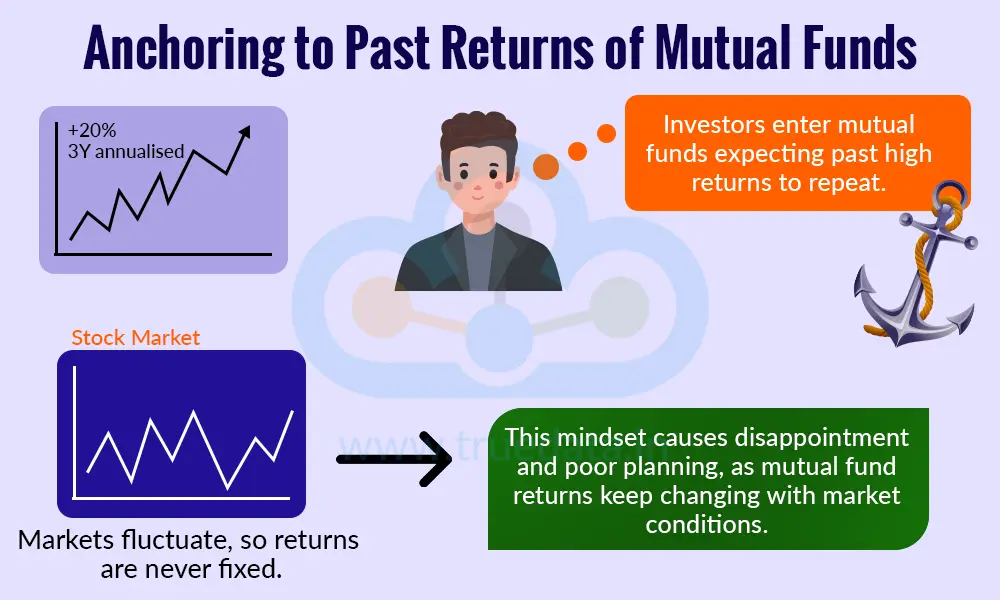
| Anchoring | “The stock was Rs. 1,000 before, so Rs. 700 is cheap.” | Reassess value from the business and current information, not an old price. |
| Herd behaviour | “Everyone in my group is buying; I will miss out.” | Your group’s enthusiasm does not establish quality, valuation, or suitability. |
| Loss aversion | “I cannot sell below my purchase price.” | The purchase price is history. Ask whether you would buy the same holding today. |
The image’s mutual-fund example is anchoring. A past return, prior NAV, or old share-price high can become a mental reference point. But market conditions, interest rates, business performance, valuation, and fund portfolios change. Past performance may be relevant evidence; it is not a fixed forecast.
For short-term positions, crowd behaviour can look especially tempting because prices sometimes rise rapidly. For long-term investing, it can lead to buying a fashionable business at an unsustainable valuation. The time horizon differs, but the discipline is the same: do not substitute excitement for a reasoned plan.
Use a decision firewall before acting
Create distance between receiving a tip and placing an order. The following decision firewall is a repeatable process you can use for a stock headline, a TV recommendation, a mutual-fund ranking, or a forwarded message.
Step 1: Record the claim precisely
Write down:
- the security name;
- what is alleged to happen;
- the stated time horizon;
- the source and date;
- whether it is presented as fact, opinion, or recommendation.
“Buy XYZ” is not precise enough. “The message claims XYZ will benefit from a new order and rise within one month” is something you can investigate.
Step 2: Check the source and incentive
Identify the author or organisation. Can you verify their identity? Is there a SEBI registration claim to check? Are disclosures visible? Is the content paid, sponsored, or linked to a course, subscription, brokerage account, or messaging group?
If the message is anonymous, promises certainty, demands urgency, or asks for money or credentials, stop there. It fails the source-quality test.
Step 3: Find the underlying evidence
For a company-specific claim, look for the original NSE or BSE filing and read what it actually says. For a mutual-fund claim, later modules will show you how to use scheme documents, factsheets, portfolio disclosures, and AMFI data rather than a “top fund” list.
Ask:
- Is this event confirmed, or merely a rumour?
- Is the information new?
- Is the headline leaving out an important condition or risk?
- Is there a primary document behind it?
Step 4: Search for disconfirming evidence
Before looking for more bullish content, search for reasons the thesis might fail:
- competitor pressure;
- debt or funding needs;
- weak cash flow;
- regulation;
- valuation already reflecting the good news;
- management or governance concerns;
- a mismatch between the stock and your intended holding period.
You will not yet know how to analyse every one of these in depth. That is fine. A question you cannot answer is a reason to wait, not a reason to guess.
Step 5: Decide on the appropriate action
The answer does not have to be “buy” or “sell.” Often the correct action is one of these:
- Ignore a low-quality or unsafe message.
- Add to a watchlist and research later.
- Read the primary disclosure before forming a view.
- Use a diversified mutual fund instead if you cannot evaluate a single company confidently.
- Take no action because the idea does not fit your goal, risk capacity, or horizon.
This process protects you from impulsive action without requiring you to predict every market movement.
A compact note template
Keep one short note for any idea that tempts you to act:
| Field | What to write |
|---|---|
| Claim | The specific statement being made |
| Source | Name, platform, date, and whether identity is verifiable |
| Incentive or disclosure | Holding, sponsorship, fee, promotion, or unknown |
| Primary evidence | Filing, report, or official document found |
| Key risk or opposing case | The strongest reason the claim could fail |
| My decision | Ignore, watchlist, research, or no action |
| Reason | One sentence tied to evidence and your objective |
The note is not bureaucracy. It makes it easier to spot a later bias such as, “I bought because three people in a group mentioned it,” and it creates a record you can review honestly.
Key takeaways
- Treat news, tips, and recommendations as claims requiring verification, not trading instructions.
- Prefer primary evidence such as exchange filings and company disclosures; use news and social media as context or leads.
- Check the identity, registration, method, disclosures, and incentives of anyone making a recommendation. Registration improves accountability but does not guarantee a profitable call.
- Guaranteed returns, anonymous group tips, artificial urgency, unknown apps, requests for credentials, and extreme price targets are serious warning signs.
- Pump-and-dump schemes rely on manufactured excitement and can trap late buyers, particularly in illiquid shares.
- Attention, confirmation, recency, anchoring, herd behaviour, and loss aversion can distort decisions even when information is genuine.
- Use a written decision firewall: record the claim, check the source, locate primary evidence, seek the opposing case, and allow “no action” as a valid decision.
Next, Module 2 moves from information quality to your own financial framework: you will translate a financial goal into a target amount, time horizon, and liquidity requirement. That framework will later determine whether a particular stock or mutual fund idea deserves a place in your portfolio at all.
Can't find a good explanation? Sign up and we'll make it for you
Sign up