Hello! Welcome to the first lesson of our module on pricing.
In our last session, we concluded that for your new woodworking business, a narrow "focus" strategy—specializing in premium doors, for instance—is strategically sound. It concentrates your resources, helps build a strong brand, and avoids the trap of being "stuck in the middle."
Today, we'll address the next critical question: how do you price your premium product? Your pricing decision doesn't happen in a vacuum; it depends on how your competitors will react. This lesson will equip you to model a pricing decision as a simultaneous-move game to anticipate competitor responses. We'll introduce the core tool for this analysis: the payoff matrix.
When Decisions Happen at the Same Time
Imagine you're ready to launch your line of premium doors. You need to set your prices. At the same time, an established local furniture maker (let's call them "General Furniture Co.") is deciding whether to keep their prices stable or run a sale on their own, more mass-market doors. You both have to make your pricing decision without knowing for sure what the other will do.
This is a simultaneous-move game. Your best move depends on their move, and their best move depends on yours. To analyze this, we use a tool called a payoff matrix.
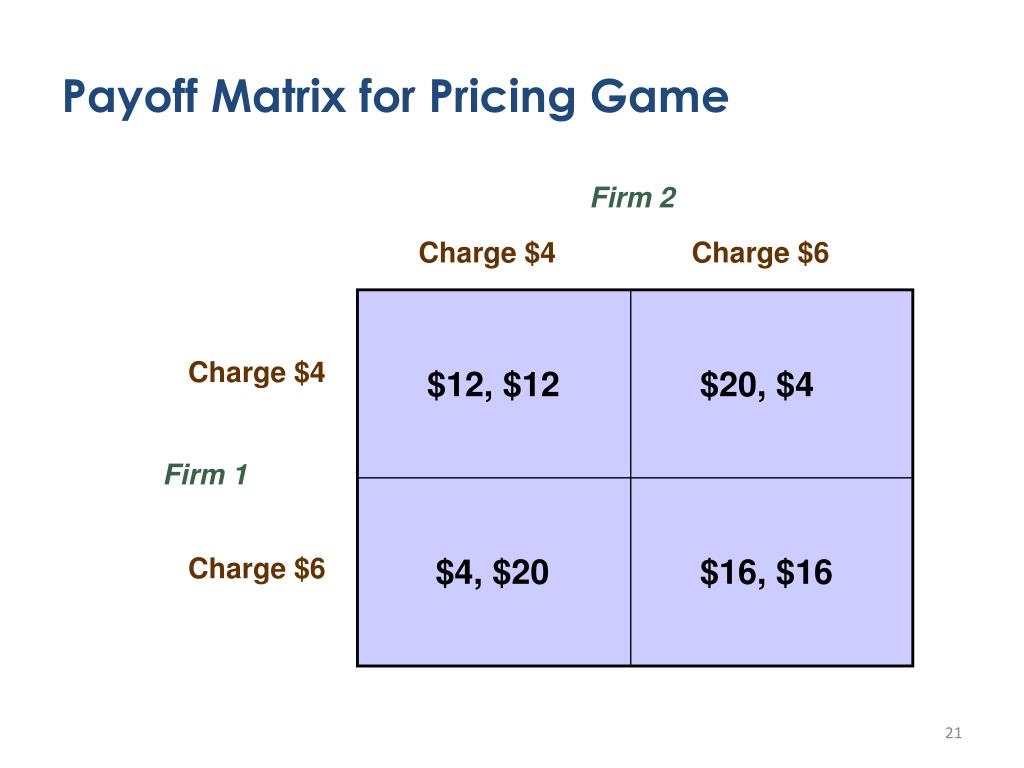
A payoff matrix is essentially a grid that shows all possible outcomes (or "payoffs") for each player based on the combined choices everyone makes.
Building the Pricing Game for Your Business
To model your pricing decision, we can follow a systematic, five-step process. This structured approach should feel familiar given your engineering background. It helps us translate a complex business situation into a clear, analyzable game.
16 Simultaneous Games - Profit Analytics for Entrepreneurs
The article 'Simultaneous Games' from Profit Analytics for Entrepreneurs provides an excellent, practical walkthrough of how to set up a pricing game. We will use its five-step structure.
Please read the section '16.2 Pricing Game with a Single Nash Equilibrium'. Focus on the five steps used to build and solve the game: Identify the Players Outline Possible Actions Determine Payoffs Identify Player Strategies Solve for Equilibrium Pay close attention to how the payoffs are defined and how the game is represented in the matrix. We will apply this exact framework to your business.
Now, let's apply those five steps to your specific situation.
Step 1: Identify the Players
- Player 1 (You): "Premium Woodworks," a new entrant specializing in high-end, custom doors.
- Player 2 (Competitor): "General Furniture Co.," an established company selling a wider range of standard-quality furniture, including doors.
Step 2: Outline Possible Actions
For simplicity, let's assume each of you has two primary pricing strategies:
- Your Actions:
Price High(reflecting your premium quality) orPrice Low(to be more competitive and gain market share quickly). - Competitor's Actions:
Hold Price(maintain their standard pricing) orCut Price(run a promotion or permanently lower prices to compete).
Step 3: Determine the Payoffs
Payoffs don't have to be exact dollar amounts. We can use "ordinal" values that rank the outcomes from best to worst. Let's say we rank them from 4 (best outcome) to 1 (worst outcome) for each player.
Here's a plausible set of payoffs:
- You
Price High, CompetitorHolds Price: This is your ideal outcome. You establish your premium brand, and they don't compete on price. Your quality difference is clear. Your Payoff: 4, Their Payoff: 3 (They still do okay). - You
Price High, CompetitorCuts Price: You look overpriced. Customers might be drawn to their sale, hurting your initial launch. Your Payoff: 1, Their Payoff: 4 (They steal market share from you and others). - You
Price Low, CompetitorHolds Price: You gain market share fast, but you hurt your premium branding and leave profit on the table. Your Payoff: 3, Their Payoff: 2 (They lose some sales to you). - You
Price Low, CompetitorCuts Price: A price war! You both sacrifice margins, and your premium positioning is damaged. This is bad for both of you. Your Payoff: 2, Their Payoff: 1 (You might be slightly better off as you're leaner, but it's a poor outcome).
This gives us the following payoff matrix. Your payoff is the first number in each cell, and the competitor's is the second.
| General Furniture Co. (Competitor) | ||
|---|---|---|
| Hold Price | Cut Price | |
| You (Premium Woodworks) | ||
| Price High | (4, 3) | (1, 4) |
| Price Low | (3, 2) | (2, 1) |
Finding the Likely Outcome: Best Responses and Nash Equilibrium
Now that we have the game set up, how do we "solve" it? We need to find the Nash Equilibrium—a stable outcome where no player has a reason to unilaterally change their strategy. To do this, we figure out each player's best response to every possible move the other player can make.
The following videos demonstrate a simple and highly effective visual method for finding the best responses and identifying the Nash Equilibrium.
Game Theory Simultaneous Moves
This video from Ashley Hodgson clearly explains how to read a payoff matrix and use a 'circling' method to find each player's best response.
Watch the entire video (around 8 minutes). Pay close attention to: How to read the matrix and identify which payoff belongs to which player. The step-by-step process of finding a player's best response to each of the opponent's actions. How to use the 'circling' method to mark best responses and find the Nash Equilibrium (where both payoffs in a cell are circled).
Step 4 & 5: Identifying Strategies and Solving for Equilibrium
Let's apply the circling method from the video to our woodworking pricing game.
1. Find Your Best Responses:
- If General Furniture
Holds Price: You canPrice High(payoff of 4) orPrice Low(payoff of 3). Your best response is toPrice High. We circle your payoff of 4. - If General Furniture
Cuts Price: You canPrice High(payoff of 1) orPrice Low(payoff of 2). Your best response is toPrice Low. We circle your payoff of 2.
2. Find the Competitor's Best Responses:
- If You
Price High: They canHold Price(payoff of 3) orCut Price(payoff of 4). Their best response is toCut Price. We circle their payoff of 4. - If You
Price Low: They canHold Price(payoff of 2) orCut Price(payoff of 1). Their best response is toHold Price. We circle their payoff of 2.
Here's the resulting matrix with the circles:
| General Furniture Co. (Competitor) | ||
|---|---|---|
| Hold Price | Cut Price | |
| You (Premium Woodworks) | ||
| Price High | (④, 3) | (1, ④) |
| Price Low | (3, ②) | (②, 1) |
Notice that no single cell has two circles. This means there is no "pure strategy" Nash Equilibrium in this specific game. What does this tell you? It suggests the market will be unstable.
- If you price high, their best move is to cut their price.
- But if they cut their price, your best move is to price low.
- But if you price low, their best move is to hold their price.
- But if they hold their price, your best move is to price high... and we're back where we started.
This cycle suggests that a stable pricing structure might not emerge easily. Competitors might constantly change their pricing in response to each other, or you might see a mix of strategies over time. Anticipating this instability is a powerful insight in itself.
Test your understanding!
Let's change the payoffs slightly. Suppose your low price isn't as appealing, and a price war is more damaging to the established competitor.
New Payoffs:
- You
Price Low, CompetitorHolds Price: (2, 2) - You
Price Low, CompetitorCuts Price: (1, 1)
Here is the new matrix. Using the circling method, can you find the Nash Equilibrium?
| General Furniture Co. (Competitor) | ||
|---|---|---|
| Hold Price | Cut Price | |
| You (Premium Woodworks) | ||
| Price High | (4, 3) | (1, 4) |
| Price Low | (2, 2) | (1, 1) |
Show answer
Let's find the best responses:
-
Your Best Responses:
- If they
Hold Price, you preferPrice High(4) overPrice Low(2). Circle your 4. - If they
Cut Price, you preferPrice High(1) orPrice Low(1). You are indifferent, so you can circle both of your 1s. For simplicity, let's just sayPrice Lowis a weak best response. Let's circle your 1 in the bottom-right cell.
- If they
-
Competitor's Best Responses:
- If you
Price High, they preferCut Price(4) overHold Price(3). Circle their 4. - If you
Price Low, they preferHold Price(2) overCut Price(1). Circle their 2.
- If you
The matrix with circles:
| General Furniture Co. (Competitor) | ||
|---|---|---|
| Hold Price | Cut Price | |
| You (Premium Woodworks) | ||
| Price High | (④, 3) | (1, ④) |
| Price Low | (2, ②) | (①, 1) |
Again, we find no cell with two circles. This pricing environment remains strategically unstable. The key insight is that your competitor has a strong incentive to undercut you if you choose to price high.
Conclusion
Today, we've taken a significant step in developing your strategic toolkit. You've learned how to translate a complex, real-world pricing problem into a structured, analyzable game.
Key Takeaways:
- Simultaneous Games: Many business decisions, especially pricing, are made without full knowledge of a competitor's concurrent choice.
- Payoff Matrix: This is the essential tool for modeling such games. It maps players, actions, and the resulting payoffs for every outcome.
- Best Response Analysis: By systematically identifying each player's best move for every action the opponent can take, you can anticipate their behavior.
- Nash Equilibrium: This is the stable outcome of the game. Even when a stable equilibrium doesn't exist, the analysis reveals the dynamic and potentially cyclical nature of the competition you face.
Preview of the Next Lesson:
In our analysis, we saw how both you and your competitor might be drawn into a price war, even though it leads to a worse outcome for both of you. This is a very common and famous scenario in game theory known as the Prisoner's Dilemma. In our next lesson, we will dive deep into this model to understand the powerful forces that can make mutually beneficial cooperation so difficult to achieve—and what you can do about it.